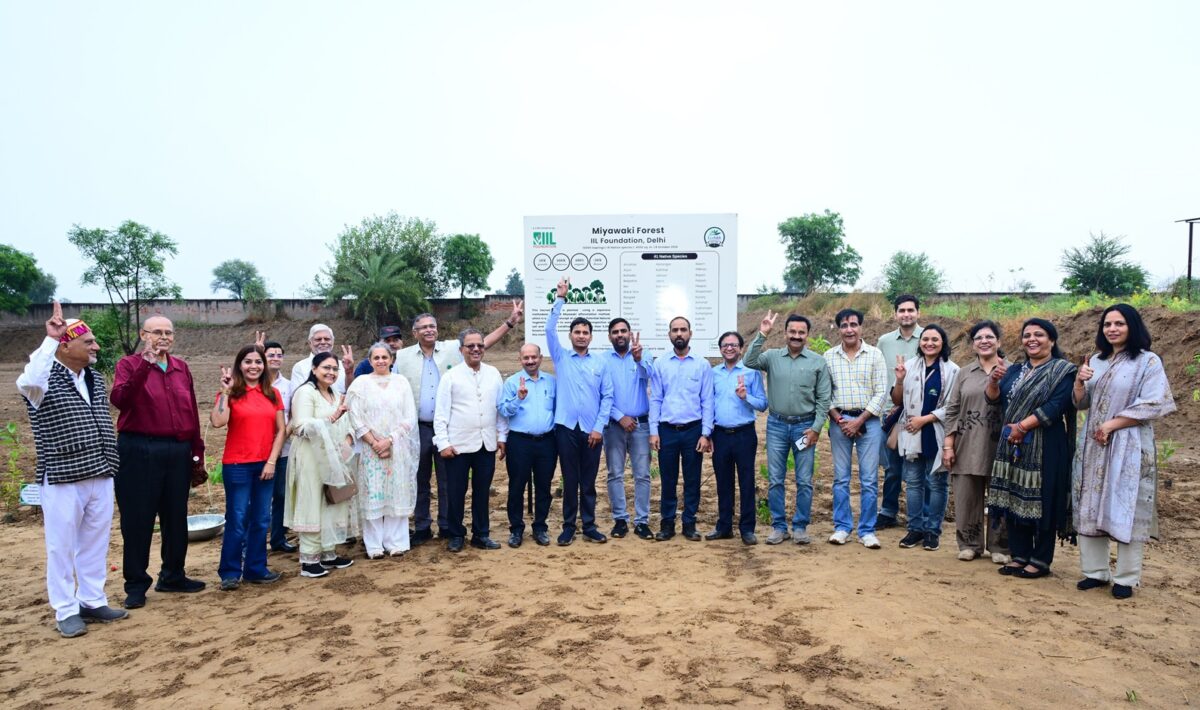
IIL Foundation, the CSR arm of Insecticides (India) Limited, has planted 10,000 saplings at Rabarka village in Rajasthan’s Khairthal-Tijara district to develop a Miyawaki forest under its environmental sustainability initiative, Project IIL Green.
The plantation drive is part of the Green Bhiwadi – Clean Bhiwadi campaign and has been undertaken in association with EcoSikh Charitable Society and the Gram Panchayat of Rabarka. The new green space is expected to strengthen the region’s green cover, support biodiversity and contribute to a healthier local environment.
The plantation was inaugurated at the village cremation ground, where the Miyawaki forest is being developed using a diverse mix of native plant species.
Project IIL Green Moves Towards 50,000 Plantation Target
Launched in 2024, Project IIL Green was established with a commitment to create sustainable green spaces across the Bhiwadi and Sotanala regions of Rajasthan.
Since its launch, IIL Foundation has planted more than 30,000 saplings at different locations. With the addition of 10,000 saplings at Rabarka, the foundation is moving closer to its target of completing 50,000 plantations in 2026.
The initiative focuses on developing green spaces that can contribute to ecological restoration, improve local environmental conditions and provide long-term benefits to surrounding communities.
Miyawaki Method to Support Dense Green Cover
The Rabarka plantation follows the Miyawaki afforestation method, which involves planting a variety of native species in closely spaced arrangements to develop dense green spaces.
The approach is intended to encourage vegetation growth and create habitats that support local biodiversity. The selection of native plants also helps align the plantation with the ecological characteristics of the region.
By developing the forest at a community location, the initiative seeks to extend environmental benefits beyond industrial and urban spaces.
Earlier Green Initiatives Across Rajasthan
The Rabarka project builds on several environmental interventions undertaken by IIL Foundation under Project IIL Green.
Among its major initiatives is the development of a Miyawaki dense forest at Nagar Van in Bhiwadi, where the foundation has undertaken responsibility for planting and nurturing 10,000 trees.
At Chopanki, the organisation has developed an Oxygen Bank comprising approximately 4,000 plants. It has also established green spaces at Sotanala with more than 10,000 plants, contributing to the expansion of vegetation across the region.
Together, these initiatives form part of the foundation’s broader effort to promote environmental conservation and sustainable development in areas surrounding its operations.
IIL Leadership Highlights Environmental Responsibility
Rajesh Aggarwal, Managing Director of Insecticides (India) Limited, said that protecting the environment is closely connected with securing the future of agriculture, farmers and coming generations.
He emphasised that Project IIL Green goes beyond plantation activities by focusing on the development of sustainable green spaces that can create lasting environmental and community benefits.
The Rabarka Miyawaki forest, he added, brings the foundation closer to its commitment of planting 50,000 saplings.
Representing IIL Foundation at the inauguration were Dr. Mukesh Kumar, Vice President; M. K. Rao, Senior General Manager; and Dr. M. M. Gupta, Senior General Manager, along with other members of the organisation.
Strengthening Community-Led Environmental Sustainability
The Rabarka plantation highlights the role of corporate foundations, environmental organisations and local administrations in developing community-based green spaces.
Through its partnership with EcoSikh Charitable Society and the Gram Panchayat, IIL Foundation is combining corporate CSR support with local participation to expand environmental conservation efforts.
With more than 30,000 saplings already planted and additional initiatives underway, Project IIL Green aims to build a wider network of green spaces across Rajasthan while contributing to biodiversity conservation and community well-being.
Disclaimer: This report has been editorially prepared using publicly available information and official company disclosures. Readers are advised to refer to official company announcements and disclosures for further details.
Author

About the Author