
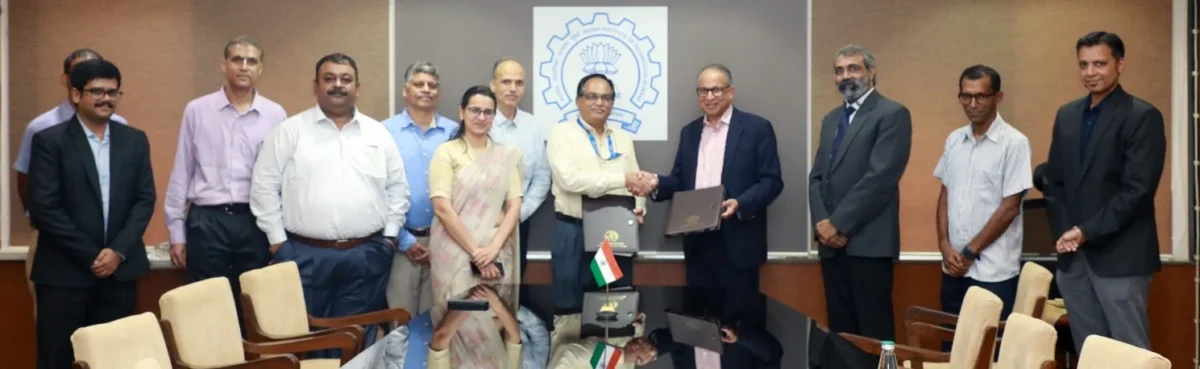
Tata Power and the Indian Institute of Technology Bombay (IIT Bombay) have entered into a long-term strategic partnership aimed at accelerating the development, scale-up and commercialisation of next-generation clean energy technologies.
The two institutions have signed a Master Research Agreement (MRA) that will bring together IIT Bombay’s advanced research capabilities and Tata Power’s industry experience and large-scale deployment expertise. The partnership is designed to bridge the gap between laboratory research and commercially viable technologies that can be deployed across India’s rapidly evolving energy sector.
The agreement was signed at the IIT Bombay campus by Dr. Praveer Sinha, CEO and Managing Director of Tata Power, and Prof. Shrikrishna V. Kulkarni, Dean (Research & Development), IIT Bombay, in the presence of Prof. Shireesh Kedare, Director, IIT Bombay.
Focus on Next-Generation Energy Technologies
Under the collaboration, Tata Power and IIT Bombay will work together across a broad range of emerging technologies that could shape India’s future power ecosystem.
Key areas include smart grids, power electronics, energy storage, electric mobility, cybersecurity, artificial intelligence for power systems, digital grid technologies, carbon capture and circular economy solutions.
The partnership will focus not only on developing new technologies but also on moving promising innovations beyond the laboratory stage. By combining academic research with industry-level testing, deployment and commercial expertise, the two organisations aim to shorten the journey from research and development to real-world implementation.
Bridging the Gap Between Research and Industry
One of the biggest challenges in advanced energy technology is converting promising laboratory research into solutions that can operate reliably at commercial scale.
IIT Bombay brings its expertise in scientific research, engineering and technological innovation, while Tata Power provides experience in operating and deploying energy infrastructure across the country.
The partnership is therefore intended to create a pathway through which cutting-edge research can be tested, refined and eventually transformed into industry-ready technologies.
Dr. Praveer Sinha said the collaboration would help combine IIT Bombay’s research capabilities with Tata Power’s experience in deploying solutions at scale, with the objective of developing a more resilient, secure, intelligent and sustainable power ecosystem.
Energy Storage and Smart Grids in Focus
Energy storage and smart-grid technologies are becoming increasingly important as India rapidly expands solar and wind power.
Renewable generation can fluctuate depending on weather and time of day, creating new challenges for grid management. Technologies such as advanced battery storage, digital grids and intelligent power-management systems can help integrate larger quantities of renewable electricity while maintaining grid stability.
The collaboration’s focus on AI for power systems and digital grid technologies could also support the development of more intelligent electricity networks capable of monitoring demand, predicting fluctuations and optimising power flows.
Supporting India’s Clean Energy Transition
The partnership comes as India seeks to expand clean energy while simultaneously improving energy security and reducing dependence on fossil fuels.
Advanced technologies will play an increasingly important role in this transition, particularly in areas such as energy storage, electric mobility, carbon capture and efficient power transmission.
The collaboration between Tata Power and IIT Bombay is expected to contribute to this effort by developing indigenous technologies that can potentially be scaled for wider deployment in India’s energy ecosystem.
Prof. Shireesh Kedare said the partnership reflects IIT Bombay’s objective of translating advanced laboratory research into reliable and scalable industry solutions, while strengthening India’s energy security and supporting decarbonisation.
Tata Power’s Expanding Clean Energy Footprint
Tata Power has been expanding its presence across India’s clean energy value chain, including renewable generation, solar manufacturing, energy storage, electric mobility and power distribution.
The company has more than 26 GW of total operational and under-construction capacity, including around 17.7 GW of clean and green energy capacity. It has also established 4.9 GW of integrated solar cell and module manufacturing capacity, signed agreements for 2.8 GW of pumped hydro storage projects and expanded its EV charging network to more than 7,000 public charging points across India.
The company has set a target of achieving Net Zero by 2045.
A Step Towards Commercialising Indian Innovation
The Tata Power-IIT Bombay partnership could become particularly important as India looks to build domestic capabilities in technologies critical to the energy transition.
Rather than relying solely on imported technologies, industry-academia collaborations can help develop solutions suited to India’s specific requirements — from grid management and storage to electric mobility and clean industrial technologies.
The new agreement therefore represents more than a research partnership. It is an attempt to create a stronger pipeline from scientific discovery to commercial deployment, potentially helping India build a more technology-driven, resilient and sustainable energy system.
Author

About the Author