
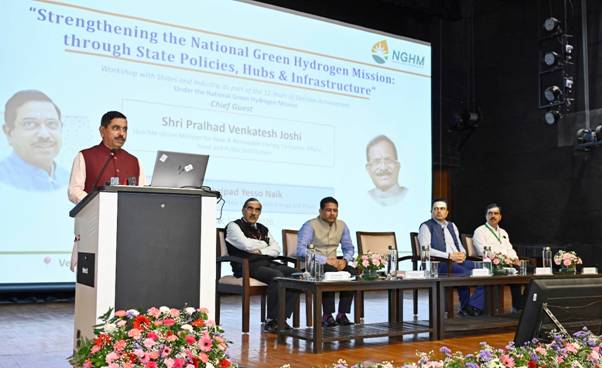
New Delhi, 18 June: Union Minister for New and Renewable Energy Pralhad Joshi on Tuesday launched the Green Hydrogen Certification Portal of India (GHCI), a digital platform designed to support certification, compliance, and transparency in the country’s emerging green hydrogen sector. The portal, developed by the Ministry of New and Renewable Energy (MNRE), will operate under the Green Hydrogen Certification Scheme and aims to strengthen credibility and regulatory oversight across the industry.
The launch took place during a national workshop on “Strengthening the National Green Hydrogen Mission: Through State Policies, Hubs & Infrastructure,” organized by MNRE. Addressing participants, Joshi said states are playing an increasingly important role in advancing India’s hydrogen economy. According to the minister, six states have already notified dedicated green hydrogen policies, while seven others have incorporated hydrogen-related provisions into their industrial or renewable energy frameworks. Four additional states are currently finalizing their policy roadmaps.
Highlighting progress under the National Green Hydrogen Mission, Joshi said incentives have been awarded to 15 companies to establish a combined 3,000 MW annual electrolyser manufacturing capacity, aimed at boosting domestic production and reducing reliance on imported technologies. He added that contracts have also been awarded for the supply of 30,000 metric tonnes per annum (MTPA) of green hydrogen to major public-sector refiners, including Indian Oil Corporation (IOC), Bharat Petroleum (BPCL), Hindustan Petroleum (HPCL), and Numaligarh Refinery Limited (NRL).
The minister noted that pilot projects worth ₹84 crore are underway to test the use of 100 percent hydrogen in steel manufacturing processes. In the mobility segment, nearly ₹208 crore has been allocated for hydrogen-powered vehicles and refuelling infrastructure, supporting 37 vehicles and nine strategic refuelling stations. An additional ₹193.35 crorehas been earmarked for strengthening testing and certification facilities through seven national laboratories and testing centres.
Joshi also highlighted efforts to promote innovation and standardisation within the sector. A dedicated research and development programme worth ₹113 crore is supporting 21 approved projects, while regulatory measures such as the Green Hydrogen Certification Scheme and standards for green ammonia and green methanol have been introduced to create a more structured market environment.
The minister said the mission is also contributing to India’s efforts to reduce import dependence in critical sectors. Agreements have been signed for the supply of 670,000 MTPA of green ammonia to 11 fertiliser plants, which is expected to support the decarbonisation of fertiliser production and reduce reliance on imported fossil-based feedstocks.
Launched in 2023 with an outlay of ₹19,744 crore, the National Green Hydrogen Mission aims to establish 5 million metric tonnes (MMT) of annual green hydrogen production capacity supported by 125 GW of dedicated renewable energy capacity. The government estimates that the mission could attract investments exceeding ₹8 lakh crore, create more than 600,000 jobs, and reduce annual carbon emissions by around 50 million tonnes.
According to Joshi, incentives under the Strategic Interventions for Green Hydrogen Transition (SIGHT) programme have already been awarded for 862,000 MTPA of green hydrogen production capacity. He also pointed to growing industry participation, citing the commissioning of a 3,600 MTPA green hydrogen plant by JSW in late 2025 as an example of the sector’s momentum.
The minister further announced a ₹100 crore startup support programme under the Green Hydrogen Mission. The first batch of nine startups has been approved for funding, receiving a combined ₹22 crore to develop innovative green hydrogen technologies and solutions.
The workshop, attended by MNRE Secretary Santosh Kumar Sarangi, state government representatives, industry stakeholders, and sector experts, was held as part of the government’s celebrations marking 12 years of governance, with a focus on clean energy expansion, industrial decarbonisation, and India’s long-term energy transition goals.
Author

About the Author


