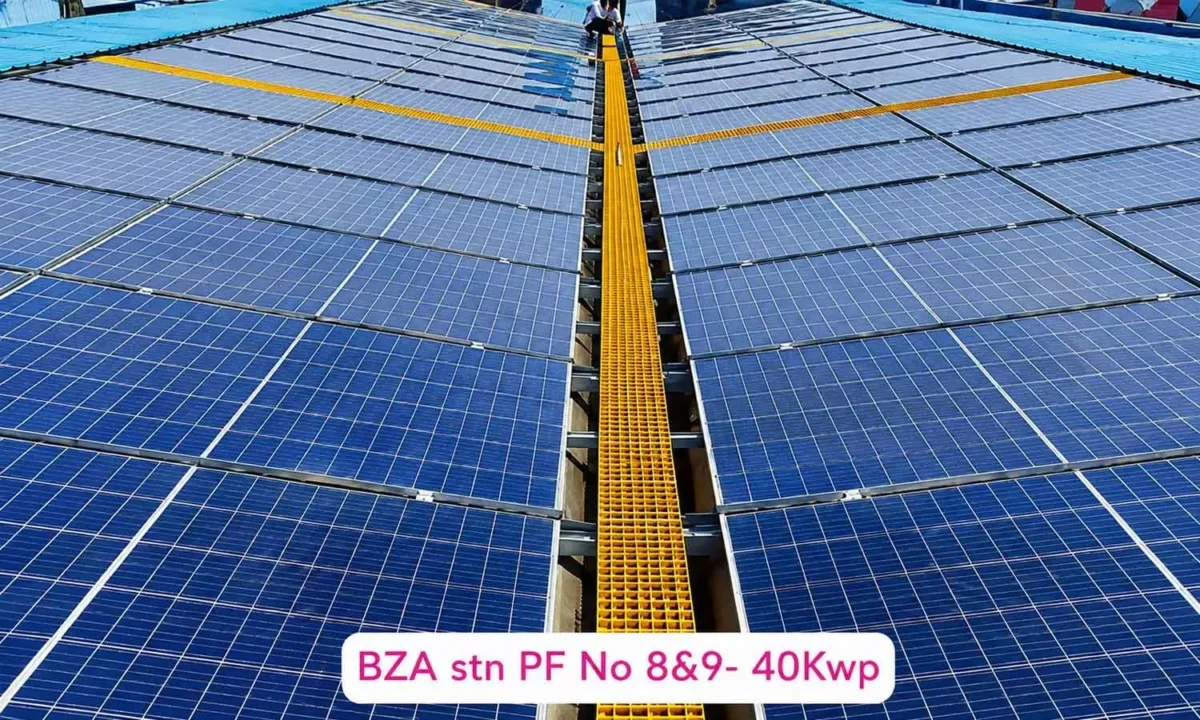
The Vijayawada Division of South Coast Railway is strengthening its renewable energy initiatives, with its total installed solar power capacity reaching 4,864 kWp across 265 rooftop and standalone installations. The initiatives were highlighted as the division observed Indian Akshay Urja Diwas (Renewable Energy Day) on Thursday, reflecting the railway division’s continued efforts to increase the use of clean energy and reduce its dependence on conventional power sources.
Of the total installed solar capacity, 2,978 kWp has been deployed at railway stations, while 1,476 kWp has been installed at service buildings and offices. Another 120 kWp has been installed at staff quarters, with 290 kWp spread across 70 level-crossing gates. The installations at level-crossing gates are particularly aimed at supporting reliable electricity availability at rural and outage-prone locations.
The division’s expanding solar infrastructure has also delivered significant energy and financial benefits. During 2025-26, the solar installations generated 44,06,903 units of clean electricity, helping the railway division save approximately ₹4.61 crore. The renewable energy generation during the year also helped avoid around 3,525.52 tonnes of carbon dioxide emissions, contributing to the division’s efforts to reduce its environmental footprint.
The momentum has continued during the current financial year. Between April and July 2026, the division generated 19,90,741 units of electricity through its renewable energy installations, resulting in reported savings of approximately ₹1.85 crore and avoiding around 1,592.59 tonnes of CO₂ emissions.
Apart from expanding solar generation, Vijayawada Division has undertaken several other energy-efficiency and renewable energy measures across its railway infrastructure. The division has completed a transition to LED lighting, helping reduce electricity consumption across its facilities.
Solar water-heating systems have also been installed at running rooms, rest houses and hospitals, with a combined capacity of 56,700 litres per day. These systems are intended to reduce conventional energy consumption for water heating while making greater use of renewable energy across railway facilities.
The division has further commissioned 81 solar-powered street lights and signal installations, extending the use of solar energy beyond station buildings and administrative facilities. Several stations have also adopted green-energy measures, including Kadiyam, Dwarapudi, Madhuranagar, Sarpavaram, Uppuluru, Ulavapadu, Kavutaram, Nidamanuru, Moturu and Pedana.
A major sustainability milestone has also been achieved at Vijayawada Railway Station, which has received IGBC Platinum certification for sustainable design. The station has additionally been equipped with 610 kWp of building-integrated photovoltaic rooftop solar panels across its platforms, further strengthening its renewable energy infrastructure.
The combination of large-scale rooftop solar installations, solar-powered lighting, solar water heating and energy-efficient infrastructure highlights the Vijayawada Division’s broader focus on integrating renewable energy into railway operations. The initiatives are aimed at reducing electricity costs, lowering carbon emissions and improving the sustainability of railway infrastructure across the division.
Author

About the Author