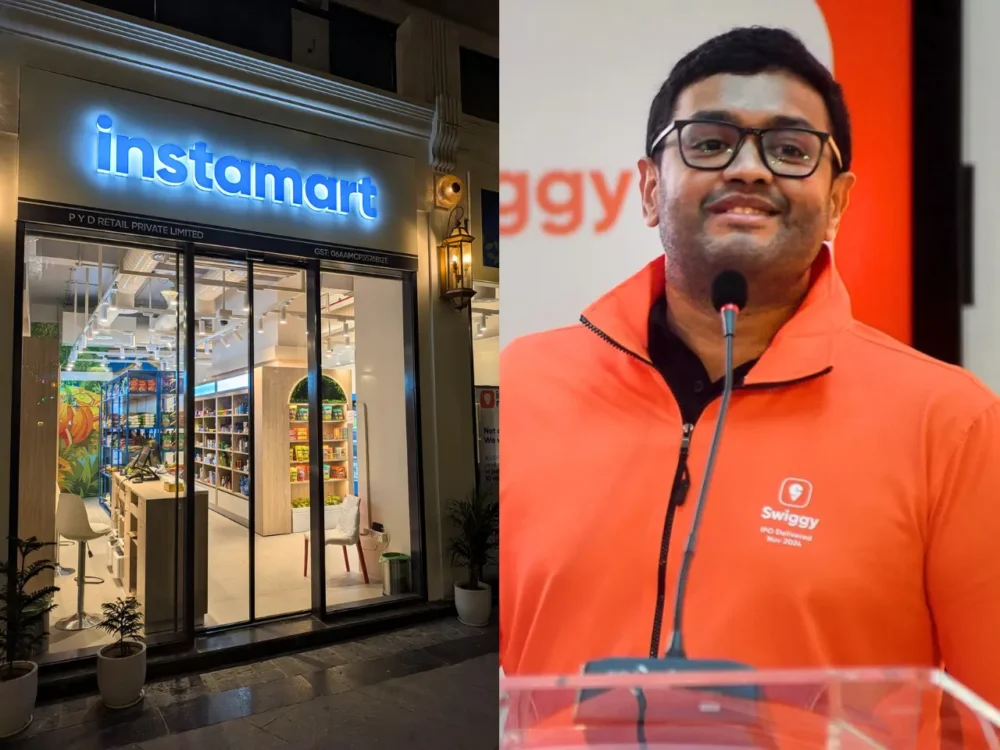
Food delivery and quick-commerce company Swiggy reported a consolidated net loss of ₹922 crore for the second quarter of FY27, marking a 16% decline from the ₹1,092 crore loss recorded in the corresponding quarter last year. Revenue from operations rose approximately 36% year-on-year to ₹7,571 crore, reflecting continued growth across its food delivery and quick-commerce businesses.
However, the company’s loss increased sequentially from ₹791 crore in the June quarter, as it continued investing in Instamart’s expansion and newer initiatives, including its affordable food delivery app, Toing. Revenue from operations grew around 11% quarter-on-quarter from ₹6,812 crore.
Including other income of ₹212 crore, compared with ₹59 crore a year earlier, Swiggy’s total income reached ₹7,783 crore during the quarter. Total expenses increased approximately 30% year-on-year to ₹8,703 crore.
For the first half of FY27, the company reported a consolidated net loss of ₹1,713 crore, down around 25% from ₹2,289 crore in the same period last year. Revenue from operations for the six-month period stood at ₹14,383 crore.
Operating Expenses Rise as Swiggy Invests in Growth
Delivery and related charges remained Swiggy’s largest operating cost, increasing approximately 33% year-on-year to ₹1,895 crore. Advertising and sales promotion expenses rose around 25% to ₹1,298 crore, while purchases of stock-in-trade increased to ₹3,607 crore from ₹2,330 crore in the year-ago quarter.
Employee benefits expenses declined slightly to ₹676 crore from ₹690 crore. Meanwhile, the supply chain and distribution segment continued to be the company’s largest revenue contributor, generating ₹3,690 crore, up 44.1% year-on-year.
Swiggy’s consolidated adjusted EBITDA loss widened to ₹760 crore from ₹695 crore a year earlier and ₹651 crore in the preceding quarter. The adjusted measure excludes certain items, including other income, share-based payments and lease rentals.
The company also reported consolidated adjusted revenue of ₹7,909 crore, representing growth of 33.8%. This measure includes user delivery charges and user fees in addition to reported revenue from operations.
Food Delivery Business Records Its Strongest-Ever Profitability
Swiggy’s food delivery business delivered a stronger performance during the September quarter, with revenue increasing approximately 22% year-on-year to ₹2,338 crore.
Gross order value (GOV) rose 17.7% to ₹10,054 crore, while monthly transacting users increased 15.2% to 19.8 million. The segment recorded its highest-ever adjusted EBITDA of ₹341 crore, compared with ₹240 crore in the corresponding quarter last year.
Its adjusted EBITDA margin improved by 58 basis points to 3.4% of GOV, reflecting stronger profitability even as the company continued expanding its customer base and delivery offerings.
Swiggy said its take rate reached a record 26.1%, supported by advertising revenue. The company also highlighted the contribution of Bolt and 99-Store, which focus on shorter-distance orders and together accounted for more than 25% of food delivery volumes. According to Swiggy, these offerings helped reduce delivery costs.
Food delivery growth exceeded 20% in September, and the company retained its full-year GOV growth guidance of 18–20%, excluding Toing.
“Our Food delivery business delivered its highest ever profits and margins while we continue to unlock new category growth through Toing, our standalone offering for affordable meals,” said Sriharsha Majety, Managing Director and Group CEO of Swiggy.
Toing has expanded to more than 50 cities. Swiggy said approximately two out of every three new users on the platform were either new to Swiggy or had been inactive for an extended period. The company believes the offering could help raise combined food delivery growth to 25–30%.
The expansion of Toing represents Swiggy’s effort to reach more price-sensitive consumers while building on its established food delivery business.
Instamart Revenue Grows 33%, but Losses Continue to Expand
Swiggy’s quick-commerce business, Instamart, recorded revenue of ₹1,306 crore during the September quarter, up approximately 33% year-on-year and 6% from the June quarter.
Despite the revenue increase, the segment’s loss widened to ₹764 crore from ₹739 crore in the year-ago quarter and ₹651 crore in the preceding quarter. Its adjusted EBITDA loss also increased to ₹895 crore from ₹778 crore a year earlier.
Quick-commerce GOV rose 31.4% year-on-year to ₹9,230 crore. Net order value, which excludes discounts, increased 13.4% sequentially to ₹6,594 crore. Orders grew 29.3% to 130 million, while monthly users increased by 1.3 million to reach 14.8 million.
Instamart added 69 net dark stores during the quarter, matching the total number of net additions across the previous three quarters combined. Its network consequently expanded to 1,240 stores across 133 cities.
However, its contribution margin deteriorated to minus 1.0% of GOV compared with the June quarter. Swiggy attributed the pressure to targeted pricing initiatives aimed at reactivating dormant customers, changes in the user mix and expenses associated with newly opened stores that have yet to reach full utilisation.
The company said it believes adjusted EBITDA losses peaked in Q2 FY27. It expects Instamart’s adjusted EBITDA margin to improve by approximately 100 basis points in the December quarter.
Swiggy also indicated that Instamart would require approximately 2.3 times its current scale to reach break-even, corresponding to an annualised net order value of around ₹60,000 crore.
Nevertheless, the company cautioned that competition in the quick-commerce market remains intense and is unlikely to ease in the near term, particularly as major e-commerce players continue competing through the festive season.
Ownership Restructuring Could Improve Instamart’s Margins
Swiggy is also preparing a structural change to Instamart’s operating model. Shareholders approved a cap of 49.5% on foreign shareholding, calculated on a fully diluted basis, to help the company qualify as an Indian-owned and controlled entity. Swiggy said domestic ownership has subsequently risen above 58%.
The change is expected to enable Instamart to hold its own inventory. The transition is scheduled to begin around the middle of the December quarter and is expected to take two to three quarters to complete.
Swiggy estimates that the change could add approximately 80 basis points to Instamart’s contribution margin, potentially supporting its efforts to improve the economics of its quick-commerce operations.
The company is also reshaping its portfolio through the sale of its B2B distribution business, Lynks Logistics. In September, Swiggy agreed to sell Lynks to Trustroot Internet, the parent company of Udaan, for approximately ₹500 crore in preference shares.
Alongside a separate investment of ₹75 crore, the transaction is expected to give Swiggy an approximately 3.2% stake in Udaan. Lynks was deconsolidated from Swiggy’s financials effective September 15.
There was also a leadership change at Instamart during the quarter. Amitesh Kumar Jha resigned as the business’s CEO with effect from July 28, and Nandita Sinha assumed the role on August 3.
Eternal Reports Profit as Blinkit Expands Its Store Network
Swiggy’s results come amid continued competition with Eternal, the parent company of Zomato and Blinkit.
Eternal reported a net profit of ₹125 crore for the same quarter, with revenue reaching ₹24,138 crore. Its quick-commerce business, Blinkit, posted an adjusted EBITDA profit of ₹184 crore, while its store network expanded to 2,751 locations—more than twice Instamart’s network of 1,240 stores.
Zomato’s food delivery net order value grew 21.5% year-on-year, highlighting continued activity in the food delivery market as the two companies compete for customers, restaurant partners and delivery volumes.
The comparison underscores the different financial trajectories of the businesses. Swiggy’s food delivery segment has strengthened its profitability, but Instamart’s expansion continues to weigh on consolidated earnings. Blinkit’s reported adjusted EBITDA profitability and larger store network provide a contrasting picture of quick-commerce performance.
Swiggy ended the September quarter with a consolidated cash balance of ₹13,662 crore, following a cash burn of ₹708 crore during the period.
Swiggy Targets ₹10,000 Crore Adjusted EBITDA by FY31
Swiggy’s long-term ambitions remain focused on scaling its businesses while improving profitability. At its first Capital Markets Day on August 6, the company outlined a goal of achieving ₹10,000 crore in adjusted EBITDA by FY31, supported by gross order value exceeding ₹2.5 lakh crore.
The September-quarter results show progress in food delivery profitability alongside continued investment in quick commerce. The central challenge for Swiggy will be to sustain revenue and order growth while reducing Instamart’s losses and improving the efficiency of its expanding store network.
Disclaimer: This report has been editorially prepared using publicly available information and official company disclosures. Readers are advised to refer to official company announcements/disclosures for further details.
Author

About the Author