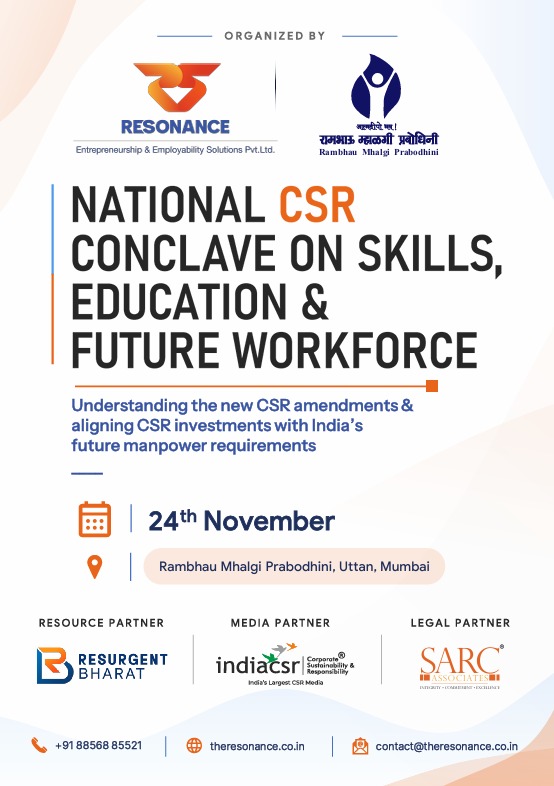
A National CSR Conclave focusing on skills, education and future workforce development is scheduled to take place on November 24, 2026, at Rambhau Mhalgi Prabodhini (RMP), Uttan, Mumbai. The event will bring together corporate leaders, CSR professionals, educational institutions, government representatives, non-profit organisations and industry stakeholders to discuss how corporate social responsibility investments can better address India’s evolving manpower requirements.
The conclave will be organised by Resonance Entrepreneurship & Employability Solutions Pvt. Ltd., in association with Rambhau Mhalgi Prabodhini and India CSR. Its central theme, “Understanding the New CSR Amendments & Aligning CSR Investments with India’s Future Manpower Requirements,” will place workforce development and industry-linked education at the centre of discussions.
Aligning CSR with Future Workforce Requirements
As industries continue to evolve, the demand for skilled, adaptable and employment-ready professionals is increasing across sectors such as manufacturing, infrastructure, logistics, healthcare, banking and financial services, tourism, food processing, technology and renewable energy.
The conclave aims to examine how CSR programmes can move beyond isolated education and training initiatives towards a more integrated talent-development ecosystem. Discussions will cover school education, vocational training, employability, apprenticeships, workplace learning and entrepreneurship.
Participants will also explore ways to strengthen educational institutions, improve access to quality learning, develop industry-relevant skills and establish clearer pathways from education to employment and sustainable livelihoods.
Focus on New CSR Amendments and Social Stock Exchange
An important part of the programme will be dedicated to the Companies (Corporate Social Responsibility Policy) Amendment Rules, 2026 and the expanding role of the Social Stock Exchange in India’s social-sector financing ecosystem.
Under the revised framework, companies can undertake eligible CSR activities through subscriptions to Zero Coupon Zero Principal (ZCZP) instruments issued by eligible not-for-profit organisations registered on the Social Stock Exchange. Such expenditure is subject to a cap of 10% of a company’s total CSR expenditure for the relevant financial year.
The amendments have also introduced definitions for not-for-profit organisations and ZCZP instruments, providing a regulated mechanism for eligible social-sector organisations to mobilise funds for public-welfare initiatives.
The discussions will examine the practical implications of these provisions, including opportunities for transparent fundraising, improved accountability and outcome-oriented social investments. Recent changes to the Social Stock Exchange framework, including revisions to registration and minimum subscription requirements for ZCZP issuances, will also be considered.
Six Key Sessions on Skills and Employability
Following a 45-minute inaugural session, the conclave will feature six focused discussions covering different aspects of CSR, education and workforce development.
The sessions will address the 2026 CSR amendments and compliance landscape, industry expectations from education and skilling programmes, and the role of the National Education Policy (NEP) 2020, academic-industry partnerships and work-integrated learning.
Other discussions will examine government priorities in skill development, implementation challenges and successful workforce initiatives, before concluding with a roadmap for collaborative investments in future-ready talent.
Perspectives from organisations including the National Stock Exchange (NSE) and Bombay Stock Exchange (BSE), along with corporate-law experts and other stakeholders, are expected to contribute to discussions on the evolving regulatory environment.
Building Stronger Industry-Academia Partnerships
The conclave will also highlight the importance of collaboration among companies, educational institutions, government agencies, CSR foundations and civil-society organisations.
Stronger partnerships can help identify regional skill gaps, develop relevant training programmes, strengthen implementation institutions and create employment opportunities aligned with industry requirements.
For companies, such collaboration can help connect CSR strategies with sector-specific workforce needs and national development priorities. Educational institutions and non-profit organisations, meanwhile, can benefit from deeper industry engagement and opportunities to develop scalable programmes.
Expected Outcomes
The organisers expect the conclave to contribute to the development of a CSR–Future Workforce Framework, a Skill Investment Matrix, a pipeline of cross-sector partnerships, potential pilot projects and a national action agenda for education, employability and workforce development.
By bringing together stakeholders from across the development and corporate sectors, the initiative aims to encourage a more coordinated approach to using CSR investments to strengthen India’s future talent pool.
CSR, HR and ESG professionals have been invited to participate in the conclave. Organisations and individuals interested in speakership opportunities or participation can contact the organisers for further details.
Disclaimer: This report has been editorially prepared using publicly available information and official statements. Readers are advised to refer to official announcements for further details.
Author

About the Author