
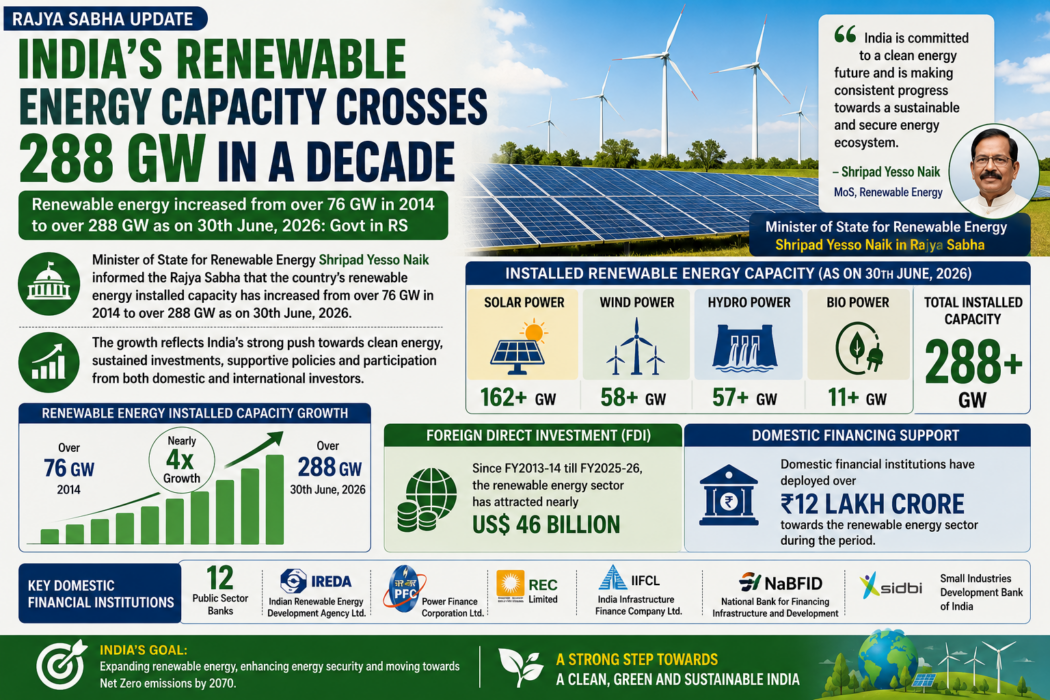
India’s renewable energy installed capacity has grown nearly fourfold over the past decade, increasing from over 76 GW in 2014 to more than 288 GW as of June 30, 2026, reflecting the country’s accelerated transition towards clean energy, the government informed the Rajya Sabha on Tuesday.
In a written reply, Minister of State for New and Renewable Energy Shripad Yesso Naik said the significant expansion has been driven by sustained investments, supportive policy measures and growing participation from both domestic and international investors.
According to the minister, solar power has emerged as the largest contributor to India’s renewable energy portfolio, with an installed capacity of over 162 GW. It is followed by wind power, which has reached around 58 GW, while hydropower contributes approximately 57 GW. Bio power accounts for more than 11 GW of installed renewable energy capacity.
The government highlighted that India’s renewable energy sector has also attracted substantial foreign investment over the years. Between FY2013-14 and FY2025-26, the sector received nearly US$46 billion in Foreign Direct Investment (FDI), reflecting increasing global confidence in India’s clean energy market.
Alongside foreign investments, domestic financial institutions have played a major role in funding renewable energy projects across the country.
The minister informed the Upper House that more than ₹12 lakh crore has been deployed towards the renewable energy sector during the period by domestic financial institutions.
These include 12 public sector banks, Indian Renewable Energy Development Agency Limited (IREDA), Power Finance Corporation (PFC), REC Limited, India Infrastructure Finance Company Limited (IIFCL), National Bank for Financing Infrastructure and Development (NaBFID) and the Small Industries Development Bank of India (SIDBI).
The continued expansion of renewable energy capacity supports India’s broader objective of enhancing energy security, reducing dependence on fossil fuels and meeting its long-term climate commitments.
India has set ambitious clean energy goals, including expanding renewable energy generation, promoting green hydrogen, strengthening grid infrastructure and progressing towards its Net Zero emissions target by 2070.
The steady increase in installed renewable energy capacity, coupled with strong public and private investment, underscores the country’s growing position as one of the world’s leading renewable energy markets.
Disclaimer: This report has been editorially prepared using publicly available information and official government statements. Readers are advised to refer to official replies tabled in Parliament and Ministry of New and Renewable Energy announcements for complete details.
Author

About the Author