
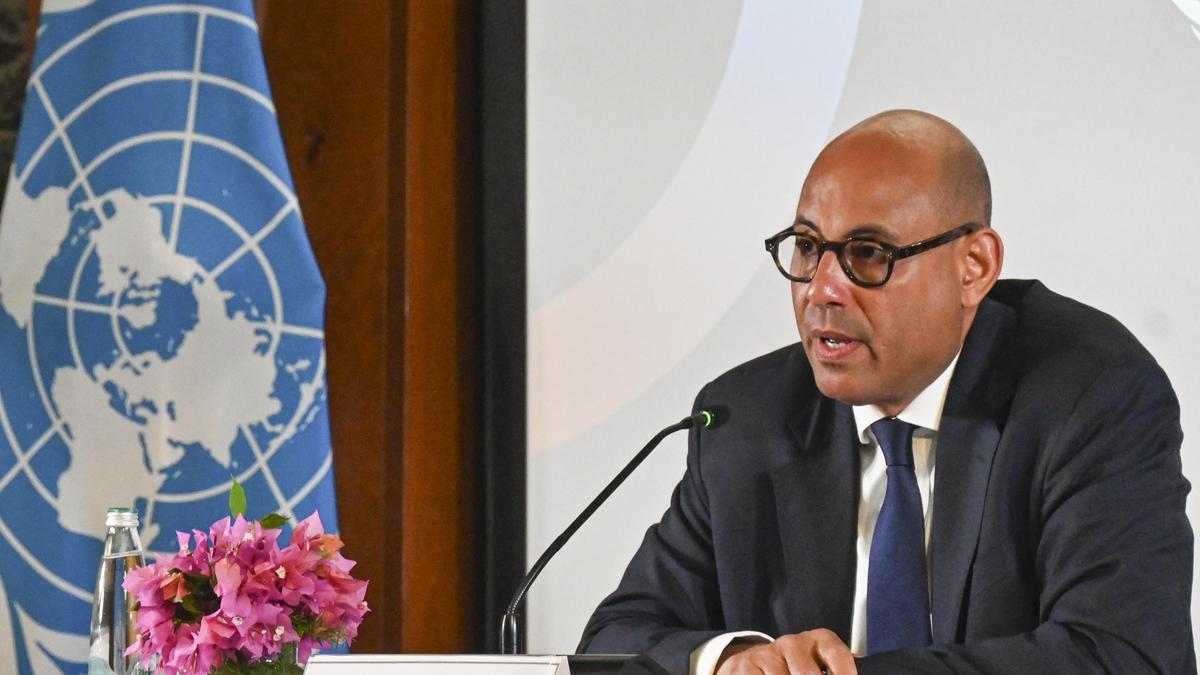
India’s strategy to address the technical and financial challenges of transitioning to a low-carbon economy lies in accelerating decarbonisation and electrification, according to Simon Stiell, Executive Secretary of the United Nations Framework Convention on Climate Change (UN Climate Change). He said these measures are not only essential for tackling climate change but are also firmly aligned with India’s long-term economic and energy interests.
Speaking to journalists after two days of discussions with Indian ministers and business leaders, Stiell said India’s energy transition faces challenges across a broad spectrum—from strengthening electricity infrastructure to mobilising adequate climate finance.
On the technical front, he identified electricity grids and energy storage as two of the most critical areas requiring attention. According to Stiell, these are common challenges faced by major economies pursuing clean energy transitions, and greater international cooperation can help accelerate the development of practical solutions.
He noted that modernising power grids and expanding storage capacity are central to the global electrification agenda, which has been prioritised by Turkey and Australia, the hosts of COP31, scheduled later this year.
Electrification aims to significantly increase the share of electricity in global energy consumption, with a target of ensuring that at least 35% of the world’s total energy use comes from electricity by 2035. Achieving this objective will require large-scale deployment of renewable energy alongside stronger transmission infrastructure and advanced storage technologies.
India’s growing dependence on solar and wind energy has highlighted the importance of reliable energy storage. Since renewable energy generation is intermittent, coal-fired power plants continue to play a balancing role by supplying electricity when renewable generation declines, particularly during nighttime and periods of low wind.
At the same time, excess solar power generated during daylight hours is sometimes curtailed to maintain grid stability, underscoring the need for expanded battery storage and more flexible electricity networks.
Addressing the financial dimension of the transition, Stiell said decarbonisation and electrification are firmly in India’s self-interest and are attracting increasing levels of both public and private investment.
However, he acknowledged that financing remains a significant challenge, particularly for climate adaptation initiatives, where commercial returns are often limited compared to renewable energy investments.
According to Stiell, expanding climate finance remains essential for helping developing countries implement adaptation measures while strengthening resilience against the impacts of climate change.
Earlier during his visit, the UN climate chief described India as a “solar superpower,” highlighting the country’s rapid progress in renewable energy deployment.
He noted that non-fossil fuel sources now account for nearly half of India’s installed electricity generation capacity, a milestone achieved five years ahead of schedule. He also observed that renewable energy helped India save approximately $18 billion in fossil fuel imports over the past year.
India’s progress was also highlighted by Union Minister for Environment, Forest and Climate Change Bhupender Yadav, who said discussions with the UN delegation focused on climate adaptation, technology transfer, climate finance, the global stocktake process and ensuring a just transition toward cleaner energy.
The minister reiterated that under the leadership of Prime Minister Narendra Modi, India has successfully submitted and achieved its enhanced Nationally Determined Contributions (NDCs) ahead of the timelines committed under the Paris Agreement.
Reflecting on the Bonn Climate Conference, held in June as a preparatory meeting for COP31, Stiell described the negotiations as producing mixed outcomes. While some progress was made, he said considerable work remains before countries meet later this year in Antalya for the annual United Nations climate conference.
He also acknowledged growing international discussions on reforming the global climate negotiation process. The UN Climate Change Secretariat has established an expert group to examine possible improvements to the climate governance framework, with wider consultations involving member countries expected over the coming months.
On climate finance, Stiell recalled that COP29, held in Baku, resulted in a new global commitment to mobilise $300 billion annually in climate finance while outlining a longer-term roadmap to increase funding to $1.3 trillion per year.
He emphasised that these ambitious financing goals cannot be achieved through public funding alone and will require stronger participation from private financial institutions, investors and international development partners. Discussions on innovative financing mechanisms are expected to continue through COP33 in 2028.
As India continues expanding renewable energy capacity, strengthening grid infrastructure and promoting clean technologies, international cooperation, climate finance and technological innovation are expected to remain central to achieving the country’s long-term decarbonisation goals while supporting sustainable economic growth.
Disclaimer: This report has been editorially prepared using publicly available information and official statements. Readers are advised to refer to official announcements from UN Climate Change and the Government of India for further details.
Author

About the Author