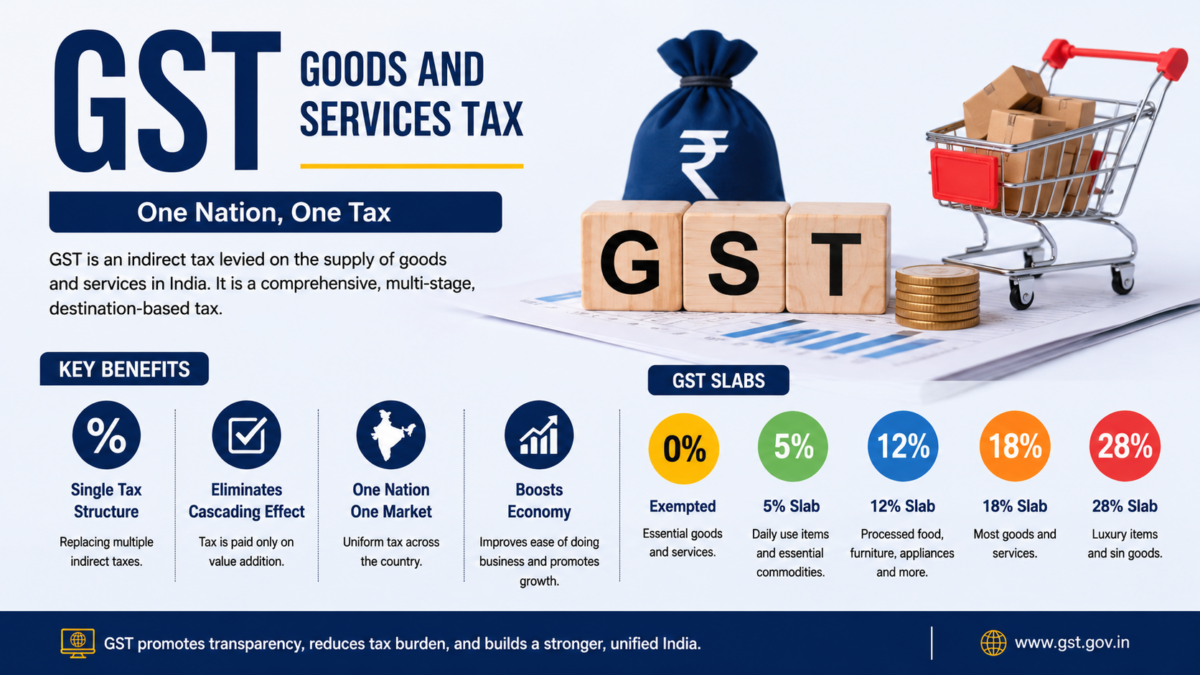
India’s gross Goods and Services Tax (GST) collections rose 15.4% year-on-year to over ₹2.11 lakh crore in July, reflecting resilient domestic consumption, strong industrial activity and higher tax collections from imports.
The latest GST collections surpassed both ₹1.83 lakh crore recorded in July 2025 and ₹1.95 lakh crore collected in June 2026, indicating sustained momentum in economic activity despite global uncertainties.
Domestic Transactions and Imports Drive Growth
According to official GST data released by the Finance Ministry, tax collections from domestic transactions increased 10.1% year-on-year to over ₹1.44 lakh crore.
Meanwhile, GST revenue from imports surged 29% to ₹66,511 crore, contributing significantly to the overall growth in collections.
The strong import-related collections reflect both higher import activity and increased customs valuations, although experts note that currency movements may also have played a role.
GST Collection Break-up
The July GST collections comprised:
- Central GST (CGST): ₹39,835 crore
- State GST (SGST): ₹47,881 crore
- Integrated GST (IGST): Over ₹1.23 lakh crore
After issuing refunds worth ₹29,968 crore, which increased 13.1% compared to last year, the net GST revenue stood at over ₹1.81 lakh crore.
Major Manufacturing States Continue to Lead
Tax experts said the strong GST performance reflects broad-based economic activity across India’s key manufacturing and consumption centres.
According to M.S. Mani, Partner at Deloitte India, the steady rise in GST collections demonstrates that domestic consumption is becoming increasingly resilient to seasonal fluctuations and global economic headwinds.
He noted that major manufacturing states including Maharashtra, Gujarat, Karnataka and Telangana recorded healthy growth in GST collections during the month.
Experts Highlight Consumption Resilience
Industry experts believe the sustained double-digit growth in GST collections points to continued strength in India’s domestic economy.
Manoj Mishra, Partner at Grant Thornton Bharat, said the 10.1% growth in domestic GST reflects robust household consumption, increasing formalisation of the economy and healthy industrial activity.
He added that strong collections from states such as Maharashtra, Gujarat, Karnataka, Haryana, Telangana and Uttar Pradesh indicate widespread economic momentum across manufacturing, services and consumption sectors.
Imports Remain a Key Area to Watch
While analysts welcomed the strong revenue growth, some cautioned that rising import-related GST collections warrant closer examination.
Abhishek Jain, Indirect Tax Head at KPMG India, said it would be important to determine whether higher import GST collections were driven by increased imports of finished goods, raw materials or simply higher valuations resulting from a weaker rupee.
Similarly, Saurabh Agarwal, Tax Partner at EY India, observed that elevated import GST collections highlight the need to further strengthen domestic manufacturing capacity despite ongoing initiatives such as Production Linked Incentive (PLI) schemes and Aatmanirbhar Bharat.
GST Collections Continue Strong Growth in FY27
For the first four months of the financial year (April–July 2026), gross GST collections increased 10.1% to approximately ₹8.43 lakh crore, while net GST collections rose 9.2% to ₹7.21 lakh crore after refunds.
The continued rise in GST revenues underscores the resilience of India’s consumption-led growth and reflects improving tax compliance, expanding formalisation and sustained economic activity across sectors.
Author

About the Author