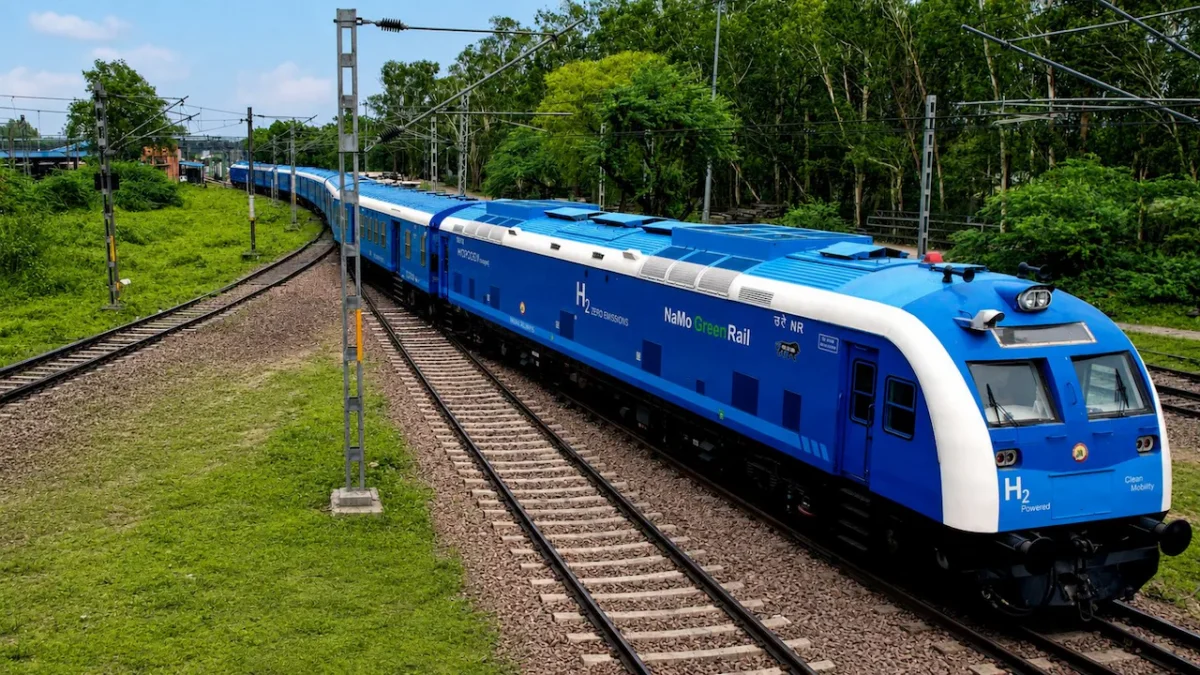
India has entered a new era of sustainable rail transportation with the launch of its first hydrogen-powered train, flagged off by Prime Minister Narendra Modi. The pioneering train will operate on the 89-kilometre Jind-Sonipat route in Haryana under the Northern Railway, marking a significant milestone in the country’s efforts to adopt cleaner and greener transportation technologies.
The hydrogen-powered train is the first in India to use hydrogen fuel cell technology, which generates electricity by combining hydrogen with oxygen, producing only water as a by-product. The technology offers a zero-emission alternative to conventional diesel-powered trains and is expected to play an important role in reducing the carbon footprint of the Indian Railways.
Sharing the announcement on social media platform X, Prime Minister Modi said the launch places India among a select group of nations that have adopted hydrogen-powered railway technology.
He noted that the initiative would significantly contribute to accelerating the adoption of clean technologies across India’s railway network while supporting the country’s broader sustainability and climate goals.
The hydrogen train has been introduced as a pilot project to evaluate the operational feasibility of hydrogen fuel cell technology under Indian conditions. The project also includes the development of dedicated hydrogen storage and refuelling infrastructure, laying the foundation for future expansion of hydrogen-powered rail services.
The newly launched train consists of a 10-coach hydrogen fuel cell trainset powered by a 1,200-kilowatt hydrogen fuel cell propulsion system. It has been approved to operate at a maximum speed of 75 kmph, while its design speed is 110 kmph. The train is capable of carrying approximately 2,600 passengers, making it suitable for regional passenger services.
The service will connect Jind Junction, Gohana Junction and Sonipat, while also serving several intermediate stations including Jind City, Pandu Pindara Junction, Lalit Khera Halt, Bhambhewa, Isapur Kheri Halt, Butana Halt, Khandrai Halt, Rabrah Halt, Lath Halt, Mohana, Barwasni Halt and Sonipat New.
With the launch, India joins a select group of countries exploring hydrogen-powered rail transport, including Germany, Japan, China and the United States.
Germany was the first country to introduce hydrogen-powered passenger trains through the Alstom Coradia iLint, which entered commercial service as a zero-emission alternative to diesel trains. Japan is also preparing to launch its first hydrogen hybrid train, known as Hybari, by fiscal year 2027, while the United States introduced its first hydrogen-powered passenger train in California in 2024.
The initiative aligns with India’s broader commitment to promoting green energy, reducing dependence on fossil fuels and achieving its long-term net-zero emissions targets. If the pilot project proves successful, hydrogen-powered trains could become an important part of the Indian Railways’ future strategy for sustainable transportation.
Disclaimer: This report has been editorially prepared using publicly available information. Readers are advised to refer to official Indian Railways announcements for detailed technical specifications and operational updates.
Author

About the Author