
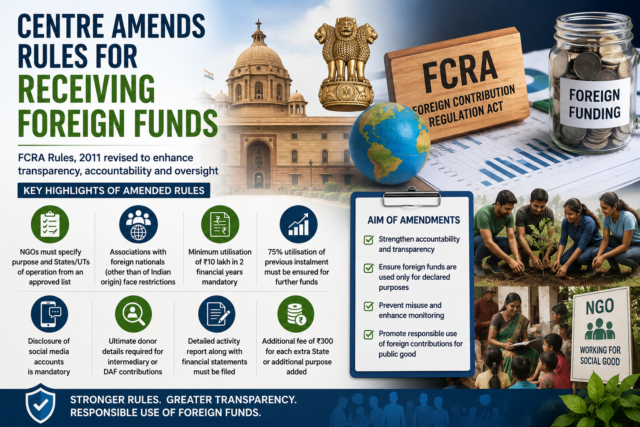
New Delhi, 23 June: The Central Government has amended the Foreign Contribution Regulation Act (FCRA) Rules, 2011, introducing a series of measures aimed at enhancing transparency, accountability, and monitoring of foreign funding received by non-governmental organizations (NGOs) and associations in India.
Under the revised rules notified by the Ministry of Home Affairs, organizations seeking FCRA registration or prior permission will now be required to clearly specify the purpose of receiving foreign contributions and identify the States or Union Territories where the funds will be utilized.
NGOs Must Select Approved Activity Categories
Applicants will be required to choose their activities from a predefined list of approved purposes covering religious, educational, social, cultural, and economic sectors. These selected purposes and operational areas will be recorded in the registration certificate issued by the government.
The amendments also clarify that certain faith-based activities, including religious education, preservation of faith traditions, and documentation of indigenous beliefs, may be permitted. However, such activities must explicitly exclude proselytisation or religious conversion efforts.
Foreign Nationals Face Stricter Eligibility Norms
The revised rules state that associations having foreign nationals, other than persons of Indian origin, as key functionaries will generally not be considered eligible for FCRA registration or prior permission. However, the Central Government retains the authority to grant exceptions in specific cases through separate orders.
The definition of “key functionary” has also been expanded to include company directors, trustees, partners, members of governing bodies, Karta of Hindu Undivided Families, and other individuals exercising management control over an organization.
Existing NGOs Given One Year to Comply
Organizations already registered under FCRA before 2026 will have one year to update their registrations by specifying their approved purposes and areas of operation.
The government has also introduced additional fees for expanding registrations, with an extra ₹300 charge applicable for every additional State or activity category added to an application.
Minimum Utilisation Requirement Introduced
To discourage inactive organizations from retaining FCRA registrations, the government has introduced a minimum utilisation benchmark. NGOs seeking renewal or continuation of registration must demonstrate expenditure of at least ₹10 lakh of foreign contributions on approved activities during the previous two financial years.
For organizations operating under the “Prior Permission” route, subsequent installments of foreign funding will be released only after at least 75% of the previous installment has been utilized. Field verification may also be conducted to confirm fund usage.
Greater Transparency and Disclosure Requirements
The amended rules require NGOs to disclose their social media accounts while applying for registration or renewal. Organizations receiving funds through intermediary channels, including donor-advised funds, must also identify and disclose the ultimate source of the contribution.
Additionally, annual returns filed under FCRA must now include detailed activity reports alongside financial statements, providing greater visibility into the utilization and impact of foreign contributions.
The government said the amendments are intended to strengthen oversight of foreign funding, improve accountability, and ensure that foreign contributions are utilized strictly for their declared purposes.
Author

About the Author


