The Bihar government is planning to expand the use of solar energy in agriculture by promoting solar-powered crop drying systems for farmers, self-help groups (SHGs), farmer producer organisations (FPOs) and larger agricultural clusters.
The Bihar Horticulture Development Society (BHDS), under the Department of Agriculture, has invited bids from original equipment manufacturers (OEMs) and authorised agencies for the empanelment, supply, installation, commissioning, training, warranty support and maintenance of solar crop dryers across the state.
The initiative aims to bring renewable energy into post-harvest agricultural activities while helping farmers and rural enterprises improve the processing and preservation of agricultural produce.
Solar Dryers From 20 Kg to 1,000 Kg Capacity
The tender covers solar crop dryers in different capacities ranging from 20/25 kg to 500 kg, along with a larger 1,000-kg category for cluster-level and institutional projects.
The systems will be suitable for drying a wide range of agricultural and horticultural products, including:
- Fruits and vegetables
- Spices
- Medicinal and aromatic plants
- Flowers
- Grains
- Other horticultural produce
The smallest 20/25-kg systems are intended for individual farmers, kitchen gardens and small growers.
The 50-kg systems will primarily cater to progressive farmers, SHGs, nurseries and demonstration centres, while 100-kg dryers are aimed at SHGs, FPOs and village-level enterprises.
Larger 250-kg and 500-kg systems will serve farmer clusters, institutional users and aggregation or processing centres. The 1,000-kg systems are specifically intended for larger cluster and institutional projects.
Solar Energy for Post-Harvest Operations
The programme seeks to integrate solar power into Bihar’s post-harvest agricultural ecosystem.
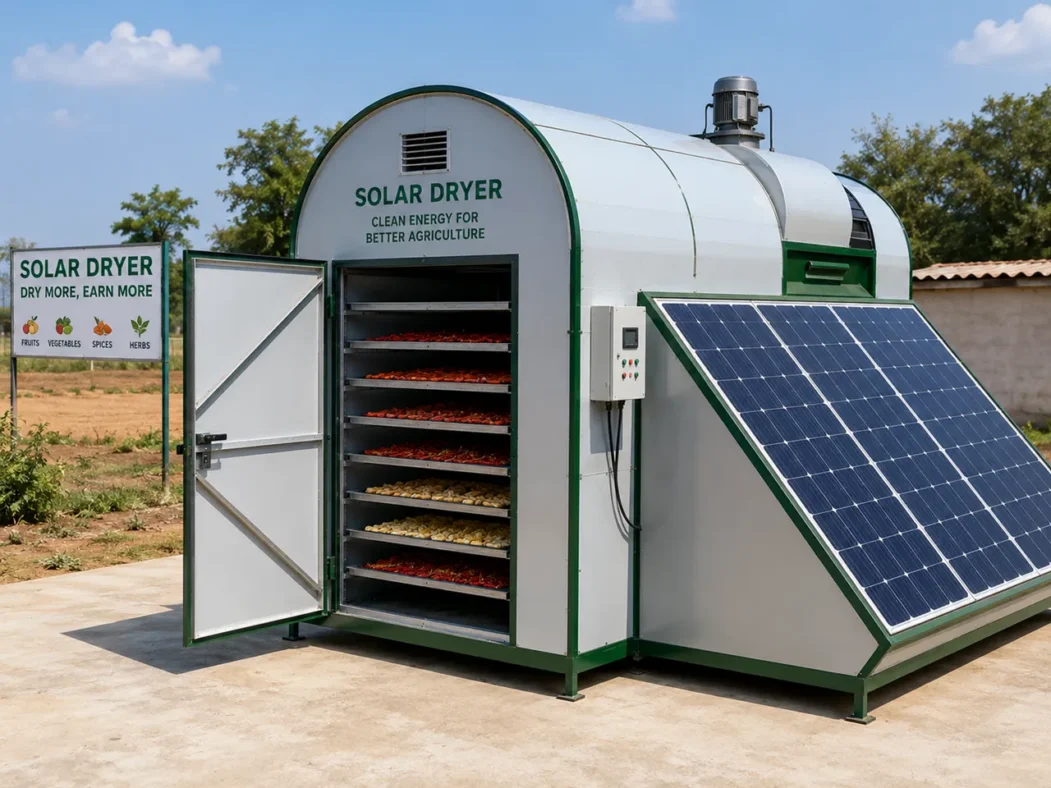
According to the tender requirements, a solar crop dryer will use solar thermal energy and/or solar PV-powered air circulation and control systems to provide controlled drying conditions for agricultural and horticultural products.
The selected agencies will be responsible for supplying complete systems, including:
- Drying chambers or tunnels
- Trays and racks
- Covers or glazing
- Structural frames
- Fans and blowers
- Sensors and controllers
- Solar PV modules
- Batteries, where applicable
Suppliers will also have to provide installation and maintenance manuals along with crop-wise standard operating procedures in Hindi and English.
Focus on Quality and Performance
The tender lays down several technical requirements for the systems.
For dryers with a capacity of 50 kg and above, forced-air circulation will be mandatory.
PV modules, inverters/controllers and batteries supplied as part of the systems will have to comply with applicable Indian Standards, BIS requirements and MNRE norms.
For systems with a capacity of 100 kg and above, the equipment must also include temperature and humidity displays along with data-logging capabilities, allowing users to monitor drying conditions and performance.
Pre-Dispatch Inspection and Warranty
BHDS has proposed a structured quality-control mechanism covering the procurement and operation of the solar dryers.
The process will include:
- Pre-dispatch inspection
- Field acceptance testing
- A 30-day hidden-defect observation period
- A 90-day performance observation period
At least 5% of supplied units, or a minimum of one unit per district/package, whichever is higher, may be selected for random inspection.
The tender requires suppliers to provide a minimum five-year comprehensive system warranty, while the structure must meet a minimum seven-year durability requirement.
Suppliers will also be responsible for preventive and corrective maintenance and service support throughout the warranty period.
Eligibility Criteria for Suppliers
Companies bidding for the programme must have at least three years of relevant experience and must have completed at least 25 installations during the previous five financial years.
The tender also requires an average annual turnover of at least ₹1 crore from relevant renewable-energy or agro-processing activities during the last three financial years.
Applicable relaxations have been provided for eligible MSMEs and startups.
Solar Energy Could Strengthen Rural Agri-Processing
The proposed solar dryer programme could help Bihar expand the use of renewable energy beyond electricity generation and irrigation into food processing and post-harvest management.
By providing controlled drying systems powered primarily through solar energy, the initiative could help farmers, SHGs and FPOs process agricultural produce locally while reducing dependence on conventional energy sources.
The availability of different dryer capacities also allows the programme to cater to individual farmers as well as larger rural processing and aggregation centres.
The initiative represents another step towards combining clean energy, agricultural value addition and rural entrepreneurship, potentially creating new opportunities for farmers and village-level enterprises across Bihar.
Author

About the Author