
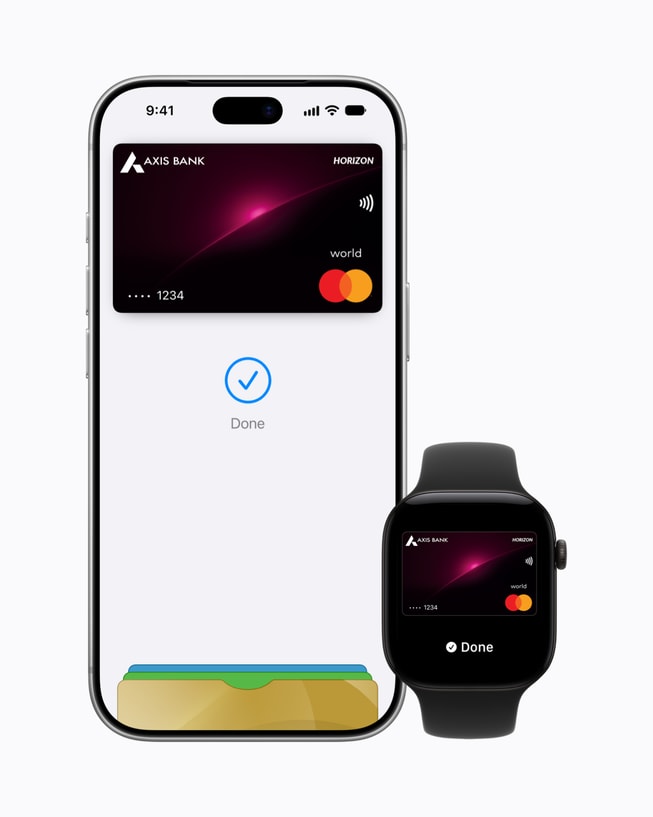
Apple has officially launched Apple Pay in India, bringing its digital payment service to one of the world’s largest and fastest-growing digital payments markets after years of speculation around an India rollout. The service became available in India on September 30, 2026, initially with support for eligible Axis Bank Visa and Mastercard credit cards.
The launch gives Indian iPhone, Apple Watch and iPad users a new way to make card payments without carrying a physical card. Instead of entering card details or using the physical card at a payment terminal, users can add an eligible Axis Bank credit card to Apple Wallet and authenticate transactions using Face ID, Touch ID or a device passcode.
Apple’s entry is significant because India is fundamentally different from many of the markets where Apple Pay has operated for years. The country’s payment ecosystem is heavily dominated by UPI, which enables consumers to make instant bank-account payments using QR codes, mobile numbers and other interfaces. Apple Pay’s Indian launch, however, is initially centred on the existing card ecosystem rather than UPI.
Apple Pay starts with Axis Bank
Axis Bank is the first Indian bank to officially support Apple Pay, allowing eligible customers with Visa and Mastercard credit cards to add their cards to Apple Wallet. The bank said customers can add their cards either through the Axis Bank mobile banking application or directly through Apple Wallet.
Once a card has been verified and added, customers can use Apple Pay across supported physical stores, apps and websites. Apple says the service works on iPhone, Apple Watch and iPad, while Mac support is expected to follow.
For in-store payments, users can authenticate on their Apple device and hold it near a compatible contactless payment terminal. On an iPhone with Face ID, the usual process involves double-clicking the side button, authenticating with Face ID and bringing the phone close to the contactless reader. Apple Watch users can double-click the side button and hold the watch near the terminal.
The service can also be used within participating applications and websites, allowing users to complete purchases without repeatedly entering card numbers, billing information or other payment details.
What happens to the physical card?
Apple Pay does not replace the underlying credit card. Instead, it creates a digital representation of the card that can be securely used through an Apple device.
When an eligible card is added, Apple Pay does not simply store the physical card number on the iPhone. Apple says it uses a device-specific number, while the actual card number is not stored on Apple’s servers or shared with merchants. Each transaction also uses a unique security code.
This process is known as tokenisation.
The basic idea is that the merchant does not receive the user’s actual card number during an Apple Pay transaction. Instead, the payment infrastructure receives information associated with the tokenised card and the particular device.
Apple says the payment credentials are protected through the device’s Secure Element and that transactions are authenticated using Face ID, Touch ID or a passcode.
Why Apple Pay’s India launch is different
Apple Pay’s global model generally revolves around adding payment cards to Apple Wallet and using those cards across physical and digital commerce.
India already has an enormous real-time payments ecosystem built around UPI.
That creates an unusual situation for Apple.
In many countries, Apple Pay can become the primary digital interface through which users access their bank cards. In India, consumers already have established payment habits around apps such as UPI-enabled banking and payment applications.
Reuters reported before the launch that Apple was initially pursuing a bank-by-bank rollout, with Axis Bank as the starting partner. The company had also been in discussions with HDFC Bank and ICICI Bank, although commercial terms had not been finalised at the time of the report.
The phased approach means Apple Pay’s availability will initially be narrower than its presence in mature Apple Pay markets.
No UPI integration at launch
One of the biggest questions surrounding Apple Pay in India has been whether Apple would integrate UPI directly into the service.
The initial Indian rollout does not include UPI functionality.
That means Apple Pay users cannot currently treat Apple Wallet as a replacement for their regular UPI apps for QR-based bank-account payments. The initial service is fundamentally a card-based payment system.
This distinction is important.
If a customer has an eligible Axis Bank credit card, Apple Pay can provide a convenient way to use that card through an iPhone or Apple Watch. But if the customer wants to make a normal UPI payment directly from a bank account, Apple Pay’s current Indian implementation does not provide that functionality.
Reports before the launch indicated that UPI support could require further technical and commercial arrangements involving India’s payments ecosystem. Apple has not announced UPI support as part of the current launch.
India remains overwhelmingly a UPI market
Apple’s entry comes at a time when UPI has become deeply embedded in India’s payment infrastructure.
Reuters reported that UPI accounted for roughly 84% of India’s digital payments volume, highlighting the scale of the challenge for any new payment interface entering the market.
UPI’s strength comes from its ability to connect bank accounts directly and enable payments through QR codes, mobile numbers and other interfaces. It is used across everything from large retailers and e-commerce platforms to small merchants, street vendors and service providers.
Apple Pay approaches the market from a different direction.
Rather than trying to replace the bank-account payment infrastructure underneath UPI, Apple’s initial strategy is to make existing credit-card payments easier to access through Apple devices.
That places Apple Pay closer to the contactless card ecosystem than to traditional UPI applications.
India’s credit-card market gives Apple another opportunity
While UPI dominates the broader digital payments landscape, India’s credit-card market has also expanded considerably.
Business Standard, citing RBI data, reported that India had around 124.05 million outstanding credit cards in August 2026, compared with 112.34 million a year earlier. Credit-card payment transactions during August stood at around 632.45 million, with transaction value of approximately ₹2.02 lakh crore.
This growing card base provides a potential market for Apple Pay.
The service is particularly relevant to consumers who already use credit cards and Apple devices and want a faster way to make contactless payments without taking the physical card out of their wallet.
The first major limitation is therefore not necessarily demand for digital payments, but the number of eligible cards and banks supported by Apple Pay.
More banks could follow
Axis Bank’s launch is being positioned as the first stage rather than the final form of Apple Pay in India.
The bank currently provides access to eligible Visa and Mastercard credit cards, while Apple has said additional banking partners are expected to be added over time.
Reuters previously reported discussions involving HDFC Bank and ICICI Bank, two of India’s major credit-card issuers. At the time, however, commercial agreements had not been finalised.
A broader bank rollout would significantly increase the number of Indian consumers who can actually use Apple Pay.
Until then, the service’s reach will depend heavily on the availability of eligible Axis Bank cards.
How to set up Apple Pay in India
For eligible Axis Bank customers, the setup process is relatively straightforward.
Users can open the Wallet app, tap the option to add a card and follow the verification process. Axis Bank also allows customers to initiate the process through its mobile banking application. Once the bank verifies the card, it becomes available for Apple Pay transactions.
The card continues to retain its existing rewards and benefits, according to Axis Bank and Apple’s India materials.
For an in-store purchase, the user can authenticate the transaction and bring the device close to a contactless payment terminal.
The merchant does not need to know the user’s actual card number for the Apple Pay transaction.
Apple Pay and NFC terminals
The Indian launch also puts greater attention on NFC-based contactless payments.
Unlike UPI’s familiar QR-code model, Apple Pay’s primary physical-store experience involves bringing an Apple device close to a compatible contactless terminal.
This means the availability of NFC-enabled point-of-sale terminals is an important part of the ecosystem.
The good news for Apple users is that Apple Pay does not require merchants to install a completely separate Apple-specific payment system. The service can work where contactless card payments are accepted.
That gives Apple Pay access to existing card acceptance infrastructure rather than requiring a new merchant network to be created from scratch.
Privacy and security are central to Apple’s pitch
Apple is also emphasising privacy and security as major elements of Apple Pay’s Indian launch.
According to Apple, the actual card number is not stored on the device or on Apple’s servers. Instead, a device-specific account number is used, while transaction-specific security information helps authorise individual payments.
Apple also says that it does not sell transaction data for third-party advertising or marketing.
If an iPhone is lost, users can use Find My to activate Lost Mode, which suspends Apple Pay functionality on the device. Apple also provides the ability to remotely erase payment cards from a lost device.
The approach allows Apple to integrate payment authentication into the device itself rather than requiring users to open a separate payments application for every transaction.
No additional Apple Pay fee for consumers
Apple says it does not charge consumers a separate fee for using Apple Pay in stores, online or within applications.
The underlying credit-card terms remain applicable, however. Any normal fees, interest charges, annual charges or other costs associated with the customer’s card continue to be determined by the issuing bank.
This means Apple Pay essentially acts as a digital payment interface layered over an existing credit card.
The customer continues to use the same card account and receives the associated rewards and benefits.
What Apple Pay could mean for the Indian payments market
The arrival of Apple Pay adds another layer to India’s rapidly evolving digital payments ecosystem.
Rather than competing directly with UPI on every transaction, the initial Apple Pay model is focused on digitising card payments for Apple users.
The distinction is particularly important because Indian consumers increasingly use multiple payment methods depending on the situation.
A consumer might use UPI for a QR payment at a local merchant, a credit card for a large purchase and Apple Pay to make that credit-card payment without physically carrying the card.
Apple Pay therefore becomes an additional interface through which an existing financial instrument can be used.
The bigger Apple ecosystem angle
For Apple, the Indian launch is also about expanding the functionality of its hardware ecosystem.
An iPhone becomes more useful when it can serve not only as a communication and computing device but also as a wallet. Apple Watch adds another layer by allowing users to make contactless payments from their wrist.
The company is effectively connecting hardware, Wallet, biometric authentication and card payments into a single experience.
Apple’s India website now explicitly promotes Apple Pay as a service for iPhone, Apple Watch and iPad users, with support for payments in stores, apps and online.
A new chapter for Apple’s India strategy
Apple Pay’s arrival comes after years of Apple expanding its presence in India across hardware, manufacturing, retail and services.
The company now has an official payments product in the country, but the initial rollout is deliberately focused.
Axis Bank is the first partner. Visa and Mastercard credit cards are supported. UPI is not part of the current launch. Additional banks and potentially broader functionality could determine how extensively Apple Pay develops in India.
For consumers, the immediate change is straightforward: eligible Axis Bank credit-card holders can now leave the physical card at home and use their Apple devices for supported contactless, in-app and online payments.
For India’s wider payments industry, the launch represents the entry of one of the world’s largest technology companies into a market where digital payments have already reached massive scale through a different architecture.
Apple Pay’s first phase in India, therefore, is less about replacing UPI and more about establishing Apple’s own payment layer on top of India’s expanding card and contactless infrastructure.
Disclaimer: This report has been editorially prepared using publicly available information and official company disclosures. Readers are advised to refer to official company announcements/disclosures for further details.
Author

About the Author