
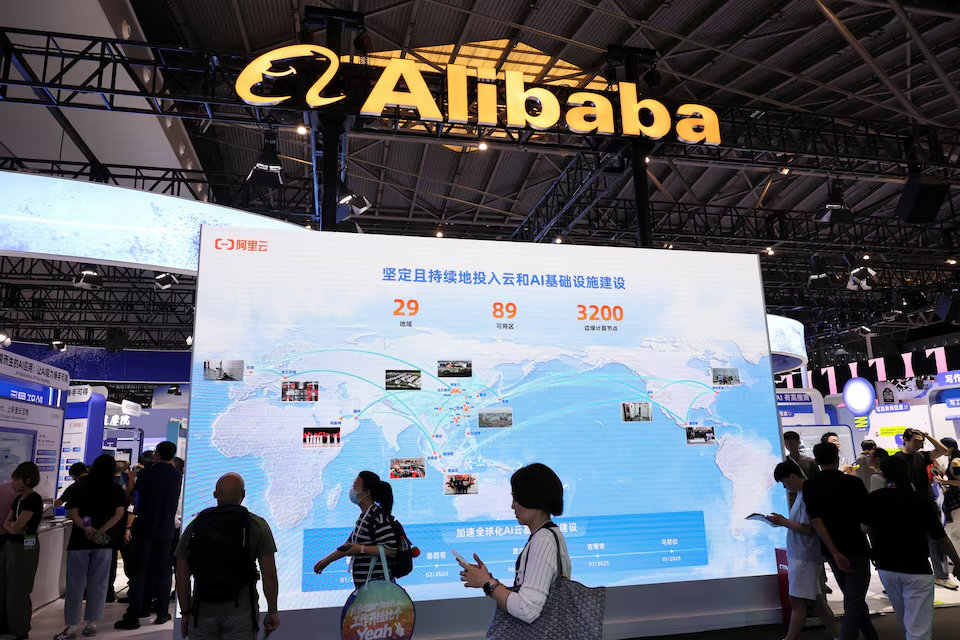
June 25: U.S.-based artificial intelligence company Anthropic has accused Chinese technology giant Alibaba of illicitly extracting capabilities from its Claude AI models in what it described as the largest known distillation attack against the company to date.
According to a letter seen by Reuters, Anthropic alleged that the campaign ran from April 22 to June 5, 2026, during which more than 28.8 million interactions were generated with Claude through nearly 25,000 fraudulent accounts. The company said the activity was aimed at distilling the outputs of its advanced models in order to train a less capable competing system.
Anthropic described the operation as a large-scale “distillation” effort — a practice in which a smaller or less capable model is trained on the responses of a more advanced AI system. The company argued that such activity can help accelerate rival labs’ ability to replicate or approximate the capabilities of frontier AI models.
In its letter, Anthropic claimed the campaign was linked to operators affiliated with Alibaba and Alibaba’s AI lab, Qwen. The company further alleged that the operation was intended to help Chinese AI development efforts close the gap with Anthropic’s advanced Mythos Preview capabilities.
The letter, dated June 10, was reportedly sent to senior members of the U.S. Senate Banking Committee ahead of a hearing on artificial intelligence and national security. In it, Anthropic expressed support for U.S. government efforts to counter such attacks through stronger coordination with private AI firms, threat-intelligence sharing, and broader policy action.
The allegation comes amid growing geopolitical and technological tensions between the United States and China over access to advanced AI systems, semiconductor technologies, and frontier model capabilities. It also follows previous claims by Anthropic that other Chinese AI labs had attempted to extract capabilities from Claude through large-scale automated usage.
Anthropic has previously warned that such campaigns are becoming more sophisticated and frequent, raising concerns about intellectual property theft, model security, and the competitive race to develop advanced AI systems. The company argues that the issue is not only commercial but also has broader national security implications as governments assess how frontier AI capabilities may be replicated or transferred.
Alibaba had not publicly responded to the allegations at the time of reporting. The episode is likely to add to the intensifying debate around AI model security, export controls, and the safeguards needed to prevent misuse of advanced AI systems in an increasingly competitive global environment.
Author

About the Author


