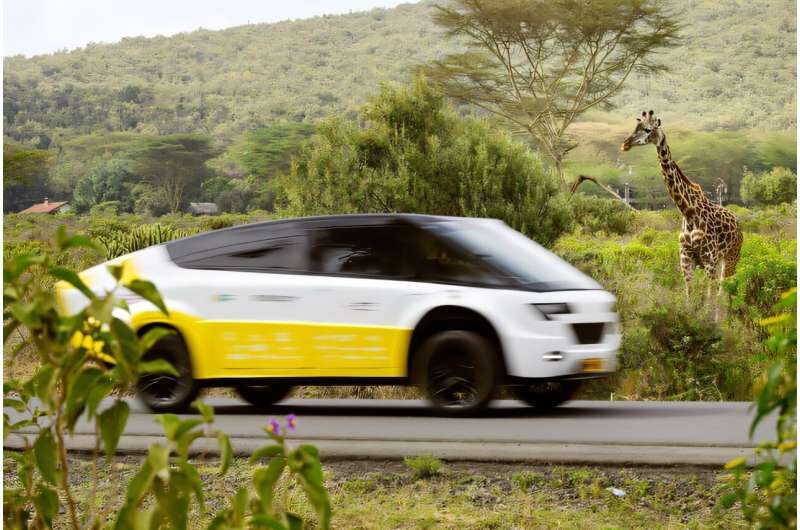
A student-led innovation from the Netherlands is demonstrating how renewable energy can help overcome one of the biggest barriers to healthcare access in remote communities: unreliable electricity and limited infrastructure. Solar Team Eindhoven, a team of 23 students from Eindhoven University of Technology, has successfully completed practical field tests of Stella Juva, a solar-powered ambulance designed to bring medical services directly to communities that are difficult to reach.
Developed in collaboration with international health organisation Amref Health Africa, Stella Juva is designed to operate independently of both the electricity grid and conventional fuel. During its field trials in Kenya, the vehicle generated more solar energy than it consumed while providing healthcare and powering its medical equipment.
Taking Healthcare Where Infrastructure Doesn’t Reach
Unlike a conventional ambulance, Stella Juva has been designed as a mobile healthcare facility, allowing medical professionals to travel directly to remote communities rather than requiring patients to make long journeys to reach healthcare centres.
The vehicle combines transportation with on-site medical capabilities, making it particularly relevant for regions where long distances, poor roads and unreliable electricity can restrict access to diagnosis and treatment.
Its solar-energy system includes roof-mounted solar panels, supplemented by extendable solar panels that can be deployed from the sides of the vehicle when it is stationary. The electricity generated is sufficient to support both the vehicle’s mobility and its medical equipment.
Tested Across More Than 800 Kilometres
The first major field trials were conducted around Kenya’s Narok region, exposing Stella Juva to the type of conditions in which it could eventually operate.
The vehicle travelled more than 800 kilometres across a combination of paved and unpaved roads. One particularly demanding journey involved approximately six hours of travel to reach the remote field location of Mosiro.
Despite the challenging terrain, the vehicle experienced only one significant mechanical problem—a broken steering rod—which the team replaced within approximately half an hour.
The successful journey provided an important real-world test of the vehicle’s reliability and ability to operate outside conventional road and infrastructure conditions.
Solar Power for Critical Medical Equipment
Stella Juva has been equipped with medical technologies that can be particularly valuable in remote healthcare settings, including:
- X-ray equipment
- Ultrasound
- Automated external defibrillator (AED)
- Vaccine cooling equipment
During a two-day test conducted with Amref Health Africa, the vehicle demonstrated that it could potentially support healthcare services for approximately 200 people.
One of the most significant findings came while the ambulance was stationary. With its medical equipment operating simultaneously, Stella Juva was still able to generate more solar energy than it consumed.
This demonstrated the vehicle’s ability to provide medical services without depending on an external electricity connection or fuel supply.
Potential Impact on Maternal and Child Healthcare
The implications could be particularly significant for maternal and child health.
According to Geoffrey Sadera, Project Lead for Maternal and Child Health at Amref Health Africa, communities in Narok continue to face difficulties accessing quality healthcare because of long distances and unreliable electricity.
A mobile, energy-independent healthcare unit could allow health workers to conduct diagnostic services directly within communities.
For example, a single outreach could potentially provide ultrasound examinations to 30–40 pregnant women without requiring them to travel to distant healthcare facilities.
The potential need extends beyond Narok. Sadera noted that approximately one-third of Kenya’s counties face similar challenges, including significant maternal and child health concerns.
By bringing diagnostic equipment and reliable power directly to underserved communities, vehicles such as Stella Juva could potentially help healthcare workers identify risks earlier and intervene sooner.
Where Clean Energy Meets Social Impact
The project represents a broader approach to sustainable innovation—using renewable energy not merely to reduce emissions, but to address a fundamental social challenge.
For remote communities, the problem is often interconnected: healthcare facilities may be far away, roads may be difficult to navigate, electricity may be unreliable and transporting fuel can be expensive or impractical.
Stella Juva attempts to address several of these barriers simultaneously by combining mobility, renewable energy and medical infrastructure in one platform.
The successful Kenyan trials therefore represent more than a demonstration of solar-powered transportation. They show how clean-energy technology can potentially become an enabler of essential public services in locations where conventional infrastructure is difficult to establish.
From Student Project to Scalable Solution
For Solar Team Eindhoven, the Kenya trials represent an important first step towards determining whether the concept can eventually be deployed at a larger scale.
Team Manager Mathijs van Gerven said the project demonstrated the potential of combining sustainable mobility with fully independent healthcare delivery, particularly in areas where access to energy is limited.
The team now hopes that companies, governments and social organisations will explore opportunities to further develop and deploy the technology.
The bigger question is no longer simply whether a solar-powered ambulance can work. After successfully travelling through challenging Kenyan terrain and powering medical equipment using the sun, Stella Juva has provided an early demonstration that renewable energy can support mobile healthcare even far from the electricity grid.
If such systems can be made affordable, durable and scalable, the model could offer a new way of reaching communities where traditional healthcare infrastructure remains difficult to provide.
Stella Juva ultimately represents a convergence of clean mobility, renewable energy and healthcare access—showing how sustainability can be designed not just around reducing environmental impact, but around improving people’s access to essential services.
Author

About the Author