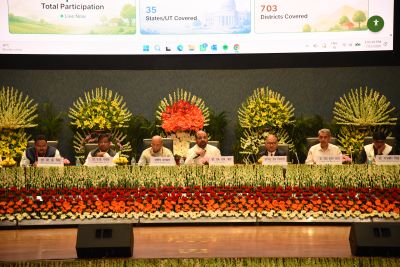

Corporate Social Responsibility (CSR) in India needs to move beyond simply measuring how much money companies spend and focus more strongly on the impact, outcomes and lasting value created for communities, said Gyaneshwar Kumar Singh, Director General and CEO of the Indian Institute of Corporate Affairs (IICA).
Singh made the remarks while addressing the inauguration of the 11th Batch of the IICA Certified CSR Professional Programme (ICPCSR) on August 21, 2026. The virtual session brought together 45 professionals representing Central Public Sector Enterprises (CPSEs), corporates, government institutions, academia and civil society.
India’s CSR Spending Crosses ₹1.44 Lakh Crore
Highlighting the scale of India’s CSR ecosystem, Singh referred to figures presented before Parliament showing that companies spent ₹34,908.75 crore on CSR during FY 2023-24.
Cumulative CSR expenditure between FY 2019-20 and FY 2023-24 exceeded ₹1,44,159 crore, reflecting the growing role of corporate resources in supporting social and development priorities across the country.
However, Singh stressed that the next phase of CSR should focus less on expenditure figures and more on what those investments actually achieve on the ground.
Focus Needed on Underutilised CSR Areas
Singh also called for greater attention to relatively underutilised areas under Schedule VII of the Companies Act, including women’s empowerment, innovation, and art and culture.
He highlighted the potential of technology and data to improve transparency and coordination between corporates, implementing agencies and communities. Platforms such as the CSR Exchange Portal can play an important role in strengthening information-sharing and accountability across the CSR ecosystem.
According to Singh, strengthening the capabilities of implementing agencies is equally important because the quality of execution ultimately determines whether CSR investments translate into meaningful and lasting outcomes.
He also emphasised the need to develop a strong pool of professionally trained CSR specialists who can bring greater discipline, accountability and outcome orientation to CSR programmes.
Coal Sector Highlights Importance of Community Needs
Speaking at the event, Rupinder Brar, Additional Secretary, Ministry of Coal, said meaningful CSR should begin with understanding what communities actually need.
She highlighted the importance of sound project design, capable implementation partners and rigorous monitoring to ensure that CSR initiatives deliver tangible improvements in people’s lives.
Brar also called for stronger capacity building among implementing agencies and greater use of social audit mechanisms to assess whether projects are producing the intended results.
She acknowledged IICA’s collaboration with the Ministry of Coal in developing a comprehensive CSR framework for the sector, incorporating measurable outputs and outcomes.
CPSEs Continue to Play a Major CSR Role
Lucas L. Kamsuan, Joint Secretary, Department of Public Enterprises (DPE), Ministry of Finance, highlighted the significant contribution of CPSEs to India’s CSR landscape.
CPSEs have played an important role in directing corporate resources towards social development and national priorities, making stronger CSR frameworks and outcome measurement particularly relevant for the sector.
Training the Next Generation of CSR Professionals
The nine-month IICA Certified CSR Professional Programme is designed to build specialised capabilities across the CSR ecosystem.
According to Dr. Garima Dadhich, Head of the School of Business Environment (SBE), IICA and Programme Director, the programme will be delivered through weekly live sessions led by an interdisciplinary faculty comprising academicians, policymakers and practitioners.
The programme covers seven modules, including CSR’s legal and regulatory framework, governance, project planning, impact assessment, reporting, ESG and the Social Stock Exchange.
The inauguration of ICPCSR Batch 11 reinforces IICA’s focus on developing professionals capable of designing CSR programmes that are transparent, accountable, measurable and outcome-oriented.
As India’s CSR spending continues to grow, the discussion points towards a broader shift in the sector — from asking “How much was spent?” to asking “What changed because of it?”
Author

About the Author