TNGECL submits DPR for one of India’s largest renewable energy projects.
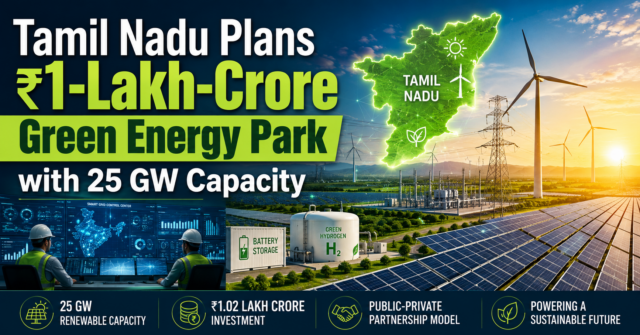
Chennai, 22 June: Tamil Nadu Green Energy Corporation Limited (TNGECL) has proposed a massive 25 GW Integrated Green Energy Park with an estimated investment of ₹1.02 lakh crore, positioning the state among India’s leading renewable energy hubs. The Detailed Project Report (DPR) has been submitted to the state government, which is expected to formally announce the project during the ongoing Budget session.
The proposed renewable energy park will be developed across non-agricultural land in southern and western Tamil Nadu, particularly in parts of Ramanathapuram, Thoothukudi, Tirunelveli, and Karur districts, identified for their high solar irradiation potential.
Spread over an estimated 1 lakh to 1.25 lakh acres, the project is expected to require approximately four to five acres of land for every megawatt of installed solar capacity. The investment will cover both renewable power generation facilities and associated transmission infrastructure.
The project is proposed to be implemented through a Public-Private Partnership (PPP) model via a Special Purpose Vehicle (SPV). Under the plan, project land will be leased for 30 years, providing long-term certainty for investors while generating a stable revenue stream for the state.
According to officials, the mega project is designed to strengthen Tamil Nadu’s long-term energy security, support industries in meeting their Renewable Purchase Obligation (RPO) targets, and reduce exposure to volatility in global fossil fuel markets.
Five-Phase Development Plan
The integrated green energy park is expected to be developed in five phases, adding 5,000 MW annually.
The first phase will focus on land aggregation, establishment of pooling substations, grid connectivity, and commissioning of the initial 5 GW capacity. Subsequent phases will expand transmission infrastructure, integrate the project with the State Transmission Utility (STU) network, and connect it to the Inter-State Transmission System (ISTS).
Advanced grid management technologies, including micro-grid optimisation, power balancing systems, and real-time telemetry infrastructure, are planned in later stages to ensure efficient operations and grid stability.
The final phase will involve commissioning the remaining capacity, complete system integration, and network stabilisation.
Boost to Tamil Nadu’s Green Energy Ambitions
TNGECL has also sought support from the government to utilise existing single-window clearance mechanisms through industrial agencies such as SIPCOT and TIDCO for aggregating suitable government-owned non-agricultural land.
If approved, the project would rank among the largest renewable energy developments in India and significantly contribute to Tamil Nadu’s clean energy ambitions, industrial growth, and transition towards a low-carbon economy.
The proposed 25 GW Green Energy Park is expected to play a pivotal role in meeting future electricity demand while accelerating the state’s journey toward becoming a leading renewable energy destination in the country.
Author

About the Author