
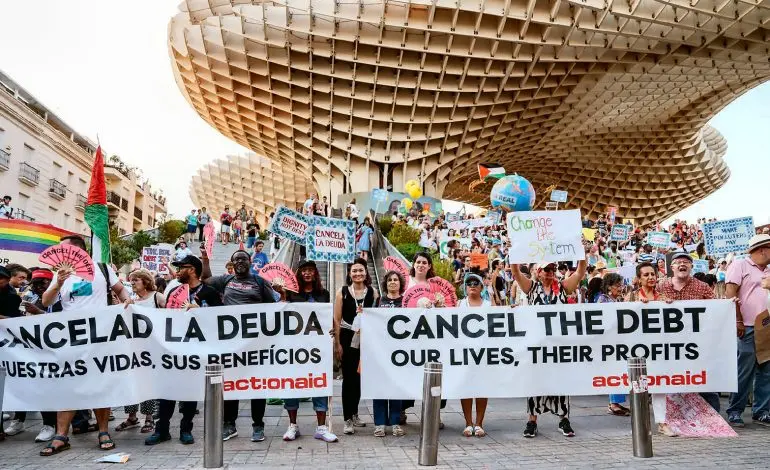
A coalition of international non-governmental organisations (NGOs) has criticised the International Monetary Fund (IMF), alleging that its lending policies continue to prioritise debt repayments over social development in low- and middle-income countries, particularly across Africa.
The report, jointly published by ActionAid, Education International and the Tax and Education Alliance, argues that despite the IMF’s evolving public messaging on inequality, social protection and gender inclusion, its policy recommendations have remained largely unchanged in practice.
Report Examines IMF Advice Across African Countries
The coalition analysed IMF policy recommendations issued over a three-year period for 11 countries, including Ghana, Kenya, Malawi, Nigeria, Zambia, Zimbabwe, Uganda and Senegal.
According to the report, although the IMF has increasingly acknowledged issues such as inequality and the importance of protecting vulnerable communities, the NGOs contend that these commitments have not translated into meaningful policy changes.
The report argues that IMF programmes continue to place strong emphasis on fiscal consolidation and debt repayment without adequately addressing the structural causes of recurring debt crises.
Concerns Over Social Spending
The coalition claims that IMF policy advice does not sufficiently assess the trade-offs between debt servicing and investments in essential public services such as healthcare and education.
According to the report, in seven of the eight African countries examined, government spending on debt servicing exceeded expenditure on healthcare. It also notes that IMF assessments did not compare external debt repayments with spending on health or education.
The organisations further argue that debt restructuring measures have often been delayed or insufficient, leaving several countries vulnerable to continued debt distress.
Criticism of Austerity Measures
The report also questions the IMF’s recommendations on public sector spending, stating that advice to contain public sector wage bills can adversely affect healthcare and education systems, particularly in countries already facing staff shortages.
The coalition further argues that the IMF’s approach to social protection relies heavily on targeted assistance programmes rather than broader investments in public services.
On taxation, the report says the IMF’s benchmark for tax-to-GDP ratios is inadequate for enabling countries to finance long-term development goals and public services.
Calls for Structural Reform
The NGOs have called for broader reforms to the global financial system, including fairer debt restructuring mechanisms and greater international cooperation to address sovereign debt challenges.
The report also references proposals discussed during the Fourth International Conference on Financing for Development (FfD4) in Seville in 2025, where several African countries advocated reforms to the global debt architecture.
According to the coalition, international financial institutions should place greater emphasis on sustainable development, public investment and social welfare alongside fiscal stability.
The IMF has consistently maintained that its lending programmes are designed to preserve macroeconomic stability while protecting vulnerable populations, and has in recent years highlighted increased attention to social spending, tax reforms and gender inclusion within its policy framework.
Author

About the Author