
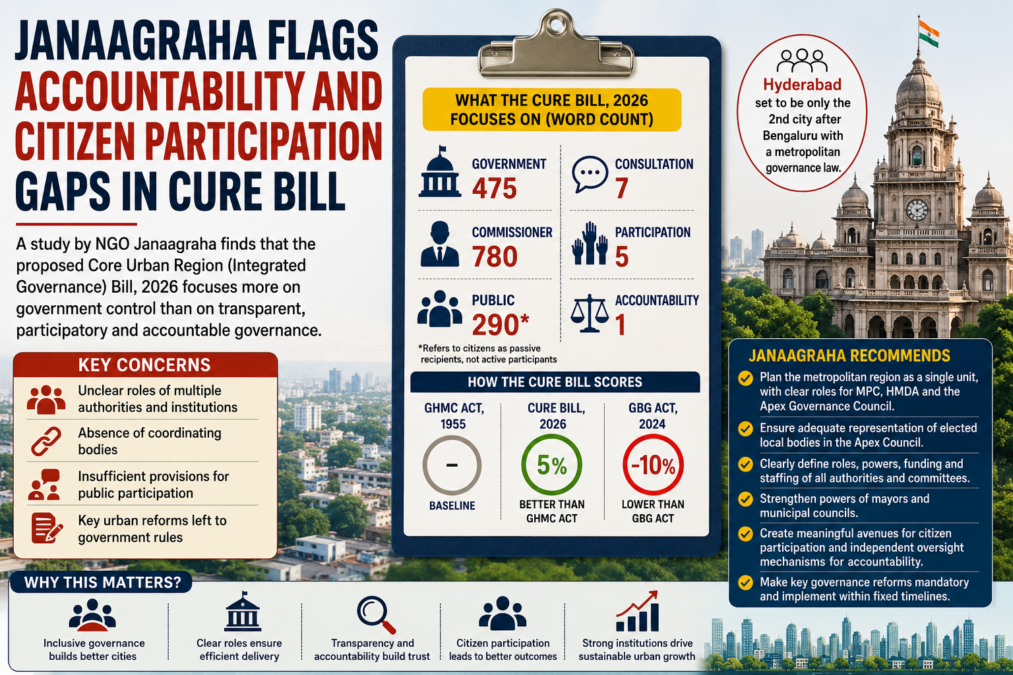
Urban governance advocacy organisation Janaagraha has raised concerns over the proposed Core Urban Region (Integrated Governance) Bill, 2026 (CURE Bill), stating that the legislation provides limited emphasis on transparency, accountability and citizen participation while concentrating greater authority within government institutions.
Addressing a press conference on Tuesday, Janaagraha representatives Anita Kumar, V.R. Vachana and Srikara Prasad, who were part of the study team, presented an assessment of the 271-page Bill and compared it with the Greater Hyderabad Municipal Corporation (GHMC) Act, 1955 and the Greater Bengaluru Governance (GBG) Act, 2024.
According to Janaagraha’s analysis, the language used throughout the proposed legislation reflects a stronger focus on administrative structures than on participatory governance. The organisation noted that the word “government” appears 475 times, while “commissioner” is mentioned 780 times in the Bill.
In contrast, terms associated with democratic governance appear far less frequently. The word “consultation” is used seven times, “participation” appears five times, and “accountability” is mentioned only once.
Although the word “public” occurs 290 times, Janaagraha argued that it largely refers to citizens as recipients of government services rather than as active participants in decision-making and urban governance.
The organisation evaluated the three legislations across five key parameters—city planning, powers of elected representatives, transparency and accountability, citizen participation, and institutional effectiveness.
Based on this assessment, Janaagraha said the proposed CURE Bill performs 5% better than the decades-old GHMC Act but scores 10% lower than the recently enacted Greater Bengaluru Governance Act, 2024, suggesting that there remains considerable scope for strengthening the proposed framework.
While welcoming the introduction of a dedicated metropolitan governance law for Hyderabad, Janaagraha acknowledged that the city would become only the second Indian metropolitan city after Bengaluru to have such legislation.
However, the organisation identified several shortcomings that, in its view, require further refinement before implementation.
Among the key concerns raised were the lack of clearly defined responsibilities for newly proposed authorities and institutions, the absence of effective coordination mechanisms, and insufficient provisions to facilitate meaningful public participation in governance processes.
Janaagraha also observed that many critical aspects of urban governance reforms have been left to be determined through future government rules instead of being explicitly incorporated into the legislation itself. The organisation argued that embedding these provisions directly within the law would provide greater certainty, consistency and accountability.
To strengthen the Bill, Janaagraha recommended that the Hyderabad metropolitan region be planned and governed as a single integrated urban unit, with clearly delineated responsibilities for key institutions including the Metropolitan Planning Committee (MPC), the Hyderabad Metropolitan Development Authority (HMDA) and the proposed Chief Minister-led Apex Governance Council.
The organisation further suggested that elected representatives from local urban bodies should receive adequate representation within the Apex Governance Council to ensure that metropolitan planning and implementation remain democratically accountable and responsive to local needs.
Janaagraha also recommended that the legislation clearly define the roles, powers, funding arrangements and staffing structures of the more than 15 authorities, committees and specialised cells proposed under the Bill. According to the organisation, greater clarity would help minimise overlaps, improve institutional coordination and strengthen accountability.
The study additionally called for enhanced powers for mayors and municipal councils, arguing that stronger local leadership is essential for effective urban governance and service delivery.
It also advocated the creation of meaningful mechanisms for citizen participation, enabling residents to play a more active role in planning, monitoring and evaluating urban development initiatives.
To improve governance oversight, Janaagraha recommended establishing independent accountability mechanisms capable of monitoring institutional performance and ensuring transparency in decision-making.
The organisation further urged that major governance reforms proposed under the legislation should be made mandatory and implemented within clearly defined timelines, rather than being left to future administrative discretion.
The proposed CURE Bill seeks to create an integrated governance framework for Hyderabad’s rapidly expanding metropolitan region. As discussions continue, feedback from civil society organisations, urban planners and public representatives is expected to contribute to refining the legislation before its implementation.
Disclaimer: This report has been editorially prepared using publicly available information and official statements. Readers are advised to refer to the official text of the Core Urban Region (Integrated Governance) Bill, 2026, and related government notifications for complete details.
Author

About the Author