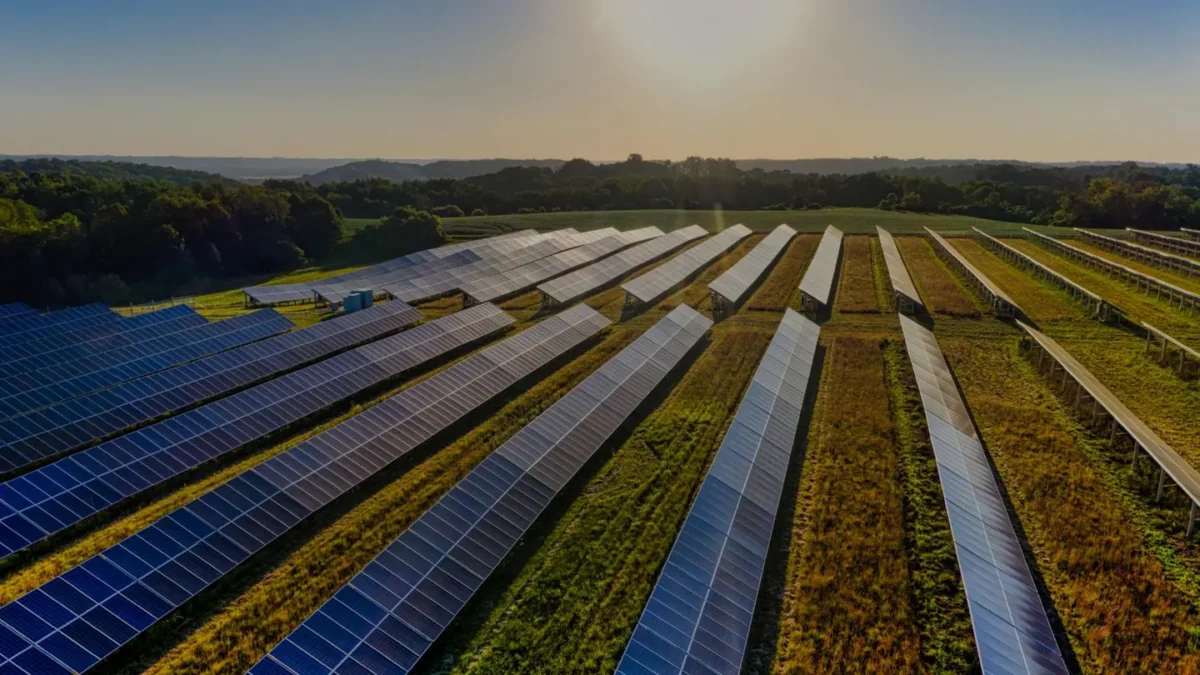
The Union Cabinet has approved the third phase of the Green Energy Corridor (GEC-III) with a total investment of ₹1,86,405 crore, marking a major expansion of India’s power transmission infrastructure to support the country’s rapidly growing renewable-energy capacity.
The programme will strengthen intra-state transmission networks across states and Union Territories, enabling the evacuation of up to 135 GW of renewable energy. It will involve the development of 51,126 circuit kilometres of transmission lines and nearly 229 GVA of transformation capacity, creating additional infrastructure to move electricity from renewable-energy generation centres to the wider grid and ultimately to consumers.
The approval comes as India’s solar and wind capacity continues to expand, while transmission constraints have emerged as an increasingly important challenge for integrating renewable power. When adequate transmission capacity is unavailable, electricity generated from renewable projects may have to be curtailed even when generation potential is available.
₹1.86 Lakh Crore Investment for Transmission and Storage
The total outlay of ₹1,86,405 crore will be divided between transmission infrastructure and battery storage.
Around ₹1,36,378 crore has been earmarked for developing and strengthening intra-state transmission systems, while another ₹50,000 crore will support the deployment of 50 GWh of Battery Energy Storage Systems (BESS).
The programme is planned for implementation over seven years and is targeted for completion by FY 2032–33.
The government will provide ₹54,082 crore in Central Financial Support under the scheme. The financial assistance is intended to help offset intra-state transmission charges and limit the impact of additional transmission costs on electricity consumers.
50 GWh Battery Storage to Improve Grid Flexibility
A major feature of GEC-III is the inclusion of a dedicated battery-storage component.
The scheme will facilitate the deployment of 50 GWh of BESS at renewable-energy generation sites or other locations considered important for grid flexibility.
Battery storage can absorb electricity during periods when renewable generation is high and release it when electricity demand rises or renewable generation falls.
This is particularly important for solar power, which produces electricity primarily during daylight hours while demand can remain significant after sunset.
The storage infrastructure is therefore expected to help manage intermittency, reduce congestion, address peak-hour curtailment and support electricity demand during non-solar hours.
Transmission Expansion to Support 135 GW of Renewable Energy
The transmission component of GEC-III is designed to create the infrastructure required to connect a larger volume of renewable generation to India’s electricity grid.
The planned 51,126 circuit kilometres of transmission lines will strengthen networks within states and Union Territories, while nearly 229 GVA of transformation capacity will provide additional capacity for transferring electricity across the network.
This expansion is particularly important because India’s renewable resources are not evenly distributed geographically. Large solar and wind projects are concentrated in areas with strong renewable-energy potential, while major electricity consumption centres may be located elsewhere.
An expanded transmission network can help bridge this geographical gap by allowing renewable electricity to travel from generation centres to areas where it is needed.
Renewable Energy Curtailment Remains a Challenge
The expansion of GEC-III comes amid concerns over renewable-energy curtailment.
Curtailment occurs when renewable electricity that could otherwise be generated is reduced or rejected because the grid does not have sufficient transmission capacity or flexibility to absorb it.
More than 8,000 GWh of renewable energy was reportedly curtailed during the first quarter of FY 2026–27, highlighting the scale of the challenge as renewable generation expands.
GEC-III is intended to address part of this problem by developing transmission capacity alongside additional energy-storage infrastructure.
Greenfield Projects to Be Awarded Through Competitive Bidding
The government has divided the transmission programme between new infrastructure and upgrades to existing networks.
Around 70% of the scheme will consist of greenfield projects, involving the construction of new transmission infrastructure. These projects will be awarded through Tariff-Based Competitive Bidding.
Under this model, transmission service providers will be responsible for building, owning, operating and maintaining the assets.
The remaining 30% will consist of brownfield projects, involving upgrades and strengthening of existing transmission networks. These projects will be implemented on a cost-plus basis, under which the project cost and an approved return are recovered through regulated tariffs.
State Transmission Utilities will serve as the overall implementing agencies.
Government Sets Up Multi-Level Monitoring
The government has also established a monitoring structure to track the implementation of the programme and reduce the possibility of project delays.
A project monitoring committee headed by a Joint Secretary will regularly review progress. The Secretary of the Ministry of New and Renewable Energy will also conduct reviews every three months.
At the highest level, a steering committee headed by the Cabinet Secretary will review the implementation of GEC-III every six months.
The mechanism will also monitor projects remaining under the earlier phases of the Green Energy Corridor.
Earlier Green Energy Corridor Projects Continue
GEC-III builds on the transmission infrastructure created under the first two phases of the programme.
The government expects the remaining projects under GEC-I to be completed by the end of the current financial year, while projects under GEC-II are expected to be completed by March 2028.
The third phase therefore expands the programme at a time when India’s renewable-energy capacity is increasing rapidly and the power system requires greater transmission and storage capabilities.
Battery Storage Linked to Domestic Manufacturing
The government is also seeking to use the BESS component to encourage the development of India’s domestic energy-storage industry.
Battery-storage deployment under the scheme will be linked to Domestic Content Requirements (DCR).
Technical consultations will be conducted to establish guidelines determining the components and equipment that will need to meet domestic-content requirements.
The move is intended to encourage greater domestic manufacturing of battery-storage components and strengthen India’s supply chain for grid-scale energy storage.
Supporting India’s Long-Term Renewable Energy Goals
The Green Energy Corridor is an important part of India’s broader strategy to integrate renewable energy into the national electricity system.
The country is targeting 500 GW of non-fossil-fuel-based installed power capacity by 2030, while its longer-term plans envisage continued expansion of clean-energy generation.
Achieving these targets requires more than simply adding solar panels and wind turbines. Transmission lines, substations, energy-storage systems and grid-management technologies are increasingly important for ensuring that renewable electricity can actually reach consumers.
GEC-III addresses these requirements by combining large-scale transmission expansion with battery storage.
Infrastructure Push Could Strengthen Clean Energy Integration
The ₹1.86 lakh crore programme represents a significant investment in the infrastructure required to support India’s energy transition.
With 51,126 circuit kilometres of transmission lines, nearly 229 GVA of transformation capacity and 50 GWh of battery storage, GEC-III is expected to improve the ability of state grids to absorb renewable electricity while providing additional flexibility during periods of changing generation and demand.
The programme could also create demand for equipment manufacturers, construction companies, transmission developers, battery-storage providers and skilled professionals involved in grid operations and maintenance.
As renewable-energy generation continues to expand, the success of India’s clean-energy transition will increasingly depend on how effectively generation, transmission and storage are developed together.
Disclaimer: This report has been editorially prepared using publicly available information and official statements. Readers are advised to refer to official announcements for further details.
Author

About the Author