
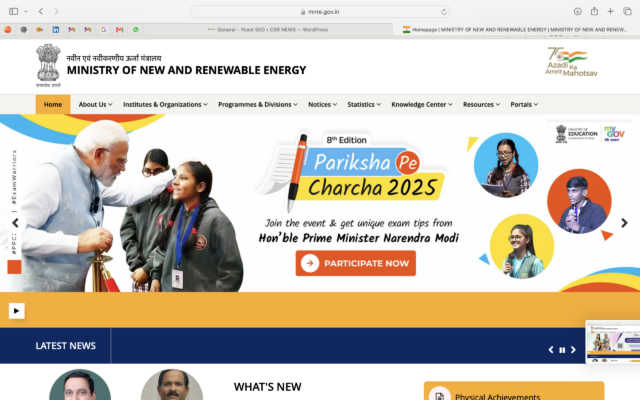
SCREENSHOT OF MINISTRY OF NEW AND RENEWABLE ENERGY
New Delhi, 6 July: At a time when the Government of India is aggressively promoting Digital India and positioning itself as a global leader in renewable energy, the official website of the Ministry of New and Renewable Energy (MNRE) appears to be sending a contradictory message. A visit to the ministry’s homepage reveals several promotional banners highlighting programmes and events that concluded months—or even years—ago, yet continue to rotate prominently on the homepage as if they are current.
For a ministry that serves as the nodal agency for India’s clean energy mission, the website is often the first point of contact for citizens, investors, researchers, startups, students, and international stakeholders. The presence of expired campaigns on the homepage not only creates confusion but also raises concerns about the maintenance and governance of official government digital platforms.
Outdated Campaigns Still on Display
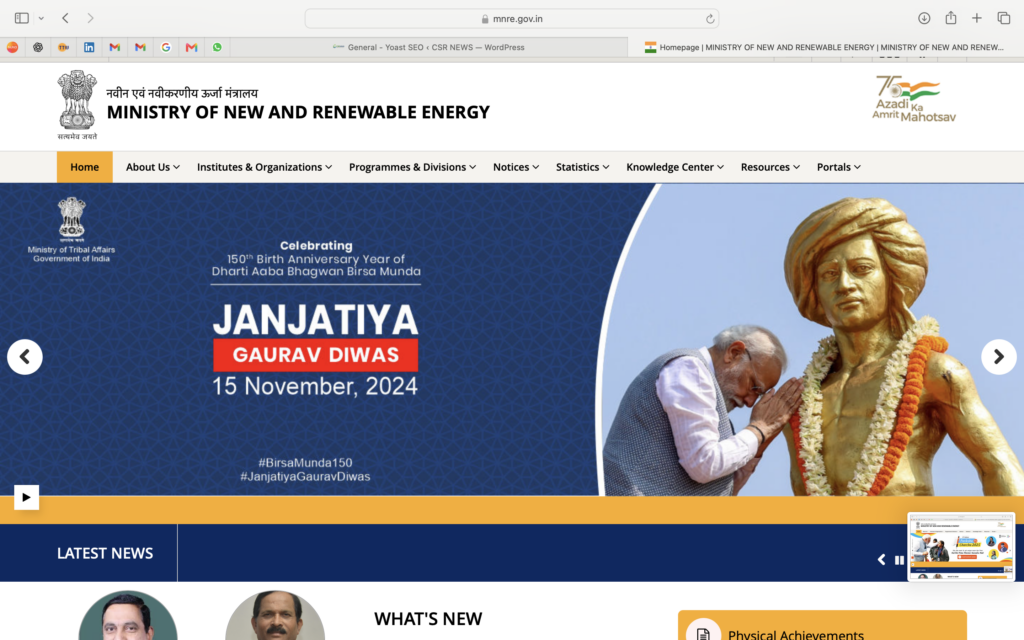
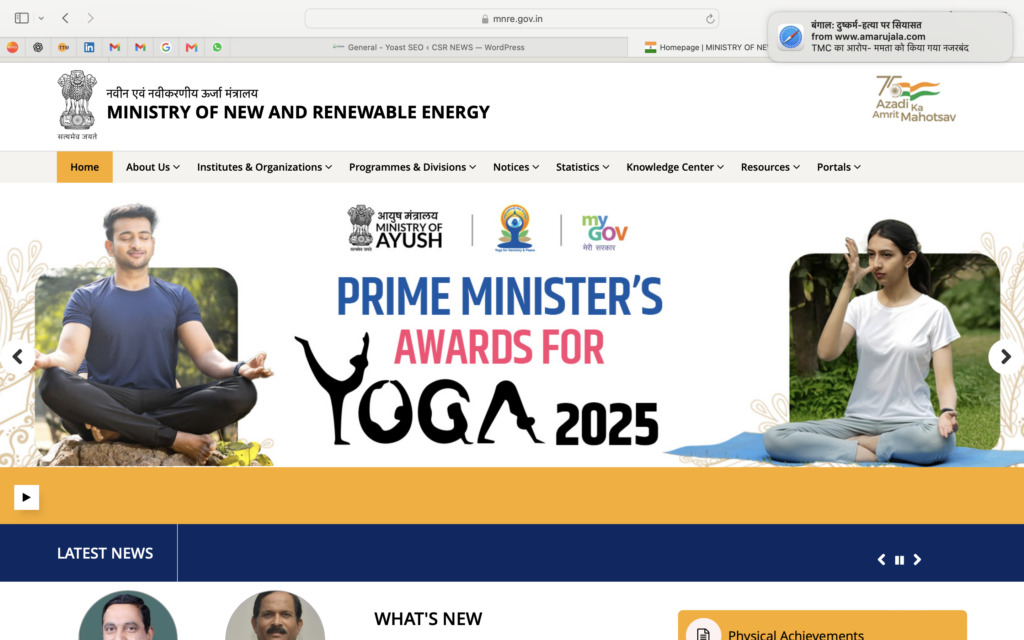
During a review of the MNRE homepage, several banners were found promoting events whose scheduled dates have already passed. Among them are:
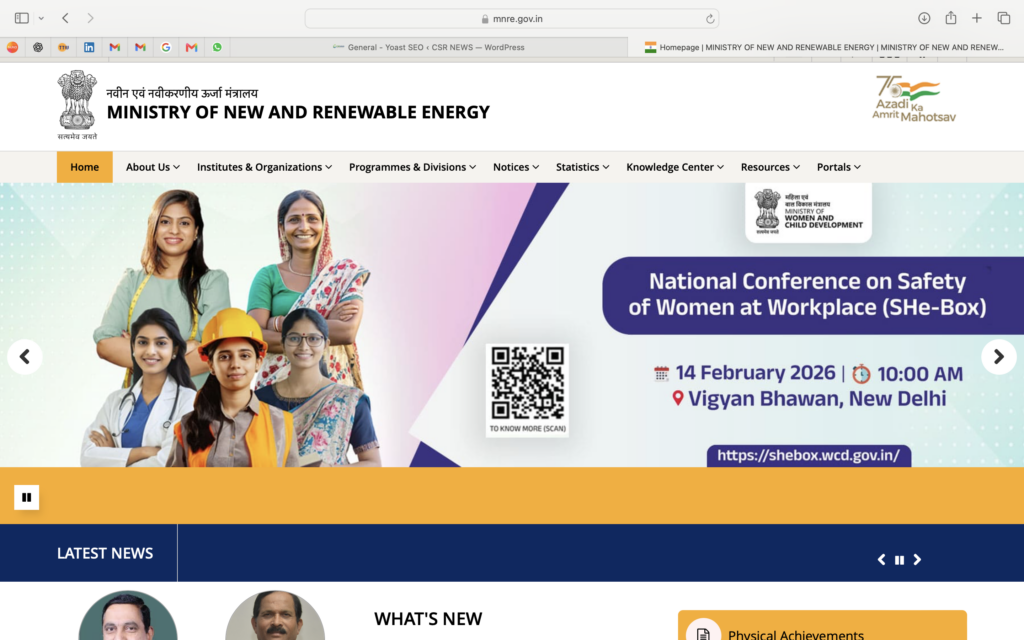
- National Conference on Safety of Women at Workplace (SHe-Box) scheduled for 14 February 2026, still appearing as an active homepage banner.
- Pariksha Pe Charcha 2025, an event conducted in early 2025, continues to occupy promotional space.
- Janjatiya Gaurav Diwas – 15 November 2024, despite being nearly two years old, remains visible.
- Prime Minister’s Awards for Yoga 2025, another concluded programme, is still displayed.
- Swachhata Hi Seva 2024, a nationwide cleanliness campaign completed long ago, also continues to rotate on the homepage.
The screenshots reviewed by CSR NEWS indicate that these banners are part of the homepage carousel, giving visitors the impression that they are still relevant or ongoing.
Mixed Signals Despite Updated Sections
Interestingly, while the homepage carousel displays old promotional material, other sections of the website are regularly updated.
The “What’s New” and “Current Notices” sections include recent notifications issued during June 2026, such as revised wind turbine guidelines, bid document uploads, and updates related to renewable energy policies. (Ministry of New and Renewable Energy)
This suggests that although official documents and policy notices are being updated, the visual communication presented on the homepage has not received similar attention.
Why It Matters
Government websites are more than repositories of documents—they represent the government’s digital identity.
For ministries handling strategic sectors like renewable energy, websites serve multiple stakeholders:
- Domestic and international investors
- Renewable energy developers
- Researchers and academic institutions
- Students
- State governments
- Industry associations
- Citizens seeking information on schemes and programmes
When outdated campaigns continue appearing on the homepage, users may struggle to distinguish between current opportunities and historical events. It can also reduce confidence in the timeliness of information presented online.
Digital Governance Is Also Good Governance
India has invested significantly in Digital India initiatives and regularly promotes transparency, accessibility, and ease of doing business through digital platforms. Maintaining accurate government websites forms an essential part of that commitment.
Regular housekeeping of homepage banners requires relatively limited effort compared to the broader task of maintaining policy databases, yet it has a significant impact on user experience.
Experts in digital governance often recommend:
- Removing expired event banners immediately after completion.
- Highlighting ongoing schemes and active programmes.
- Featuring current policy announcements and citizen services.
- Conducting periodic content audits across ministry websites.
- Ensuring homepage content reflects real-time priorities.
Opportunity for Improvement
The issue does not appear to stem from a lack of updates across the website. Rather, it reflects inconsistency between active policy content and the homepage’s visual presentation.
Given MNRE’s central role in driving India’s renewable energy transition—including initiatives related to solar power, green hydrogen, wind energy, rooftop solar, and energy storage—the ministry’s digital interface should ideally mirror the same level of efficiency and innovation that it promotes through its policies.
As India moves toward ambitious renewable energy targets and greater digital governance, keeping official websites accurate, current, and user-friendly is not merely an administrative task—it is an important element of public accountability and effective communication. (Ministry of New and Renewable Energy)
Author

About the Author


