
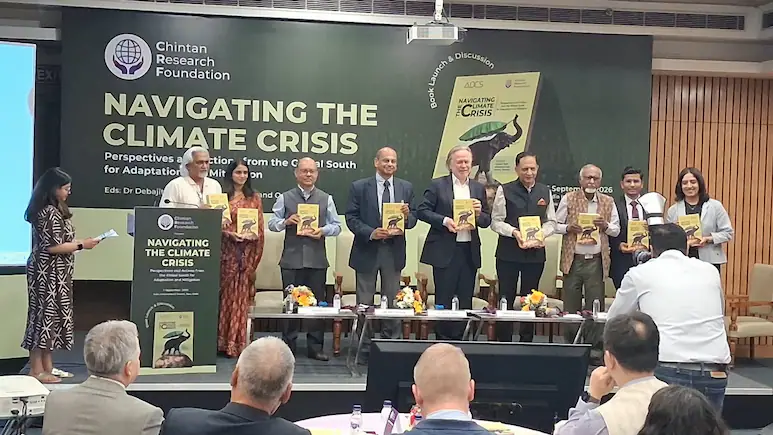
Against the backdrop of growing concerns over the accelerating impacts of climate change and the increasing vulnerability of Himalayan ecosystems, the Chintan Research Foundation has launched a new book examining climate adaptation and mitigation from the perspective of countries across the Global South.
Titled Navigating the Climate Crisis: Perspectives and Actions from the Global South for Adaptation and Mitigation, the book was launched on Tuesday at the India International Centre in New Delhi. The publication brings together research and perspectives from scholars, researchers and practitioners examining the climate challenges faced by developing nations and the strategies required to build greater resilience.
The launch comes amid heightened global concern over the effects of climate change, including the rapid melting of glaciers across the Himalayan region and the growing risks associated with climate-related disasters. The authors and editors argue that the consequences of climate change are particularly significant for communities and countries in the Global South, making region-specific perspectives essential to international climate discussions.
22 Articles Examine Climate Challenges
The book has been edited by Dr Debajit Palit, Head of the Centre for Climate Change & Energy Transition at the Chintan Research Foundation, along with young researchers Dr Akanksha Jain and Omkar Dhanke.
It features 22 articles contributed by scholars, researchers and practitioners from the Global South. The collection examines a wide range of climate-related challenges while exploring approaches centred on both adaptation and mitigation.
The publication seeks to broaden the conversation around climate change by moving beyond perspectives traditionally shaped by developed economies. It places particular emphasis on the realities faced by countries across Asia and Africa, where climate vulnerabilities often intersect with development requirements, resource constraints and socioeconomic inequalities.
Himalayan Glaciers Highlight Growing Climate Risks
Speaking about the motivation behind the publication, Dr Debajit Palit highlighted the rapid changes taking place in Himalayan glacier systems and their potential implications for water security.
He noted that global warming is contributing to rapid glacier loss and referred to a recent workshop on disaster resilience in Himachal Pradesh, where a presentation highlighted the disappearance of several glaciers in the state. Continued glacier loss could have serious implications for future water availability in Himalayan regions.
Palit said that energy transition and climate change have become increasingly critical issues for countries in the Global South. He stressed that climate change needs to be examined through the experiences and priorities of countries that are disproportionately affected by its consequences.
According to Palit, the book was conceived to bring these perspectives into greater focus by engaging prominent authors from the Global South and incorporating their research into a comprehensive publication.
The book took approximately one year to compile and includes contributions from energy and climate experts from around the world.
Global South Perspective Ahead of COP31
The publication is also expected to contribute to discussions surrounding the international climate agenda, particularly as countries prepare for the next United Nations Climate Change Conference, COP31, scheduled to take place in November in Antalya, Türkiye.
Palit emphasised the importance of ensuring that the concerns and priorities of the Global South receive adequate representation at international climate negotiations. He said presenting these perspectives at COP meetings would be crucial for ensuring that global climate policies reflect the realities faced by vulnerable developing countries.
Climate Finance Remains a Critical Challenge
Climate finance is another major theme highlighted by the book and its editors. While financial resources are widely recognised as essential for enabling countries and institutions to undertake climate adaptation and mitigation measures, questions remain regarding how funding is mobilised, the conditions attached to it and how efficiently institutions are able to deploy available resources.
Dr Akanksha Jain, co-editor of the publication, highlighted the disproportionate impact of the climate crisis on the Global South and stressed the importance of adequate financing.
According to Jain, effective climate finance is necessary to strengthen institutions and enable policies and programmes to function more effectively in responding to the growing climate challenge. The availability, accessibility and effective utilisation of climate finance therefore remain central to building long-term resilience.
Focus on Disaster-Resilient Infrastructure
With climate-related disasters becoming increasingly frequent and severe in many parts of the world, the book also dedicates a chapter to disaster-resilient infrastructure.
The focus reflects the growing need for infrastructure systems capable of withstanding climate-related risks while protecting communities and reducing economic disruption. Strengthening resilience is particularly important for vulnerable regions where extreme weather events can have significant consequences for livelihoods and essential services.
The publication examines disaster resilience alongside broader adaptation and mitigation strategies, linking climate action with the need to protect communities from immediate and long-term climate risks.
Balancing Development and Environmental Priorities
Co-editor Omkar Dhanke said the book gives particular attention to climate governance frameworks and strategies for climate adaptation and mitigation in India.
He emphasised the importance of strengthening the resilience of vulnerable communities while ensuring that environmental protection is balanced with legitimate development requirements.
For countries such as India, the challenge involves pursuing economic and social development while simultaneously responding to climate risks and reducing environmental pressures. Effective climate governance, according to the book’s approach, therefore requires policies that integrate resilience, sustainability and development priorities.
Strengthening Climate Action Through Regional Perspectives
The launch of Navigating the Climate Crisis highlights the growing importance of incorporating Global South perspectives into international climate discourse. By bringing together research from different countries and disciplines, the publication seeks to contribute to a more inclusive understanding of climate adaptation, mitigation, governance and finance.
As climate risks intensify, the experiences of vulnerable communities and developing countries are becoming increasingly important to the global response. The book’s focus on resilience, climate finance, disaster preparedness, energy transition and governance reflects the interconnected nature of these challenges.
The Chintan Research Foundation’s publication ultimately seeks to strengthen the conversation around practical climate action by placing the needs and experiences of the Global South at the centre of discussions on how societies can adapt to a rapidly changing climate while continuing to pursue sustainable development.
Disclaimer: This report has been editorially prepared using publicly available information and official statements. Readers are advised to refer to official announcements for further details.
Author

About the Author