Bengaluru-based voice artificial intelligence startup Karta AI has raised $3 million (approximately ₹28 crore) in a seed funding round led by PeerCapital and Cedar Hill Capital, as it looks to expand its AI-powered customer communication platform for banks, lenders, fintech companies and insurance providers.
The funding round also saw participation from Wyser VC, CDM Capital and Seedstars. The startup has not disclosed its valuation. It plans to use the capital to strengthen its end-to-end automation capabilities, improve multilingual support, expand deployments with financial institutions and scale its engineering and go-to-market teams.
Founded in 2024, Karta AI develops voice agents designed to handle inbound customer calls and execute complex service workflows. Unlike conventional automated calling systems that typically respond to one question at a time, the startup’s technology is designed to understand multiple customer requests during a single conversation and initiate the relevant actions by connecting with enterprise systems.
The latest investment comes amid growing interest in voice AI solutions across India’s banking, financial services and insurance (BFSI) sector, where companies are exploring automation to manage customer service volumes, improve response times and reduce operational costs.
Former Razorpay Executives Build Karta AI
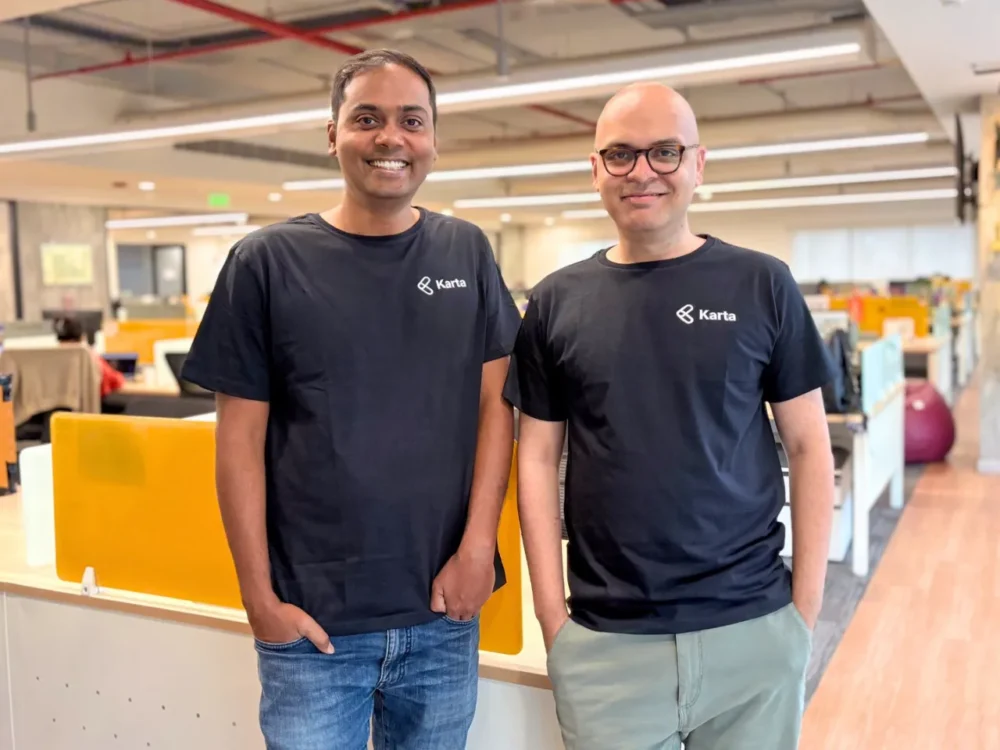
Karta AI was founded by Vijaypal Singh and Abhishek Kushwaha, both former executives at fintech company Razorpay. According to Singh, the founders worked on internal AI automation initiatives before leaving to establish the startup.
The company initially focused on chat-based automation before moving into voice AI in August 2025. It has since developed an omnichannel customer communication platform spanning voice calls, chat, email and WhatsApp, with voice remaining its primary focus.
According to the startup, it currently has between 10 and 12 paying customers, including PhonePe, Pine Labs, Bajaj and Aavas. Its focus is on financial institutions that need to manage customer enquiries involving multiple systems, processes and operational teams.
The founders believe voice automation can move beyond answering basic questions to completing tasks that traditionally require human agents to access several applications and coordinate different workflows.
How Karta AI’s Voice Agents Work
Traditional customer service bots are often designed to handle straightforward requests, such as answering frequently asked questions or retrieving a single piece of information. Karta AI is targeting more complex interactions that require agents to understand the customer’s intent, retrieve information from different systems and initiate multiple processes within the same call.
For example, a borrower contacting a lender might ask about the status of a loan disbursement and request a foreclosure statement during the same conversation. The AI agent must recognise both requests, obtain the relevant information from the lender’s systems and trigger the appropriate workflows.
The startup focuses on what the industry describes as Level 2 and Level 3 customer queries, which typically require information from multiple systems or more complicated processes. These differ from Level 1 queries, such as basic frequently asked questions, that can be answered through a simple information lookup.
Singh estimates that Level 1 queries account for approximately 30% to 40% of customer service volumes but only around 10% of associated costs. By contrast, Level 2 and Level 3 queries together account for approximately 80% of customer service costs, according to his estimates.
By automating more complex interactions, Karta AI aims to address a larger share of the operational workload handled by customer service teams rather than concentrating only on routine enquiries.
Predictive Context Engine and Enterprise Integrations
A central component of Karta AI’s platform is its proprietary predictive context engine. The system draws on standard operating procedures, knowledge bases, previous conversations handled by human and AI agents, and data available through enterprise systems.
This contextual information is intended to help the voice agents understand follow-up requests without treating every question as an isolated interaction. The agents can use information gathered earlier in a conversation to determine the next appropriate action and initiate the required workflow.
The platform also connects with enterprise systems used by banks, lenders and insurers. These integrations are important because many financial service requests require more than providing a verbal answer; they may involve retrieving account information, checking transaction status or initiating an internal process.
Karta AI uses models from OpenAI and Google’s Gemini family, alongside open-source models such as Kimi and Gemma. Its approach combines these models with the company’s own workflow and context-management technology to support customer interactions.
The startup also maintains human oversight for sensitive situations. Calls involving suspected fraud, other high-risk matters or processes without clearly defined standard operating procedures are routed to human agents. Customers can also request to speak to a person.
This arrangement is particularly relevant in financial services, where incorrect responses or unauthorised actions can have significant consequences for customers and institutions.
Fresh Capital to Support Multilingual AI and Expansion
Karta AI intends to direct the new funding towards improving the platform’s end-to-end automation and multilingual capabilities. It also plans to expand its deployments across financial institutions and increase investment in engineering and go-to-market operations.
Multilingual support is an important consideration for financial services companies serving customers across India’s diverse linguistic markets. Voice-based systems that can handle customer requests in different languages could help institutions extend automated support to a wider customer base.
Expanding end-to-end automation could also enable the startup to support more complex workflows and integrate with a greater number of enterprise systems. However, deploying such capabilities at scale requires reliable performance, secure data handling and careful controls around sensitive customer interactions.
The planned expansion will test Karta AI’s ability to move from individual deployments to a broader platform serving multiple financial institutions and use cases.
Competition Intensifies in India’s BFSI Voice AI Market
Karta AI’s funding round comes as several Indian startups attract investment for voice AI solutions aimed at banking, lending, insurance, customer service and collections.
Desible.ai recently raised ₹32 crore in a Seed Plus round led by Prime Venture Partners. In September, Navana.ai raised ₹40 crore in a Series A round led by upGrad co-founder Ronnie Screwvala. Navana.ai has said it has delivered more than 100 million voice AI minutes to BFSI clients.
Mumbai-based Rezolv raised $12.5 million in a Series A round led by Norwest in August 2026. Its AI voice agents support sales, customer service and collections across 11 Indian languages.
Other companies operating in the segment include Arrowhead, which focuses on voice AI for financial services, and Gnani.ai. While some providers concentrate on specialised applications such as collections and underwriting, Karta AI is positioning itself around inbound customer calls.
These interactions can include failed payment enquiries, blocked cards, loan-related questions and insurance claims. Such requests often require access to customer records and internal systems, making them more complicated than simple automated responses.
The growing number of competitors reflects increasing interest in applying AI to customer-facing operations. For startups, the challenge will be demonstrating measurable improvements in cost, service quality and resolution rates while maintaining accuracy and appropriate human oversight.
Outlook for Karta AI
With its latest seed funding, Karta AI plans to strengthen its technology and broaden its presence among financial institutions. Its emphasis on multi-intent conversations and complex workflow execution differentiates its approach from systems focused primarily on basic automated customer support.
The company’s progress will depend on how effectively its agents handle real-world conversations, integrate with existing enterprise infrastructure and manage sensitive customer requests. Its ability to support multiple languages and deliver consistent performance across different financial services use cases will also be important as it expands.
As banks, lenders and insurers continue to evaluate AI-driven customer service, Karta AI is seeking to establish itself as a technology provider capable of automating more than routine enquiries and helping financial institutions manage complex inbound interactions.
Disclaimer: This report has been editorially prepared using publicly available information and official company disclosures. Readers are advised to refer to official company announcements and disclosures for further details.
Author

About the Author