
Naresh Kumar Nain Honored with Honorary Doctorate for Social Impact & Rural Development
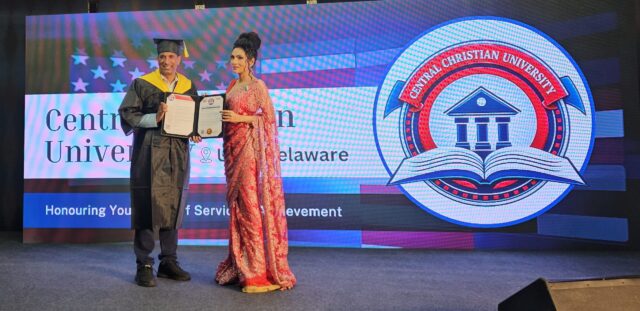
Udaipur, Rajasthan, 04 Oct : On a day that carries profound significance for India, as the nation commemorates Gandhi Jayanti and Shastri Jayanti, development professional Naresh Kumar Nain, Director at Manjari Foundation, has been recognised with an Honorary Doctorate (Honoris Causa) in Social Impact, Rural Development & Women’s Empowerment, 2026, by Central Christian University, USA.
For Naresh, the recognition comes at a particularly meaningful moment. It marks two decades of a professional journey that began in 2006—a journey rooted not in privilege or institutional power, but in villages, communities and the lives of people living at the margins of society.
It is a journey that has taken him from the remote and underserved regions of Madhya Pradesh and Rajasthan to working across India and internationally—from community mobilisation and women’s Self-Help Groups to institution building, sustainable livelihoods, digital inclusion, rural entrepreneurship and public education.
Yet, he describes the recognition with characteristic humility.
For him, it is not simply a personal honour.
It belongs to the communities, the women, the colleagues, the mentors, the grassroots institutions and the organisations—Manjari Foundation and PRADAN—that have shaped his journey.
A Journey That Began in 2006
Naresh began his professional journey in 2006, entering the development sector at a time when rural India was still struggling with deep structural challenges—poverty, limited access to formal finance, weak institutions, inadequate livelihood opportunities and the social exclusion of women and marginalised communities.
His early years of work were closely associated with some of the most underserved regions of Madhya Pradesh and Rajasthan, including areas often described as part of the country’s “Red Corridor.” The experience shaped his understanding of development.
It taught him that poverty cannot be addressed only through schemes, subsidies or short-term interventions. It requires institutions, dignity, agency, opportunity and collective action.
More importantly, it taught him that communities are not passive recipients of development.They are its most important architects.
Working with Those at the Margins
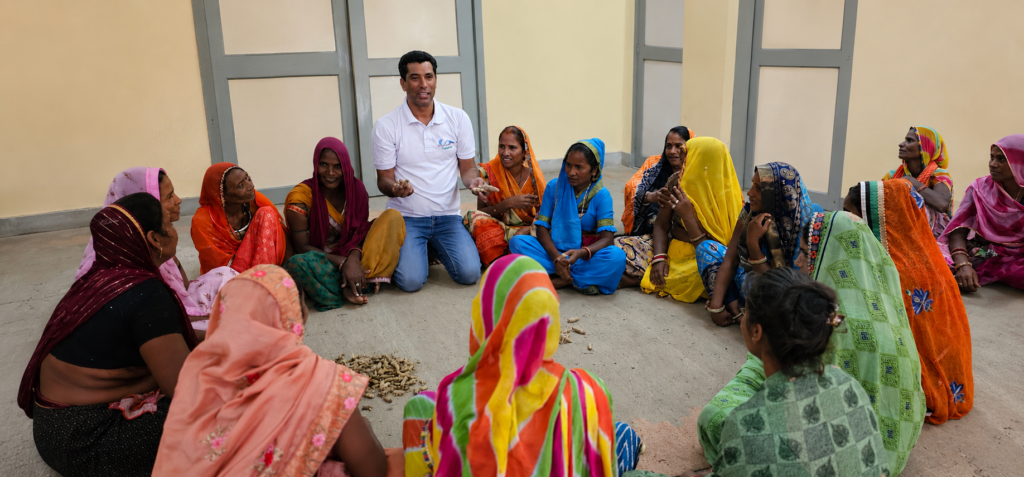
Much of Naresh’s career has been spent working with communities that remain among the most marginalised in India, including tribal and rural populations living in geographically remote and economically vulnerable areas.
The work has taken him deep into villages where development indicators often hide the complexity of people’s lives.
For him, rural development has never been simply about increasing income.
It is about asking larger questions:
- Can a woman make an independent financial decision?
- Can a farmer withstand a climate shock?
- Can a rural family access institutional credit without exploitation?
- Can a community manage its own institution?
- Can a girl continue her education?
- Can a woman become an entrepreneur?
- Can technology reach the last mile without creating a new form of exclusion?
- And, ultimately, can communities become capable of shaping their own future?
These questions have remained central to his professional journey.
This approach reflects a simple but powerful belief: meaningful development must strengthen people’s agency and enable communities to shape their own future.
Women at the Centre of Transformation
A defining theme of Naresh’s work has been the belief that women’s collective strength can transform families, economies and entire communities.
When women gain agency, families become stronger; when women lead institutions, communities become stronger; and when women control economic resources, development becomes more sustainable.
This belief has remained central to his work with women’s institutions, livelihoods, entrepreneurship and community-led development.
From Rajasthan to the GLOBAL
What began as grassroots development work in India gradually evolved into a wider learning journey.
Naresh was awarded the Netherlands Fellowship, reflecting his engagement with issues of social justice, poverty eradication and women’s empowerment. He subsequently undertook development learning at Wageningen in the Netherlands, along with learning experiences in South Africa and Indonesia. His professional profile also records his engagement with international development networks in Mali and Senegal in West Africa.
One of the most interesting dimensions of this journey has been the movement of ideas in both directions.
It was not simply about taking Indian experiences abroad.
It was about recognising that communities in different parts of the world often face similar questions—how to organise, how to build collective institutions, how to create sustainable livelihoods and how to place women at the centre of development.
A community-to-community learning initiative between Rajasthan and Mali became one example of this exchange, with Indian experiences of women’s collectives and rural economic development informing learning processes in West Africa.
This experience reinforced another important lesson:
Development knowledge does not belong to one country, one institution or one expert. Much of it lives within communities themselves.
Learning, Leadership and Continuous Growth
Naresh’s academic and professional journey has combined formal education with extensive field-based learning.
He holds a Master’s degree in English Literature and an MBA from Kurukshetra University. Alongside his formal education, he has pursued development-oriented learning through international programmes and fellowships.
He has also been awarded the Acumen Fellowship, supporting his journey towards creating larger-scale social impact.
He is empanelled as a National Resource Person with the National Institute of Rural Development and Panchayati Raj (NIRDPR), where he has contributed to building the capacities of state teams. Community institutions and supporting the DAYNRLM and Lakhpati Didi programme. He is also a certified CII Sustainability Assessor.
He has also contributed to knowledge development in rural livelihoods and livestock, including his work on Bharat Mein Pashudhan.
Recognition for Social Impact, Climate Action & Rural Entrepreneurship
Recent years have brought significant institutional and professional recognition.
At Manjari Foundation, this approach has translated into tangible impact: developing 500+ water-harvesting structures, building digital and financial literacy among 3.5 lakh people, and creating Katori and Jhulki as market platforms that empower women farmers and artisans with stronger livelihood and enterprise opportunities.
Manjari Foundation received the Rajasthan Bhamashah Samman in 2025 and 2026, marking consecutive years of recognition for its contribution to social development.
In 2026, the Foundation also received the Shiksha Vibhushan and Shiksha Bhushan recognitions for its contribution to public education. Naresh received the Shiksha Bhushan on behalf of the organisation, alongside Executive Director Sanjay Kumar, who received the Shiksha Vibhushan. The honours were presented in Jaipur by Rajasthan Deputy Chief Minister Dr. Prem Chand Bairwa, in the presence of Education Minister Shri Madan Dilawar.
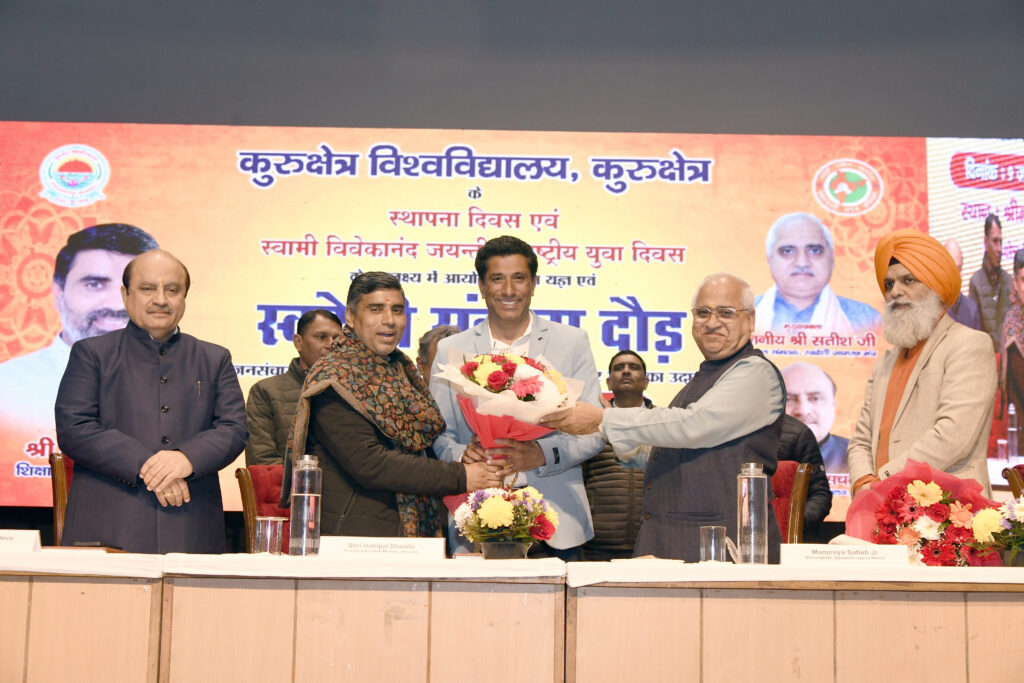
Earlier, on 9 January 2026, Naresh was also honoured by Kurukshetra University for his contribution to promoting entrepreneurship in rural India. The recognition was presented by Haryana Education Minister Shri Mahipal Dhanda.
These recognitions reflect the collective efforts of grassroots institutions, development professionals, community leaders and partner organisations working to strengthen rural India.
Gandhi Ji, Shastri Ji and the Responsibility of Service
The timing of the honorary doctorate makes it particularly meaningful.
Gandhi Jayanti and Shastri Jayanti offer an opportunity to reflect on two enduring ideas that remain relevant to India’s development journey.
Mahatma Gandhi’s vision of Gram Swaraj, self-reliance and the dignity of the last person reminds us that villages must be active participants in shaping their own development.
Lal Bahadur Shastri’s simplicity, integrity and call of “Jai Jawan, Jai Kisan” reaffirm the importance of farmers and rural communities in nation-building.
For a professional whose journey has been shaped by two decades of working alongside rural and tribal communities, these values carry deep significance.
They reinforce the belief that meaningful development begins with people, strengthens their institutions and creates opportunities for them to lead change.
An Honour Shared with the Team
Receiving the Honorary Doctorate, Naresh expressed gratitude to the communities, women, colleagues and institutions that have been part of his journey.
He particularly acknowledged PRADAN and Manjari Foundation, along with his mentors, gurus, teachers, colleagues and family members whose guidance and support have contributed to his professional growth.
For him, the recognition is both a moment of reflection and a renewed commitment to work towards a more equitable, inclusive and resilient rural India.
The honour may carry a title, but its true meaning lies in the collective journey behind it—and the responsibility it brings for the work ahead.
Author
About the Author