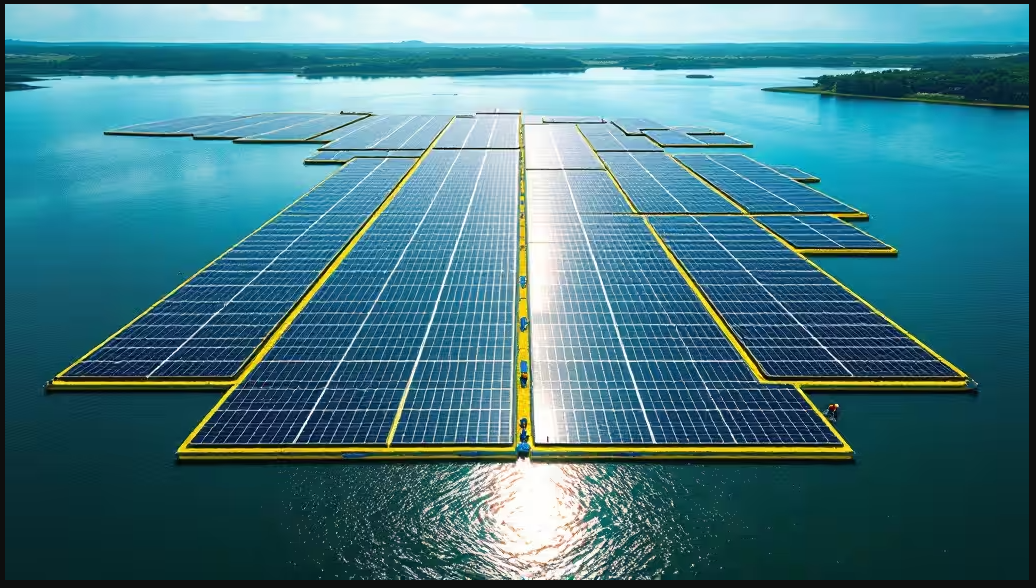
The Government of India has launched the Pradhan Mantri Surya Sarovar Yojana (PM-SSY), a national initiative aimed at accelerating the deployment of floating solar power across the country. The scheme has a total outlay of ₹5,070 crore and targets the development of 5,000 MW of floating solar capacity.
The initiative represents a strategic shift in India’s renewable-energy expansion, particularly as the availability of land for large-scale solar projects becomes increasingly constrained. Instead of relying entirely on ground-mounted solar farms, the scheme aims to utilise reservoirs, lakes and other suitable water bodies for installing solar panels.
5 GW Floating Solar Target With Energy Storage
One of the key features of PM-SSY is the integration of co-located energy storage with floating solar projects.
Eligible projects will be required to provide a minimum of two hours of storage, translating into a cumulative storage target of approximately 10,000 MWh across the scheme.
The storage component is particularly important as India adds increasing amounts of solar and wind capacity to its electricity grid. Solar generation peaks during the daytime, while electricity demand can remain high during evening and night hours. Energy storage can help bridge this gap and make renewable power more flexible and reliable.
Why Floating Solar Is Important for India
Floating solar involves installing photovoltaic panels on specially designed platforms placed on reservoirs and other water bodies.
The biggest advantage is that it allows India to generate electricity without competing directly with agricultural, industrial or urban land.
The panels can also reduce evaporation from covered portions of water bodies, while the cooling effect of water can potentially improve solar-module efficiency, particularly in India’s hot climate.
India already has experience with large floating solar installations. NTPC commissioned a 100 MW floating solar project at Ramagundam in Telangana and a 92 MW project at Kayamkulam in Kerala in 2022.
The proposed 600 MW Omkareshwar Floating Solar Park in Madhya Pradesh is another major project, with a portion already operational.
Despite these developments, India’s installed floating-solar capacity remains relatively small compared with its potential. According to an assessment cited in the report, the country could have around 102 GW of floating-solar potential based on using only 20% of suitable reservoir areas.
Government Financial Support
To encourage developers to enter the sector, PM-SSY will provide Central Financial Assistance (CFA) of ₹1 crore per MW for eligible projects after commissioning.
The scheme will also provide additional support of up to ₹50 lakh per project for preparatory work such as:
- Hydrographic surveys
- Environmental assessments
- Feasibility studies
- Other project-development activities
These studies are particularly important for floating solar because developers need detailed information about water depth, water-level fluctuations, wind conditions, anchoring requirements and environmental sensitivity before construction begins.
The scheme will have a five-year implementation period, with financial support available until FY 2032-33.
A New Opportunity for India’s Solar Industry
The government’s push could create opportunities across the entire floating-solar value chain, including floating platforms, anchoring systems, specialised electrical equipment, solar modules, engineering services and energy-storage technologies.
It could also support domestic manufacturing and generate employment as the sector expands beyond a handful of large projects.
However, floating solar remains more expensive than conventional ground-mounted solar because of the additional costs associated with floating structures, anchoring systems, specialised equipment and installation.
The addition of battery storage can further increase project costs.
Developers will therefore need access to affordable financing, long-term power purchase agreements and predictable revenue models for projects to remain financially viable.
Environmental and Implementation Challenges
Large-scale floating solar development will also require careful environmental planning.
Water bodies can experience fluctuating water levels, strong winds and waves, while ecologically sensitive areas may require detailed environmental assessments before projects are approved.
Successful implementation will therefore depend on coordination between state governments, electricity distribution companies, water-resource and irrigation departments, municipal authorities and environmental agencies.
Identifying suitable reservoirs and establishing clear responsibilities between different authorities will be crucial to ensuring projects are developed quickly without compromising environmental safeguards.
A Major Step for India’s Renewable-Energy Transition
The PM-Surya Sarovar Yojana comes at a time when India is rapidly expanding its renewable-energy capacity and simultaneously looking for solutions to land constraints and grid-balancing challenges.
By combining floating solar with energy storage, the scheme attempts to address two problems at once: finding space for new solar capacity and making renewable electricity more dispatchable.
If implemented successfully, the 5 GW programme could help establish floating solar as a mainstream component of India’s clean-energy mix, while creating a new market for energy-storage technologies and strengthening the country’s broader transition towards a low-carbon power system.
Author

About the Author