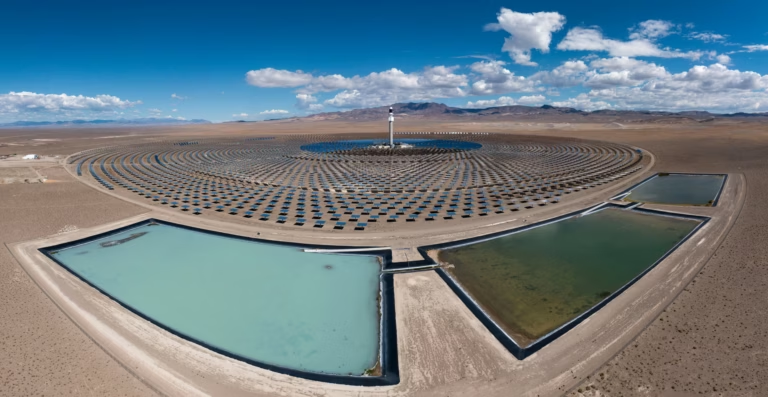
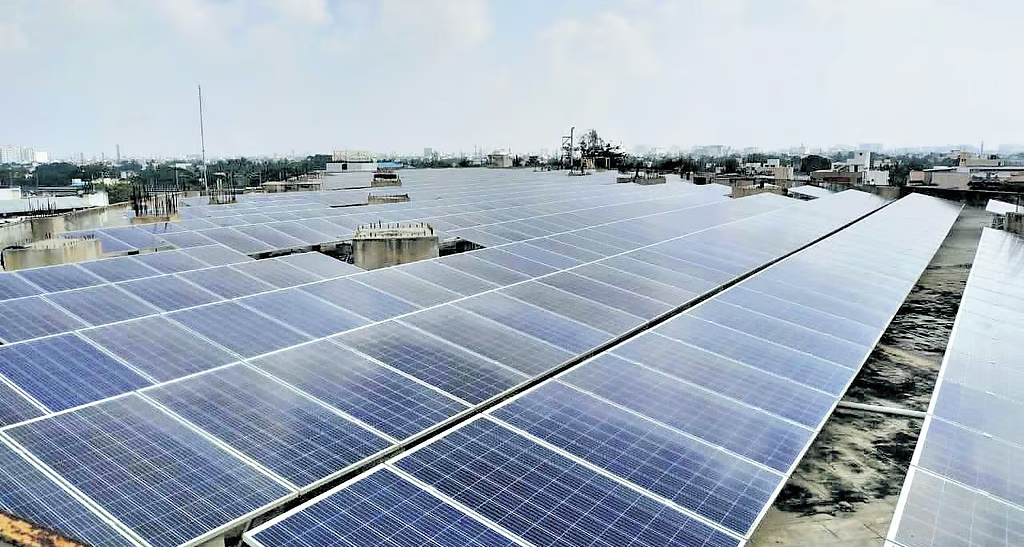
India’s installed non-fossil electricity capacity has crossed the 300 GW milestone, marking a major step in the country’s transition towards a cleaner energy system. The milestone also signals a shift in focus—from rapidly expanding renewable generation to strengthening the transmission, storage and grid infrastructure required to integrate clean power reliably.
According to the Ministry of New and Renewable Energy (MNRE), India’s installed non-fossil electricity capacity stood at 300.50 GW as of July 31, 2026.
The capacity includes:
- ☀️ Solar: 164.59 GW
- 🌬️ Wind: 58.14 GW
- 💧 Large and small hydropower: 57.24 GW
- 🌱 Bio-power: 11.75 GW
- ⚛️ Nuclear: 8.78 GW
India’s total installed power-generation capacity stood at around 552 GW at the end of July, meaning non-fossil sources now account for approximately 54% of the country’s installed capacity.
Solar Continues to Drive Expansion
Solar energy remains the biggest contributor to India’s clean-energy expansion.
During FY2025-26, India added a record 55.29 GW of non-fossil electricity capacity, including approximately 44.6 GW of solar and 6 GW of wind capacity.
The annual addition represents the country’s highest-ever increase in non-fossil power capacity in a single financial year.
India had already achieved another major milestone in June 2025, when non-fossil sources crossed 50% of cumulative installed electricity capacity. This was achieved around five years ahead of the timeline originally envisaged under India’s Nationally Determined Contribution (NDC) under the Paris Agreement.
The Focus Now Shifts From Capacity to Reliability
While India continues to add renewable generation at a rapid pace, the next challenge is ensuring that this electricity can be delivered reliably whenever consumers need it.
Solar and wind generation are variable by nature, creating greater requirements for:
- Transmission infrastructure
- Battery energy storage systems
- Pumped-storage projects
- Flexible generation
- Advanced forecasting systems
- Digital grid-management technologies
As the share of renewable energy rises, India’s power system will need to become increasingly flexible to manage fluctuations in solar and wind generation.
This means the country’s clean-energy transition is entering a new phase in which grid infrastructure and energy storage will become just as important as generation capacity.
Domestic Solar Manufacturing Expands
India is also attempting to build a stronger domestic clean-energy manufacturing ecosystem.
Capacity enlisted under the Approved List of Models and Manufacturers (ALMM) for solar photovoltaic modules has now crossed 200 GW.
Government measures such as the Production Linked Incentive (PLI) framework are supporting the development of domestic manufacturing capabilities across the solar value chain while reducing dependence on overseas supply chains.
The expansion of domestic manufacturing is expected to support India’s long-term renewable-energy ambitions while strengthening supply-chain resilience.
Green Energy Corridors Become Increasingly Important
The rapid growth of renewable power is also increasing the need for new transmission infrastructure.
Green Energy Corridors are expected to play a critical role in connecting large renewable-energy projects with demand centres and enabling electricity generated in resource-rich regions to reach consumers across the country.
With renewable generation becoming a larger component of India’s power mix, transmission networks are no longer simply supporting infrastructure—they are becoming a core part of the country’s clean-energy transition.
Storage to Support 24×7 Renewable Power
Energy storage is expected to become increasingly important as India moves towards a power system dominated by solar and wind.
Battery storage can capture surplus electricity during periods of high renewable generation and supply it during periods of peak demand. Pumped-storage projects can provide another large-scale option for balancing the grid.
The combination of solar, wind, battery storage, pumped storage and advanced grid technologies could allow India to convert variable renewable generation into a more dependable electricity supply.
Industry stakeholders have also highlighted the need for faster investment in transmission and large-scale storage as renewable capacity continues to grow.
India’s crossing of the 300 GW non-fossil capacity milestone therefore represents more than a record in installed capacity. It marks the beginning of the next stage of the country’s energy transition—one focused on building the infrastructure, technology and domestic manufacturing ecosystem needed to turn India’s growing clean-power capacity into reliable, affordable and scalable electricity.
Author

About the Author