
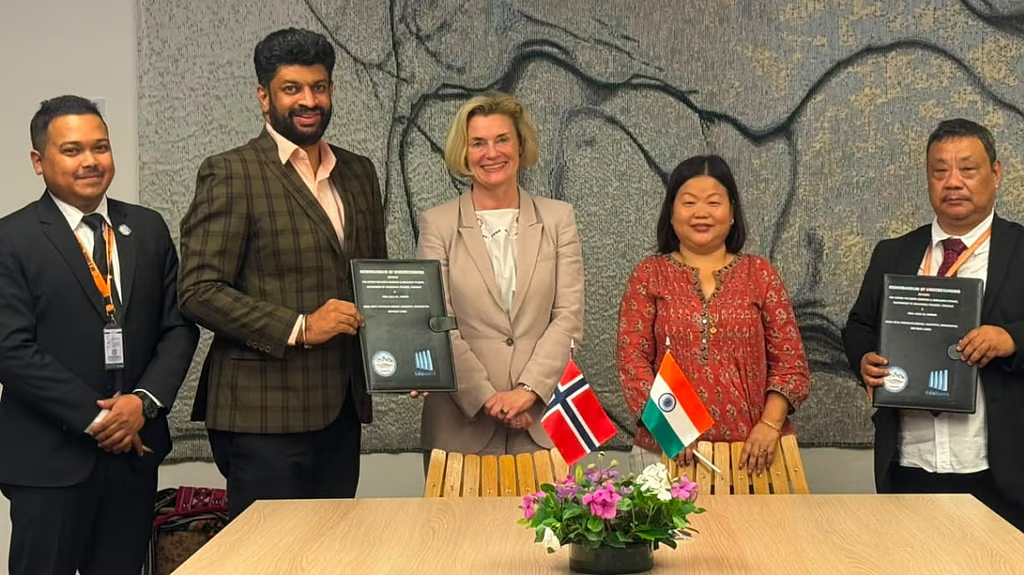
India has taken a significant step towards diversifying its renewable energy portfolio with the signing of a Memorandum of Understanding (MoU) between the Government of Arunachal Pradesh and Norway’s Tidal Sail AS to establish the country’s first River Kinetic Energy Demonstration Plant in Arunachal Pradesh.
The 500 kW River Kinetic Energy Demonstration Project will be implemented by the Centre for Earth Sciences & Himalayan Studies (CES&HS) under the India-Norway Green Partnership. The project is supported by the Ministry of New and Renewable Energy (MNRE) and Innovation Norway.
Unlike conventional hydropower projects, the river kinetic energy technology generates electricity directly from the natural flow of river currents without the need for large dams or major civil infrastructure. The approach is expected to offer an environmentally sustainable, low-impact and cost-effective renewable energy solution, particularly for remote and ecologically sensitive regions.
Speaking at the signing ceremony, Arunachal Pradesh Science and Technology Minister Dasanglu Pul described the agreement as a landmark in the state’s clean energy journey. She said Arunachal Pradesh’s vast network of rivers provides immense renewable energy potential and expressed confidence that the project would enhance energy security while ensuring the responsible utilisation of natural resources.
The Minister also acknowledged the support of the Ministry of New and Renewable Energy (MNRE), the Ministry of External Affairs, the Royal Norwegian Embassy, Innovation Norway, Tidal Sail AS, and other partner organisations for making the project possible.
Norwegian Ambassador to India May-Elin Stener said Arunachal Pradesh offers ideal conditions for demonstrating river kinetic energy technology. She noted that the project would complement existing renewable energy sources while strengthening long-term energy security and further deepening India-Norway cooperation in sustainable infrastructure, geothermal energy and green technologies.
CES&HS Director Tana Tage said the demonstration project would help diversify Arunachal Pradesh’s renewable energy mix and provide decentralised electricity generation solutions for remote and difficult-to-access regions. He added that successful deployment of the technology could reduce dependence on fossil fuels, lower carbon emissions, preserve river ecosystems and position Arunachal Pradesh as a leader in next-generation renewable energy innovation.
Tage also highlighted the institute’s growing collaboration with Norwegian organisations, including the Norwegian Geotechnical Institute, on geothermal energy, geotechnical engineering and sustainable infrastructure projects.
Officials said the agreement marks a new chapter in India-Norway renewable energy cooperation, paving the way for the deployment of advanced river kinetic energy technologies across Himalayan river systems. The initiative is expected to contribute to clean energy generation, sustainable development and improved energy access in remote communities while supporting India’s broader renewable energy and climate goals.
Disclaimer: This report has been editorially prepared using publicly available information. While every effort has been made to ensure accuracy, unintentional errors or omissions may occur. Readers are encouraged to verify important information through official sources.
Author

About the Author