
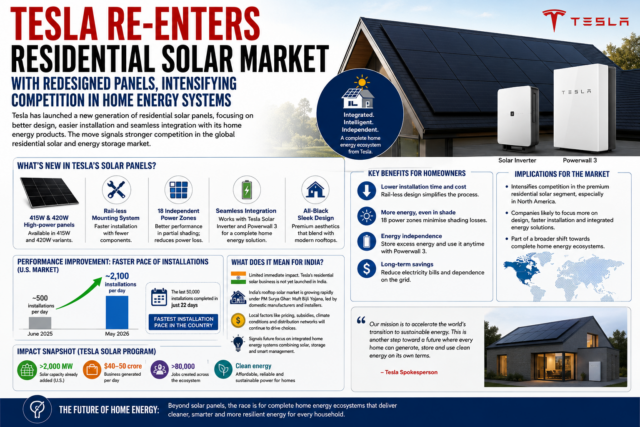
New Delhi, 29 June: After making a global impact in electric vehicles and battery storage, Tesla is once again strengthening its presence in the residential solar market with the launch of a redesigned rooftop solar panel. While the new offering is not a technological breakthrough that will disrupt the global solar industry overnight, it signals Tesla’s renewed focus on integrated home energy solutions and is expected to intensify competition in the rapidly growing residential solar market.
Manufactured at Tesla’s Gigafactory in Buffalo, New York, the new solar panels are available in 415W and 420Wvariants and feature an all-black design, improved aesthetics, and a rail-less mounting system that simplifies installation and reduces labour time. The company has also introduced 18 independent power zones, enabling better electricity generation even when portions of the panel are shaded.
Unlike conventional solar panel manufacturers that primarily sell photovoltaic modules, Tesla is positioning itself as a provider of a complete home energy ecosystem. The new panels are designed to seamlessly integrate with the Tesla Solar Inverter, Powerwall 3 home battery, and the Tesla mobile app, allowing homeowners to generate, store, monitor, and manage electricity from a single platform.
Focus on Complete Energy Independence
Industry analysts believe Tesla’s biggest innovation is not in solar panel efficiency but in creating an integrated energy ecosystem. Homeowners can generate electricity during the day, store surplus energy in Powerwall batteries, and use it during evenings or power outages, reducing dependence on the conventional electricity grid.
The company is betting that consumers increasingly prefer a single provider offering solar generation, battery storage, energy management software, and electric vehicle charging under one ecosystem.
Competition Likely to Intensify
Tesla’s renewed push comes at a time when residential solar adoption is accelerating worldwide due to rising electricity prices, government incentives, and growing climate awareness.
Although Tesla remains a relatively small player compared to global solar manufacturing giants, its brand recognition and integrated energy strategy could increase competition in premium residential solar solutions, particularly in North America.
The redesigned panels also place additional pressure on traditional solar companies to improve installation efficiency, digital monitoring, and customer experience rather than competing solely on panel efficiency or price.
Limited Immediate Impact on India
Experts believe the immediate impact on India is likely to be limited.
India’s rooftop solar market continues to be dominated by domestic manufacturers and installers such as Waaree, Tata Power Solar, Adani Solar, Vikram Solar, and RenewSys. Moreover, Tesla’s latest residential solar products are currently targeted primarily at the U.S. market.
India’s rooftop solar sector is also driven by government initiatives such as the PM Surya Ghar: Muft Bijli Yojana, which provides subsidies and encourages local manufacturing under the country’s renewable energy policy framework.
Not a ‘Game Changer,’ but a Strategic Move
Several social media videos have described Tesla’s latest launch as a development that could make the entire solar industry obsolete. However, industry experts disagree.
The new panels offer improvements in design, installation, durability, and system integration rather than a dramatic leap in power generation or efficiency. Their significance lies in strengthening Tesla’s position in the broader home energy market rather than replacing existing solar technologies.
The Bigger Picture
The global residential solar market is evolving from simply installing rooftop panels to building intelligent home energy ecosystems. Consumers increasingly seek solutions that combine solar generation, battery storage, electric vehicle charging, and smart energy management.
Tesla’s latest launch reflects this shift. Rather than competing only as a solar panel manufacturer, the company is positioning itself as a complete clean-energy solutions provider.
As countries worldwide accelerate their transition toward renewable energy, the future of residential solar may depend not just on how efficiently panels generate electricity, but on how effectively entire home energy systems work together. Tesla’s redesigned solar panels represent another step in that direction, intensifying competition in a market that is expected to grow significantly over the coming decade.
Author

About the Author