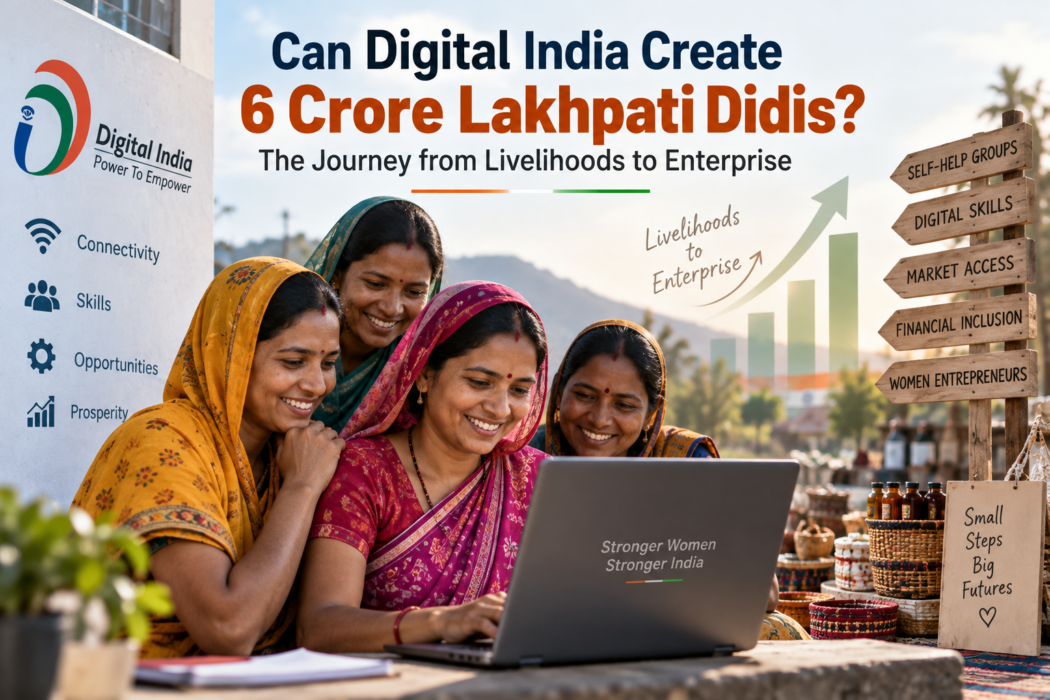
New Delhi, 14 Sept: India now has more than 1.09 billion internet subscribers (TRAI, Q1 2026) — but the country’s digital story still reads very differently depending on which pin code you are in. Rural India’s internet tele-density stood at just 48.31 subscribers per 100 people as of March 2026, against 126.80 in urban India (TRAI, Q1 2026).
That gap narrows on the gender axis, though not fully. The share of Indian women aged 15–49 who have ever used the internet has nearly doubled, from 33.3% in NFHS-5 (2019-21) to 64.3% in NFHS-6 (2023-24), with women’s individual bank account ownership climbing to 89% (NFHS-6). Men’s internet usage stands at 80.5% nationally (NFHS-6), so a 16-point gap remains even at the national level — and it tends to run wider still in remote, tribal blocks, where connectivity and digital literacy both lag behind the country’s average.
It is against this backdrop that the Government of India’s most ambitious rural women’s livelihood push is unfolding. On February 13, 2026, Prime Minister Narendra Modi approved doubling the “Lakhpati Didi” target — Self Help Group (SHG) women earning a sustainable household income of ₹1 lakh or more a year — to six crore by March 2029, after the original three-crore target was crossed by 2025, more than a year ahead of its March 2027 deadline. Union Rural Development Minister Shivraj Singh Chouhan subsequently detailed the new target at the DAY-NRLM Central Level Coordination Committee meeting in Hyderabad, noting that 3.01 crore women had already reached the milestone. The target was reiterated in the national conversation through the year. By the time India marked its 80th Independence Day on August 15, 2026, Prime Minister Modi again pointed to the six-crore goal from the Red Fort, describing it as a major expansion of the opportunity being created for rural women.
The reality on the ground is harder than the speeches suggest. Chouhan himself has said the next tranche will be tougher than the first: many of the women already counted were earning ₹50,000–60,000 a year and needed only a small push over the ₹1-lakh line. The women still to come will be starting from much further back and nowhere is that climb steeper, or more instructive, than in India’s Northeast.
A Constitutionally Distinct Tribal Belt
Part of what makes this belt distinct is its governance. The Tripura Tribal Areas Autonomous District Council (TTAADC), an autonomous body set up under the Sixth Schedule of the Constitution, which gives designated tribal areas their own legislative and administrative powers over social and economic affairs — is home to 12,16,465 people, of whom 10,21,560, or 83.4%, are Scheduled Tribes, according to the 2011 Census. Put another way: of the roughly 11.67 lakh Scheduled Tribe people living anywhere in Tripura, close to 87.55% of them live inside this one autonomous council area, a belt spanning 250 to 260 village councils across 23 tribal-dominated blocks.
However, governance is just one aspect of the region’s uniqueness. Equally critical is how development and livelihood initiatives adapt to the distinct needs of remote villages, tribal populations, and local organizations. This is precisely why the Tripura Rural Economic Growth and Service Delivery Project (TRESP) plays such a vital role.
TRESP is a six-year, World Bank-financed initiative worth USD 175 million (roughly ₹1,400 crore), 80% of it funded by the World Bank and the rest by the Tripura government. It is a multi-sectoral project covering livelihoods, road connectivity, education and stronger service delivery, implemented through the Society for TRESP across seven government departments, with 12 of its 23 blocks marked out as aspirational for special focus.
On the livelihoods side alone, it aims to directly benefit roughly 75,000 households through 2,500 Producer Groups and 61 Cluster Level Federations. Each Producer Group is eligible for a working-capital loan of up to ₹6 lakh, disbursed after a business plan is appraised at village, block and district level
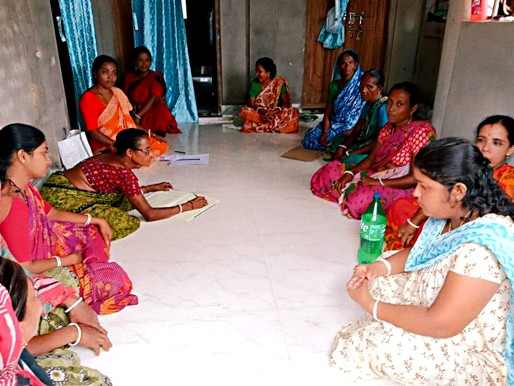
The Fisherwoman Who Turned WhatsApp Into a Marketplace
Bani Majumder, Rupaichari Block
Bani Majumder’s family once earned barely ₹3,500–₹4,000 a month from unpredictable traditional farming. Since 2024-25, with TRESP’s fisheries experts, she has built a scientific carp-and-indigenous-fish enterprise, following TRESP’s own polyculture guidelines — Catla, Rohu and Mrigal alongside high-value Pabda, plus low-cost bio-feeds like Azolla that cut commercial feed costs by up to half. A working-capital loan through her Producer Group gave her a six-ganda pond unit to scale up.
Digital tools then found her buyers. Bani uses AePS and UPI QR codes for instant, middleman-free payments, and posts photos of her fingerlings to a WhatsApp group run by her Cluster Level Federation, which now pulls advance bookings from vendors across the block. In recent months she has sold roughly 1.8 lakh fingerlings and over ₹40,000 of table-size fish, taking her monthly income to ₹12,000–₹14,000.
She now also serves as a CSP Didi, delivering banking services in her village — a role that mirrors DAY-NRLM’s national “One GP One BC Sakhi” mission, which has certified over 50,000 SHG women as doorstep banking agents (MoRD). “Earlier, our livelihood was entirely dependent on daily labour work, and I had no identity of my own,” she says. “Today, as a Lakhpati Didi, I am proud that I do everything — I inspire other sisters in my village to become self-reliant.”
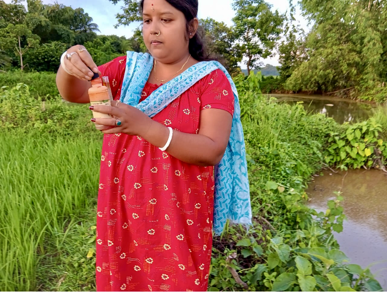
The Woman Who Built Two Businesses to Beat One Bad Season
Sagarika Dewan, Chawmanu Block
Before joining her Producer Group, Sagarika Dewan’s household earned around ₹3,000–₹4,000 a month, with little to fall back on when work dried up. Over the past two years she has deliberately run two enterprises side by side — fishery and tailoring, so that a slow season in one is cushioned by the other, a diversification strategy TRESP actively promotes among its Producer Groups to spread market and weather risk across members’ primary and secondary activities.
Digital payments and mobile banking now let her manage both income streams without depending on cash-in-hand. WhatsApp has also become her main channel for tailoring orders, helping her reach customers beyond Durgacherra village who would otherwise never have heard of her through word of mouth alone. Her monthly income has risen to approximately ₹12,000–₹13,000. She describes the biggest change in her life as the financial independence that has come with running her own enterprise rather than depending entirely on her husband’s earnings. Her goal now is to scale both activities into a single, more profitable combined livelihood over the next few years.
The Farmer Who Turned Her Backyard Into a Second Income
Bulti Baishya, Manu Block
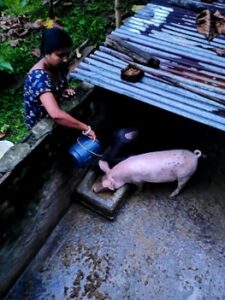
Bulti Baishya combined agriculture with pig farming — a pairing TRESP’s livestock programme is built around. Under the model, a Pig Production Unit (breeder stock of three sows and one boar) feeds surplus piglets into neighbouring Pig Fattening Units, each requiring roughly 800 sq. m of land, veterinary support from a trained Pashu Sakhi, and input supply of feed, medicine and vaccines coordinated through her Producer Group. Before this, her household’s income was limited and irregular, dependent on whatever daily-wage work she could find.
Digital tools changed how she runs both sides of the enterprise. She now uses UPI QR codes and digital payments to buy feed, medicine and vaccines for her livestock, and to receive money from buyers directly into her account, cutting out the cash-handling and delays that came with dealing through middlemen.
Mobile-based communication also gives her more convenient access to banking and to information on livestock and agriculture schemes than a village visit from an official ever could, and she now negotiates directly with buyers over WhatsApp instead of through layers of local intermediaries. Her income today stands at approximately ₹13,000–₹14,000 a month. She attributes the change chiefly to the financial independence it has given her, and plans to expand both her cultivated land and her livestock numbers further in the coming years.
The Grocer Who Diversified Her Income
Sumitra Bhowmil, Manu Block
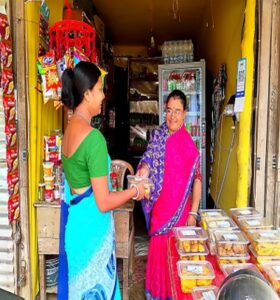
Sumitra Bhowmik chose a different combination: farming alongside a small grocery store, so that seasonal agricultural income is topped up by a steadier, year-round retail cash flow. Support through her Producer Group helped her set up and strengthen both sides of the business, turning what began as a small side venture into a genuine dual-income enterprise that now anchors her household’s finances.
Digital payments and mobile banking now handle transactions for both the farm and the store without the delays or risks of carrying cash, while WhatsApp keeps her connected to suppliers for real-time restocking and to customers for orders. Her monthly income today is approximately ₹15,000–₹17,000, the highest among the women in this story.
She credits it to the same shift, from uncertainty to financial independence, that runs through all their journeys. Her plan is to grow her grocery store’s customer base while expanding her farming activity in parallel over the next few seasons.
From SHGs to Lakhpati Didis: The National Scorecard
These four women are not isolated examples. Their journeys sit within a much larger national movement. Under DAY-NRLM, more than 10 crore rural women have been mobilised into over 93 lakh SHGs and federations, with cumulative SHG credit disbursement crossing ₹13.67 lakh crore. By July 2026, more than 3.46 crore women had reached the Lakhpati Didi milestone. The scale of this movement is significant: rural women are no longer being supported only as beneficiaries of livelihood schemes, but increasingly as producers, entrepreneurs, service providers and members of local economic institutions.
Women also hold roughly 56% of all PMJDY accounts, and close to 68% of PM MUDRA Yojana beneficiaries are women (PIB) — a base of formal banking and credit access that simply did not exist for most rural women a decade ago.
DAY-NRLM’s BC Sakhi / One GP One BC Sakhi mission — the same one behind Bani’s work as a CSP Didi — has also built a network of trained community bankers across rural India. Alongside them are cadres such as Krishi Sakhis, Pashu Sakhis who bring financial, agricultural, livestock and fisheries-related services closer to SHG households.
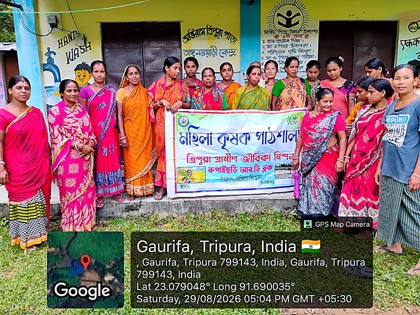
Tripura’s own digital-payment push follows the same pattern. Under TRESP, IPE Global has been engaged as the project’s Technical Support Agency for Financial Inclusion, and training is being rolled out in a cascade. District and block-level teams have been trained and are now training grassroots cadres — Financial Literacy Community Resource Persons (FL-CRPs), Master Book-Keepers, Business Correspondents and Bank Sakhis — who in turn train Producer Group and SHG members at the community level.
The curriculum covers financial literacy, digital finance, enterprise financing and digital payments, alongside how to recognise and avoid digital fraud. On the payments side, Producer Groups across the state have already been issued more than 1,000 QR codes to make transactions easier for members, with blocks such as Khowai leading the rollout while others are still catching up.
Banking access, however, is only one part of the journey. Once a woman has an enterprise, she also needs somewhere to sell, a way to reach customers and systems that help her manage and grow the business.
Three newer national programmes are trying to close that gap.
Womaniya, an initiative of the Ministry of Commerce & Industry on the Government e-Marketplace (GeM), gives women-led enterprises and SHGs a dedicated route to sell directly to government buyers. In FY 2025-26 alone, it generated over ₹28,000 crore in contract value across 2.1 lakh registered women MSEs (PIB, April 2026).
SHE-MART, announced in the Union Budget 2026-27, is building permanent, community-owned retail outlets within Cluster Level Federations to help mature SHGs move from credit-linked livelihoods to enterprise ownership.
SHE-LEAPS, launched June 29, 2026 under the Ministry’s LokOS digital platform, gives SHG women a unified digital record covering their enterprise profile and performance tracking (PIB, June 2026).
Add everyday UPI and AePS payments to this mix, and what emerges is the real scaffolding behind journeys like theirs — not one scheme, but several layers working together underneath them.
Challenges and the Road Ahead
None of this closes the gap on its own. Weak connectivity in remote blocks, gendered restrictions on smartphone ownership, low first-generation digital literacy, and the ever-present risk of cyber fraud continue to limit how much rural and tribal women can actually do with the access that does reach them.
Doubling a national target is the easy part; what closes the gap is slower and less visible — trained community cadres, banking that comes to the doorstep, and market access that doesn’t run through a middleman.
The Ministry’s own roadmap to six crore Lakhpati Didis by 2029 is built around exactly that combination, with a dedicated push to bring the roughly 10 crore SHG-linked women who are not yet part of the initiative into deeper financial inclusion (MoRD). Whether that push reaches far enough into India’s remotest blocks will decide how much of the six-crore figure shows up as income women can rely on, and how much stays a number on a dashboard. A livelihood becoming an enterprise, at that scale, is what the number is actually meant to measure and for millions of women, that shift is still a work in progress.
Authors
About the Author