
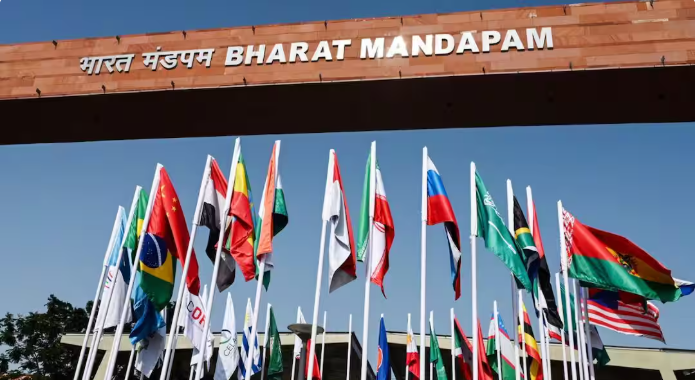
The BRICS Summit 2026 is placing artificial intelligence, green energy, development finance, trade and the evolving economic influence of the Global South at the centre of discussions on the future of the international economic order.
As BRICS members seek to strengthen cooperation across emerging technologies and sustainable development, the summit is highlighting the role of institutions such as the New Development Bank (NDB) while exploring greater collaboration in artificial intelligence, clean technologies, local-currency financing and digital infrastructure.
The discussions come at a time when developing economies are seeking greater influence over global financial and technological systems and are looking for ways to ensure that the benefits of emerging technologies are not concentrated among a small group of advanced economies.
New Development Bank Emerges as Key Financing Instrument
The New Development Bank remains one of the most important institutional mechanisms associated with BRICS.
The bank complements existing multilateral development institutions by providing financing for infrastructure and sustainable development projects in member and partner economies.
One area receiving increasing attention is the expansion of local-currency lending, which can help reduce exposure to exchange-rate fluctuations and lessen dependence on traditional international financing structures.
For developing economies, access to infrastructure capital remains critical as governments seek to finance renewable energy, transport networks, digital infrastructure, urban development and other projects necessary for long-term economic growth.
Greater financial cooperation within BRICS could therefore help members develop alternative channels for funding development priorities while strengthening the role of emerging economies in the global financial architecture.
AI Becomes a Major BRICS Priority
Artificial intelligence is another major theme emerging from the BRICS agenda.
Member countries are looking at ways to strengthen cooperation around AI governance, data, digital sovereignty, technology access and open-source ecosystems.
The rapid development of increasingly capable AI systems has created opportunities for productivity, scientific research, healthcare, education and industrial development. At the same time, unequal access to computing resources, data, advanced models and technical expertise could widen the technological gap between countries.
For the Global South, the challenge is therefore not simply how to adopt AI but how to participate in its development and ensure that access to the technology remains sufficiently broad.
BRICS cooperation could provide a platform for members to exchange expertise, develop common approaches and explore mechanisms for expanding access to AI capabilities.
Digital Sovereignty and Open AI Ecosystems
The emphasis on digital sovereignty reflects concerns among developing economies about excessive dependence on foreign technology platforms and infrastructure.
AI systems increasingly depend on access to computing capacity, advanced chips, cloud infrastructure, data and specialised technical talent. Countries seeking greater technological autonomy are therefore exploring ways to develop domestic capabilities while maintaining international collaboration.
Open-source and open AI ecosystems are particularly relevant in this context because they can allow researchers, companies and institutions to customise technologies for local requirements.
Greater collaboration among BRICS economies could potentially support the development of AI applications tailored to local languages, industries and public-sector needs.
At the same time, discussions around governance are expected to remain important as countries attempt to balance innovation with privacy, security, accountability and responsible deployment.
Green Technology Gains Strategic Importance
Climate and energy transition are also central to the BRICS agenda.
The grouping is examining opportunities for cooperation across solar and wind power, energy storage, green minerals, battery manufacturing, green hydrogen and climate finance.
The scale of investment required for the energy transition makes international cooperation particularly important for emerging economies.
Developing countries face the dual challenge of expanding access to affordable energy while reducing emissions. Cooperation on renewable technologies and financing could help address both objectives.
BRICS countries also possess significant natural resources, manufacturing capabilities and growing domestic markets that could contribute to the development of clean-energy supply chains.
Critical Minerals and Battery Manufacturing
Critical minerals have become increasingly important to the global energy transition because they are essential for batteries, electric vehicles, renewable energy equipment and other advanced technologies.
Greater cooperation among BRICS members could focus on mineral resources, processing, recycling and manufacturing capabilities.
Battery manufacturing represents another potential area of collaboration. Developing domestic and regional supply chains could reduce dependence on concentrated global production networks while creating new industrial opportunities.
Such cooperation could also help emerging economies capture more value from the clean-energy transition rather than remaining primarily suppliers of raw materials.
Green Hydrogen and Climate Finance
Green hydrogen is emerging as another potential area for BRICS collaboration.
Countries are exploring hydrogen as a potential low-carbon fuel and industrial feedstock, particularly for sectors that are difficult to electrify directly.
However, the development of green hydrogen requires substantial investment in renewable electricity, electrolysers, storage, transportation and associated infrastructure.
Climate finance will therefore remain a critical element of the transition.
For developing economies, access to affordable long-term capital could determine how quickly renewable energy, storage and green industrial projects can be scaled.
China Set to Take BRICS Presidency in 2027
With China set to assume the BRICS presidency in 2027, attention is also turning towards the grouping’s next phase.
Experts expect the agenda to potentially place greater emphasis on strengthening institutions, expanding financial cooperation, increasing local-currency trade and delivering more tangible outcomes for developing economies.
The challenge for BRICS will be converting broad areas of shared interest into practical programmes, investments and institutional mechanisms.
The grouping brings together economies with different political systems, development levels, economic structures and strategic priorities. Building consensus across such a diverse membership can therefore be complex.
Can BRICS Convert Ambition Into Action?
The 2026 discussions reflect the expanding scope of BRICS cooperation, which now extends well beyond traditional trade and economic diplomacy.
AI, green technology, development finance and digital sovereignty are increasingly interconnected with questions of economic competitiveness and geopolitical influence.
For the Global South, the central objective is to ensure that emerging technological and financial systems contribute to inclusive development rather than creating new forms of economic and technological dependence.
The New Development Bank provides an institutional foundation for development financing, while cooperation in AI and clean technologies could create new avenues for innovation and industrial development.
The effectiveness of the BRICS agenda, however, will ultimately depend on its ability to translate common objectives into measurable projects, stronger institutions and financing mechanisms that deliver benefits across member economies.
As the grouping prepares for its next phase under China’s 2027 presidency, the larger question remains whether BRICS can transform its growing economic and political weight into a more coordinated platform for an inclusive, balanced and increasingly multipolar global order.
Disclaimer: This report has been editorially prepared using publicly available information and official statements. Readers are advised to refer to official announcements for further details.
Author

About the Author