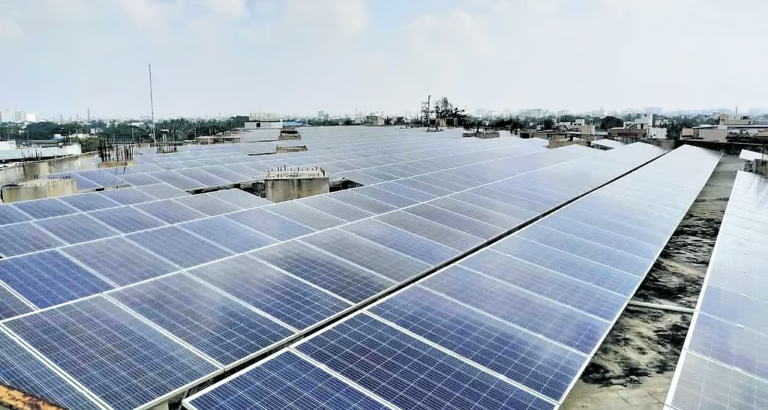

Kerala’s Cochin International Airport (CIAL) has emerged as a notable example of renewable-energy adoption in the aviation sector, becoming the world’s first airport to operate entirely on solar power in 2015. The airport’s transition to solar energy has grown from an early pilot project into a large-scale renewable-energy programme spanning multiple solar installations across its facilities.
Airports are among the most energy-intensive pieces of public infrastructure, with terminals, baggage-handling systems, lighting, security equipment, cooling systems and other operations requiring electricity around the clock. CIAL’s approach has been to meet these requirements through an extensive solar-generation network rather than relying primarily on conventional grid electricity.
From a Small Pilot to a Major Solar Network
CIAL’s renewable-energy journey began in 2013, when the airport commissioned a relatively small 100 kWp solar power plant as a pilot project.
The initiative was subsequently expanded as the airport explored the potential of solar energy to meet a larger share of its electricity requirements.
In 2015, CIAL commissioned a 12 MWp solar plant, allowing the airport to become the world’s first fully solar-powered airport according to the airport operator’s designation.
The development demonstrated that renewable energy could be integrated into the operations of a large airport without requiring the facility to fundamentally change the way passengers and airlines use it.
Solar Capacity Has Grown to 50 MWp
CIAL’s solar infrastructure has continued to expand considerably since the original project.
The airport operator now has solar installations with a combined capacity of approximately 50 MWp.
The network includes multiple solar plants located within the airport premises, along with a solar carport and an additional 12 MWp solar plant at Payyanur in Kerala.
Rather than depending on one large generation facility, the airport’s solar capacity is distributed across several installations, allowing renewable-energy generation to form an integrated part of its wider electricity infrastructure.
Airport Generates More Electricity Than It Consumes
One of the most notable aspects of CIAL’s solar programme is that its renewable-energy generation has moved beyond simply matching the airport’s own consumption.
The airport’s solar plants collectively generate around 2 lakh units of electricity per day, while CIAL’s daily electricity requirement is approximately 1.6 lakh units.
This means the airport can generate more electricity than it consumes on a daily basis under the stated operating conditions.
The surplus electricity can be supplied to the grid, allowing the airport to contribute renewable power beyond its own operational requirements.
CIAL has described this transition as a move from being power-neutral to power-positive, following the commissioning of the Payyanur solar plant in 2022.
How Solar Power Supports Airport Operations
The electricity generated by the solar installations is used to support the airport’s broad range of energy requirements.
An airport requires continuous electricity for systems that passengers may not immediately associate with energy consumption. These include baggage belts, terminal lighting, security systems, air-conditioning and other airport infrastructure.
By generating electricity through its solar network, CIAL is able to offset the conventional electricity that would otherwise be required to operate these systems.
The solar programme therefore extends beyond an environmental initiative and forms part of the airport’s overall energy-management strategy.
Solar Carport Adds Another Layer of Renewable Infrastructure
CIAL has also incorporated solar generation into its parking infrastructure through a solar carport.
Such installations allow existing spaces used for vehicle parking to perform an additional function by hosting photovoltaic panels above the parking area.
This approach can increase renewable-energy generation without necessarily requiring additional land exclusively for solar installations.
For airports, where land availability and land-use considerations can be particularly important, integrating solar generation into existing infrastructure provides another route for increasing renewable capacity.
Payyanur Plant Strengthened the Airport’s Energy Position
The 12 MWp solar plant at Payyanur played an important role in increasing CIAL’s overall renewable-energy generation.
Commissioned in 2022, the plant added significant capacity to the airport’s existing solar network and contributed to CIAL’s transition toward becoming a power-positive airport.
The additional generation means the airport can produce electricity beyond its own operational needs, with surplus power being supplied to the wider electricity grid.
Recognition for Renewable-Energy Leadership
CIAL’s approach to renewable energy has also received international recognition.
In 2018, the airport’s solar initiative was recognised through the United Nations’ Champions of the Earth award, highlighting its efforts in advancing renewable-energy adoption.
The recognition helped draw international attention to the possibility of integrating large-scale renewable generation into airport infrastructure.
CIAL’s experience has since become an example frequently associated with the use of solar energy in the aviation sector.
Why Solar Power Matters for Airports
Airports have particularly demanding electricity requirements because many of their critical systems need to remain operational throughout the day and night.
Passenger terminals require lighting, cooling and electronic systems, while baggage handling, security and aviation-support infrastructure add further energy demand.
At the same time, airports often have substantial areas of land, rooftops, parking facilities and other infrastructure that can potentially accommodate solar installations.
CIAL’s experience demonstrates how these spaces can be incorporated into a broader renewable-energy strategy.
The airport’s model also highlights an important aspect of renewable-energy deployment: clean-energy infrastructure can potentially move from simply reducing conventional electricity consumption to generating a surplus that can be supplied to the grid.
A Power-Positive Model for Aviation
CIAL’s transformation has taken place over more than a decade, beginning with a 100 kWp pilot project and eventually expanding into a 50 MWp solar-energy network.
The journey illustrates how a relatively small renewable-energy experiment can develop into a large-scale infrastructure programme when generation capacity is expanded progressively.
The airport’s current solar network generates more electricity than its reported daily consumption, allowing it to maintain its power-positive position and supply surplus renewable electricity to the grid.
For the aviation sector, the example provides a potential model for reducing dependence on conventional electricity while integrating renewable energy into the operation of energy-intensive facilities.
Kerala Airport Becomes a Renewable-Energy Landmark
What began as an experiment at Cochin International Airport has evolved into one of the most distinctive renewable-energy programmes associated with an airport anywhere in the world.
From terminals and baggage systems to lighting and security infrastructure, the airport’s daily operations are supported by a large network of solar installations.
With approximately 50 MWp of installed solar capacity and generation exceeding its own daily electricity requirement, CIAL has demonstrated how renewable energy can become a central component of airport infrastructure rather than simply an additional sustainability initiative.
Its journey from a 100 kWp pilot in 2013 to a power-positive solar-powered airport represents a significant example of how large infrastructure facilities can integrate clean energy into their core operations.
Disclaimer: This report has been editorially prepared using publicly available information and official statements. Readers are advised to refer to official announcements for further details.
Author

About the Author