
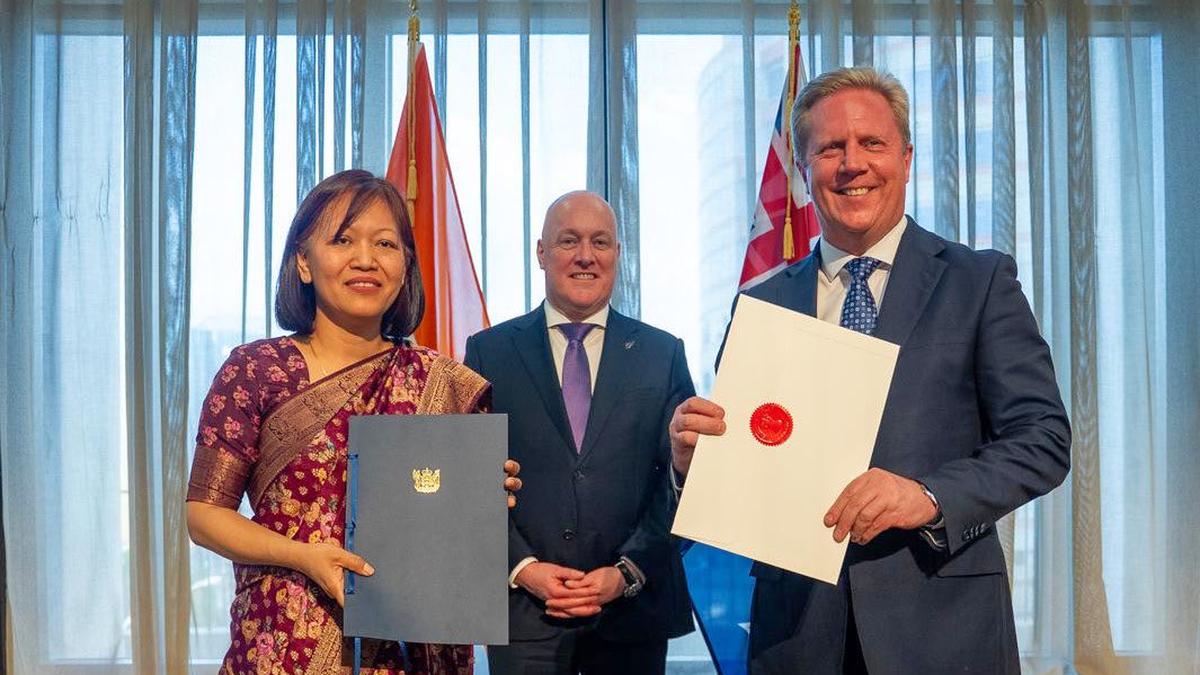
The India-New Zealand Free Trade Agreement (FTA) will come into force on October 20, 2026, after both countries completed the required ratification procedures, marking a major step in efforts to deepen bilateral trade and investment ties. The agreement was signed in New Delhi on April 27 after negotiations concluded in 2025.
Commerce and Industry Minister Piyush Goyal announced the implementation date on Monday, describing the October 20 launch, which falls on Dussehra, as an important milestone in the economic relationship between the two countries. New Zealand Trade and Investment Minister Todd McClay also confirmed completion of New Zealand’s domestic procedures, following parliamentary approval of the implementing legislation on September 16.
The FTA is expected to significantly expand market access for businesses in both countries, with India securing duty-free access for 100% of its exports to New Zealand from the first day of implementation. The agreement is also accompanied by a commitment to facilitate up to $20 billion of New Zealand investment into India over 15 years.
Indian Exports to Receive Full Duty-Free Access
One of the most significant provisions for Indian exporters is the elimination of tariffs across all Indian export lines entering New Zealand.
Indian sectors expected to gain from the agreement include textiles and apparel, leather and footwear, engineering goods, pharmaceuticals, agriculture and processed food products. The removal of tariffs is intended to improve the competitiveness of Indian products in the New Zealand market.
Before the agreement takes effect, New Zealand maintains tariffs of up to 10% on several Indian products, including ceramics, carpets, automobiles and auto components. The FTA will remove this tariff barrier for Indian exports from October 20.
The agreement places particular emphasis on labour-intensive sectors, with the Indian government highlighting potential opportunities for MSMEs and women-led enterprises as exporters gain greater access to the New Zealand market.
New Zealand Gains Greater Access to Indian Market
The agreement also provides New Zealand exporters with expanded access to the Indian market.
New Zealand will receive tariff-free access on 57% of its exports to India initially, with the coverage increasing as tariff reductions are phased in. The two countries have agreed to eliminate or reduce tariffs covering around 95% of New Zealand’s exports by value.
Products benefiting from increased access include wood and forestry products, wool, sheep meat and raw leather hides. New Zealand exporters will also receive preferential quota access for products such as apples, kiwifruit and albumins.
India, however, has retained protections for several sensitive sectors. Dairy products and a number of agricultural commodities, including onions, chickpeas, peas and almonds, remain among the products excluded from tariff concessions. Sugar and several other sensitive product categories have also been excluded.
$20 Billion Investment Commitment
Beyond merchandise trade, the agreement contains a significant investment component.
New Zealand has committed to facilitate $20 billion of investment into India over a 15-year period. Indian officials have said the arrangement could encourage New Zealand companies to establish or expand manufacturing operations in India and use the country as a base to serve both the domestic market and other export markets.
The agreement also covers cooperation in areas including agricultural productivity, pharmaceuticals and medical devices, traditional medicine, technology and trade facilitation.
India and New Zealand Target ₹35,000 Crore in Bilateral Trade
The two countries have set an ambitious target of doubling bilateral trade in goods and services to approximately ₹35,000 crore, or NZ$7 billion, by 2030.
The target forms part of the broader India-New Zealand Strategic Partnership and Roadmap to 2030 announced during Prime Minister Narendra Modi’s July 2026 visit to New Zealand. The visit was the first by an Indian Prime Minister to New Zealand in four decades.
Bilateral trade in goods and services stood at approximately $2.4 billion in 2024-25, according to current reporting on the agreement. India’s major exports to New Zealand include pharmaceuticals, textiles, engineering goods and refined petroleum products, while New Zealand supplies India with products including wood, wool, metals and agricultural commodities.
Opportunities for Professionals and Students
The FTA also extends beyond goods and tariffs to services and mobility.
The agreement provides additional pathways for Indian professionals and students, including a dedicated quota of 5,000 Temporary Employment Entry visas and expanded post-study work opportunities. The provisions are intended to support greater professional and educational mobility between the two countries.
The two governments have also identified education, research, technology, agriculture and skills development as areas for deeper cooperation under their wider strategic partnership.
Agricultural and Technology Cooperation
Agriculture forms another important component of the India-New Zealand relationship.
Under the FTA’s Agricultural Productivity Partnership, the two countries are working on initiatives covering products such as kiwifruit, apples and honey. India and New Zealand have also agreed to establish Centres of Excellence for kiwifruit in Nagaland and Uttarakhand, with cooperation involving agricultural innovation, education and skills development.
The wider partnership also includes cooperation in clean energy, agri-tech, science and technology and climate-related initiatives. New Zealand has joined the Global Biofuels Alliance, while both countries have agreed to deepen cooperation through platforms including the International Solar Alliance and the Coalition for Disaster Resilient Infrastructure.
FTA Marks New Phase in Bilateral Economic Relations
The implementation of the FTA comes after negotiations that began in March 2025 and were concluded within nine months. The agreement was subsequently signed in New Delhi on April 27, 2026.
With ratification now complete, businesses in both countries will begin operating under the new tariff and market-access arrangements from October 20.
The agreement is therefore expected to become a central pillar of the India-New Zealand economic relationship, alongside cooperation in investment, services, education, agriculture, technology and clean energy. Its implementation also gives businesses a defined framework for expanding bilateral trade as both governments work towards their ₹35,000 crore trade target for 2030.
Disclaimer: This report has been editorially prepared using publicly available information and official statements. Readers are advised to refer to official announcements for further details.
Author

About the Author