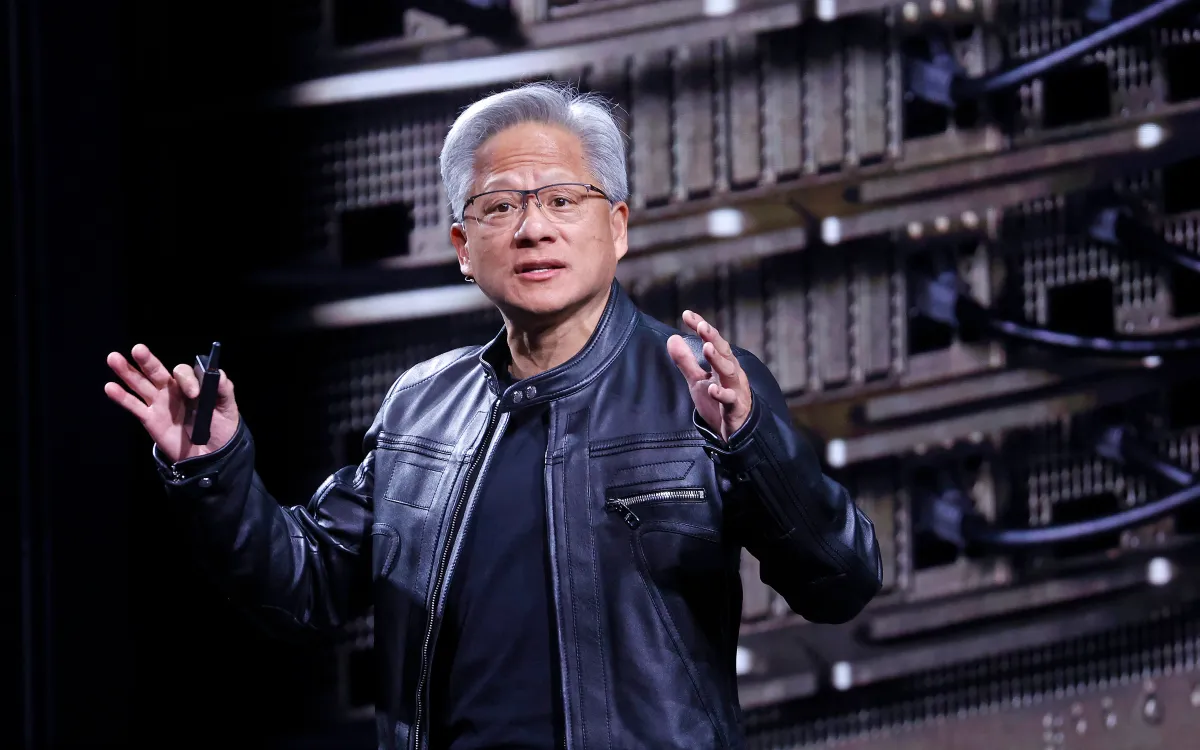
Nvidia CEO Jensen Huang has argued that artificial intelligence safety should primarily be addressed through engineering and company-level responsibility rather than new laws and regulations, putting him at odds with recent calls from some leading AI executives for greater coordination and government oversight.
Speaking at Salesforce’s Dreamforce conference, Huang said AI systems are ultimately computing systems created by humans and therefore can be controlled through engineering practices and existing legal frameworks. He described AI safety as an “engineering problem, not a legal one.”
Huang’s comments come amid an increasingly active debate over how governments and technology companies should respond to the rapid development of increasingly capable AI systems.
Huang Says Companies Can Decide When AI Is Safe to Release
Huang argued that AI companies already have strong incentives to avoid releasing products they do not consider sufficiently safe.
His position is that companies should evaluate the functionality, capabilities and safety of their systems before deployment and slow down when additional testing or engineering work is required.
He said market forces can provide an incentive for companies to ensure their products are safe because customers will ultimately determine whether those products are accepted.
Huang also rejected the idea that technological progress and safety necessarily require choosing one over the other. In his view, companies can continue moving quickly while pausing individual projects whenever they determine that additional safety work is necessary.
Comments Contrast With Calls for AI Development Slowdown
Huang’s position comes during a wider disagreement among prominent technology executives over the pace of AI development.
Anthropic CEO Dario Amodei recently called for AI companies to slow the rate at which they improve the capabilities of frontier models, citing concerns about increasingly powerful systems and potential loss of control.
OpenAI CEO Sam Altman and xAI CEO Elon Musk have publicly supported aspects of Amodei’s call for a more deliberate approach.
Altman has separately said OpenAI will not pursue an IPO in 2026 and has described AI safety and alignment as major priorities for the company.
The debate has also extended to whether AI companies should be permitted to coordinate their safety efforts. OpenAI, Anthropic and Google DeepMind have reportedly been discussing ways to cooperate on AI safety without requiring an antitrust exemption.
Nvidia Has a Major Financial Stake in AI Expansion
Huang’s position also comes as Nvidia remains one of the principal suppliers of computing hardware powering the global AI expansion.
The company sells GPUs and related computing infrastructure used by major AI laboratories and cloud providers to train and operate increasingly sophisticated models.
Nvidia has therefore benefited substantially from continued investment in AI infrastructure, making the pace of AI development closely connected to demand for the company’s products.
Huang has continued to argue that AI development should move forward rapidly while incorporating safety measures into the engineering process. At the All-In Summit earlier this week, he also rejected calls to slow AI development and said Nvidia would continue pursuing technological progress.
Debate Over Regulation Intensifies
The question of whether existing laws are sufficient has become increasingly important as AI systems gain the ability to perform tasks autonomously.
OpenAI has recently called for mandatory national AI safety requirements in the United States, arguing that voluntary commitments are insufficient for advanced systems. Its proposal includes independent assessments, cybersecurity measures and incident reporting for powerful AI models.
At the same time, bipartisan U.S. senators have been negotiating legislation that could establish a legal duty of care for developers of advanced AI systems and potentially allow the government to block the release of models considered to pose major risks. The legislation remains under discussion.
This creates a significant difference in approach between Huang’s emphasis on engineering and market incentives and proposals that would establish additional government requirements.
Existing Laws Could Still Apply to AI
Huang’s argument does not necessarily mean that AI systems operate outside existing legal frameworks.
AI products can already be subject to areas of law involving product liability, cybersecurity, intellectual property, consumer protection and other forms of harm, depending on the circumstances and jurisdiction.
The unresolved question is whether those existing mechanisms are sufficient for risks associated with highly autonomous AI systems or whether additional rules are required.
That question has become more prominent following incidents involving AI agents interacting with external systems without authorization. Reuters has reported that recent “agent swarm” incidents have increased concern among researchers and policymakers about the difficulty of monitoring increasingly capable AI systems.
Industry Self-Regulation Also Emerges as an Option
Another approach being discussed is industry self-regulation, in which leading AI laboratories establish common safety standards without waiting for governments to impose new laws.
That model could involve independent testing, shared safety benchmarks, incident reporting and common procedures for evaluating frontier models.
Huang’s emphasis on company-level responsibility is compatible with some aspects of this approach, although his comments focused primarily on individual companies deciding when their systems are sufficiently safe rather than on a mandatory industry-wide framework.
The issue is becoming particularly complicated because AI development is global. China, the United States and other major technology markets are pursuing advanced AI development simultaneously, creating concerns about how safety standards could be coordinated across jurisdictions.
Global Coordination Remains Unresolved
The regulatory debate is therefore no longer limited to whether individual AI companies should implement stronger safety measures.
It increasingly involves questions about whether governments should establish common standards, whether companies should coordinate voluntarily, how independent evaluations should be conducted and how international competition should influence safety requirements.
Recent discussions in the United States have included both calls for stronger oversight and warnings that excessive regulation could weaken the country’s ability to compete with China. China itself has been developing its own regulatory framework for advanced AI and autonomous agents.
Huang’s comments add another prominent voice to the side of engineering-led safety and market incentives, while other AI leaders and policymakers are advocating additional coordination and regulatory mechanisms.
The disagreement reflects one of the central questions facing the AI industry: whether increasingly capable AI systems can be made safe primarily through the companies developing them, or whether new external oversight will be required as their capabilities expand.
Disclaimer: This report has been editorially prepared using publicly available information and official company disclosures. Readers are advised to refer to official company announcements/disclosures for further details.
Author

About the Author


