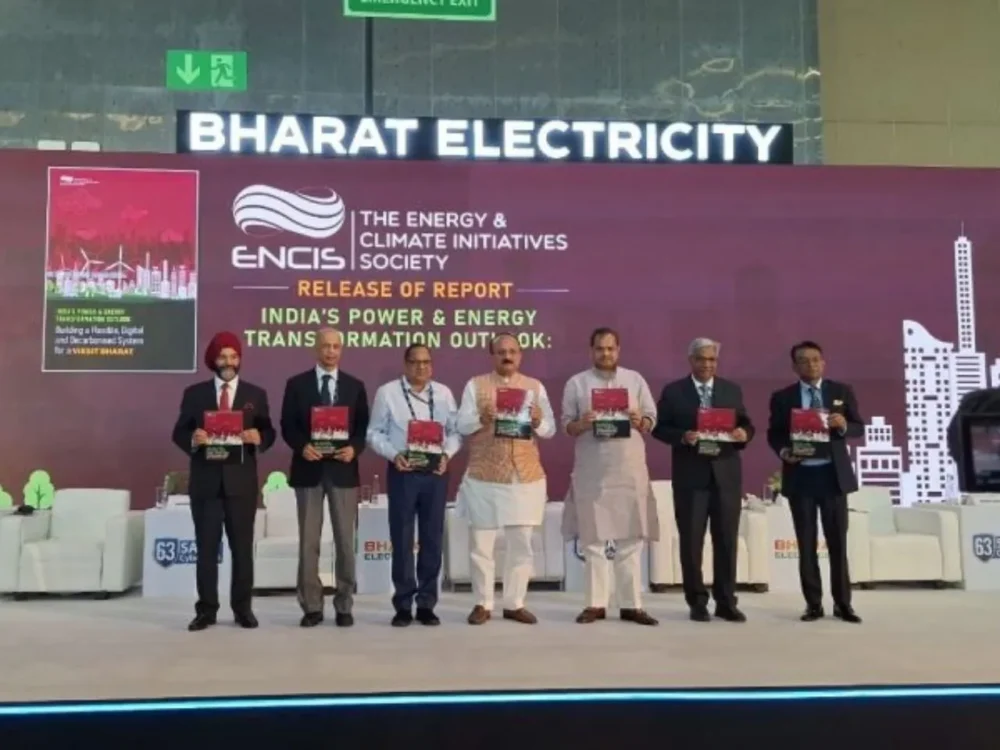
India’s installed power generation capacity is projected to more than quadruple over the next two decades, crossing 2,000 GW by 2047, as the country accelerates its shift toward renewable energy and modernises its power infrastructure, according to the India’s Power & Energy Transformation Outlook released by ENCIS in New Delhi.
The report outlines a major transformation in India’s electricity sector, with solar energy expected to account for the largest share of capacity growth. Solar capacity is projected to rise nearly tenfold from around 119 GW currently to more than 1,100 GW by 2047.
The scale of the expansion is expected to require sustained investment across the entire power ecosystem, extending beyond generation capacity to transmission networks, energy storage, distribution infrastructure, digital systems and skilled manpower.
Solar Set to Anchor India’s Long-Term Power Expansion
Solar energy is expected to remain at the centre of India’s clean-energy expansion over the coming decades. The projected increase from 119 GW to more than 1,100 GW would represent one of the largest additions of renewable capacity in the country’s power sector.
However, the report emphasises that increasing generation capacity alone will not be sufficient. India’s power system will need stronger grids, significantly larger storage capacity and greater flexibility to manage the variable nature of renewable generation.
Bhupinder Singh Bhalla, IAS (Retd.), Chairperson of the Governing Council for the event and former Secretary, Ministry of New and Renewable Energy, said India’s next phase of energy transition would require a greater focus on coordination across the power system.
“India’s energy transition is now about orchestration, not just expansion.”
He said the success of the next phase should be measured not merely by the number of gigawatts added, but by the ability to create an electricity system that remains reliable, affordable, flexible and secure.
India Reaches Non-Fossil Capacity Milestone Ahead of Schedule
The report highlights the rapid progress already made in India’s clean-energy transition. Non-fossil sources account for 53% of the country’s 540 GW installed power capacity, with the milestone being achieved five years ahead of schedule.
At the same time, India’s electricity demand profile has undergone a significant transformation. Peak power demand has nearly tripled since 2000 and is expected to reach 366 GW by 2032, representing a further 34% increase.
The rise is expected to be driven partly by emerging electricity-intensive sectors and technologies, including data centres, electric mobility and green hydrogen production.
Ghanshyam Prasad, Chairperson of the Central Electricity Authority, said India’s power sector was witnessing rapid capacity additions alongside a growing shift toward clean energy.
He stressed that the challenge would increasingly involve integrating renewable generation, storage and emerging technologies into the grid while maintaining reliability, flexibility and affordability.
Energy Storage Requirements Expected to Surge
Energy storage is expected to become one of the most critical components of India’s future power system.
The report projects that grid-scale storage capacity will need to increase approximately 40-fold to reach 200 GWh by 2030. The scale of the requirement represents a major infrastructure challenge as India seeks to integrate substantially larger volumes of variable renewable energy.
The report also calls for India to nearly triple renewable-energy deployment by 2030 while taking non-fossil capacity to 500 GW.
Large-scale storage would help bridge the gap between renewable generation and electricity demand, allowing excess clean electricity to be stored and subsequently supplied when renewable output is lower or demand is higher.
Smart Metering and Distribution Remain Critical
India’s distribution sector is expected to play an increasingly important role in the country’s power transformation. Smart-meter deployment is projected to reach 250 million units by FY2028, potentially placing around 90% of consumer electricity demand under real-time management.
The expansion of digital metering is expected to support more efficient demand management while helping utilities improve their understanding and control of electricity consumption.
Distribution losses have already declined to around 15% following digital and operational reforms, while the report targets national aggregate technical and commercial losses of below 10%.
Despite this progress, distribution remains a major bottleneck for the sector. Around 44 GW of renewable capacity is reportedly held up in financing or contractual uncertainty, highlighting the need for stronger project execution and coordination across the power value chain.
Coal Expected to Continue Supporting Grid Stability
While renewable energy will dominate new capacity additions, coal is expected to retain an important role in ensuring grid stability during the transition.
According to the report, coal-fired power plants will need to adapt to a more flexible operating environment, including operating at minimum technical loads of around 40% and achieving ramp rates of 3% by 2030.
This reflects the changing role of conventional generation as renewable energy penetration increases. Instead of operating primarily as continuous baseload capacity, coal plants will increasingly be required to respond to fluctuations in renewable generation and changes in electricity demand.
$500 Billion Investment Requirement by 2030
The scale of India’s power-sector transformation will require substantial capital deployment. The report estimates that around $0.5 trillion in investment will be required across the power sector by 2030.
Investment will need to cover renewable generation, transmission and distribution infrastructure, energy storage, digitalisation and other supporting technologies.
The transition will also create a significant demand for skilled workers. The report estimates that more than one million newly skilled workers will be required to support India’s shift toward a cleaner, more digital and technologically advanced energy system.
With electricity demand continuing to rise and renewable energy taking a growing share of the generation mix, India’s challenge is increasingly shifting from simply adding capacity to building an integrated power system capable of delivering reliable electricity around the clock.
By 2047, the projected expansion to more than 2,000 GW of installed capacity would represent a fundamental transformation of India’s energy landscape, with solar generation, storage, digital distribution and grid flexibility expected to form the backbone of the country’s future power system.
Disclaimer: This report has been editorially prepared using publicly available information and official statements. Readers are advised to refer to official announcements for further details.
Author

About the Author