New field observations from Italy are adding fresh evidence to the potential of agrivoltaic systems to moderate extreme heat around crops, while also highlighting the delicate balance farmers must maintain between providing shade and preserving agricultural productivity.
Giuseppe Ferrara, a fruit-tree crops professor at the University of Bari Aldo Moro, has reported that soil beneath an agrivoltaic installation in Puglia measured more than 20 degrees Celsius cooler than exposed soil a short distance away. The reading was taken at around 11 a.m. during an unusually hot period, making it an important indication of the cooling effect of solar panels but not a measure of average seasonal temperature reduction.
The observation comes as agrivoltaics, which combines agricultural production with solar power generation, attracts increasing attention as a potential way to address energy, heat and water challenges simultaneously. However, Ferrara’s research also points to an important limitation: increasing shade does not necessarily translate into better agricultural outcomes.
A 20°C Difference Recorded Beneath Solar Panels
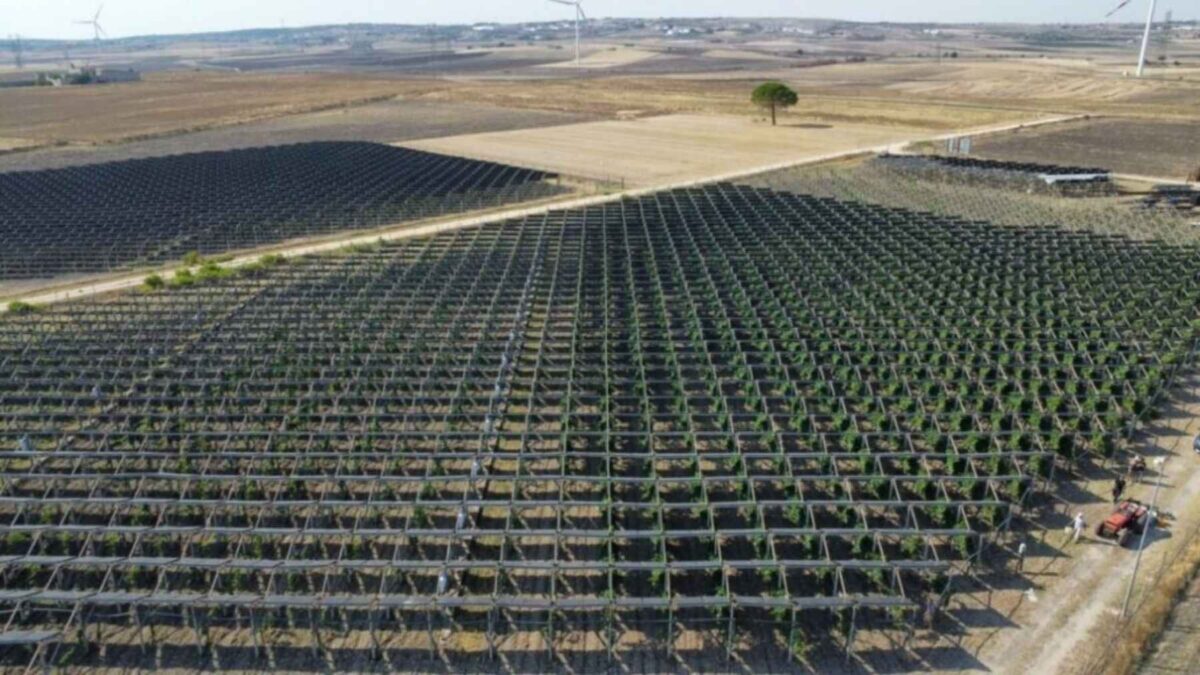
Ferrara’s measurements were taken at an agrivoltaic site in Laterza, in Italy’s Puglia region. Soil beneath the solar array recorded a temperature more than 20°C lower than soil exposed to direct sunlight nearby.
The difference corresponds to more than 36°F, because the Celsius-to-Fahrenheit temperature interval is larger by a factor of 1.8.
However, Ferrara has stressed that the measurement should not be interpreted as the typical temperature difference throughout an entire farm or growing season. Soil temperature responses vary depending on factors including latitude, time of day, ambient temperature and soil characteristics.
The measurement was taken during a period of unusually high temperatures, meaning it represents a particularly hot-day observation rather than an average annual or seasonal cooling figure.
That distinction is important as agrivoltaic projects increasingly use claims about shade and cooling to demonstrate potential benefits for agricultural production.
Shade Can Help, But Too Much Can Hurt
While reduced heat exposure can benefit crops during extreme conditions, Ferrara’s earlier research indicates that there is a threshold beyond which additional shade can negatively affect agricultural performance.
A 2024 review co-authored by Ferrara, Magarelli and Mazzeo recommended keeping shading below 30% to avoid substantial declines in fruit yield and quality.
The finding highlights one of the central challenges of agrivoltaic farming. Solar panels can reduce exposure to intense sunlight and lower temperatures, but crops still require sufficient light for photosynthesis and productive growth.
For fruit growers, therefore, the objective is not simply to maximise shade. Instead, solar installations need to be designed around the requirements of the specific crop, local climate and production system.
Two Italian Sites Under Study
Ferrara’s team is studying agrivoltaic systems at two sites in Italy as part of a collaboration involving the University of Bari, the Italian National Agency for New Technologies, Energy and Sustainable Economic Development (ENEA), Agridatalog and other partners.
The first project is the Vigna Agrivoltaica di Comunità at Laterza in the province of Taranto. Operated by Svolta Srl, the project has approximately 970 kW of solar capacity distributed across around 7,770 thin-film panels rated at 135 W, 125 W and 100 W.
The panels are installed at a 28-degree tilt on reinforced concrete structures designed around a pergola-style vineyard configuration.
Researchers at the site are examining conditions affecting fig and olive cultivation, including the interaction between solar infrastructure, soil temperatures and crop environments.
The second project is located at Scalea in Calabria, where the Le Greenhouse consortium is involved in agricultural operations. The project is designed to examine lemon cultivation under different photovoltaic configurations, including fixed panels and single-axis trackers.
The installation also incorporates bifacial solar modules, battery storage and a reverse-osmosis system capable of producing up to 240 litres of treated water per hour from brackish water.
Researchers are studying lemons and lavender at the site, providing an opportunity to compare how different crops respond to different photovoltaic configurations.
Agrivoltaic Designs Produce Different Outcomes
The two Italian projects illustrate why agrivoltaic systems cannot be assessed using a single set of assumptions.
Panel height, orientation, tracking mechanisms, crop type, local climate, soil characteristics and shading levels can all influence agricultural results. A configuration that works for one crop or region may not produce the same outcome elsewhere.
Ferrara’s group is therefore using the two sites to examine different combinations of crops and photovoltaic technologies rather than treating agrivoltaics as a uniform technology.
The approach is particularly relevant as farmers and solar developers explore ways to integrate electricity generation with productive agricultural land.
Princeton Study Finds Cooling Benefits for Tomatoes
Independent modelling from researchers at Princeton University has also examined the interaction between solar panels, crops and heat.
Erfan Hosseini and Elie Bou-Zeid used a model to simulate air, heat and moisture movement around solar panels, soil and plants using data from a tomato farm under a typical New Jersey summer day.
Their study, published in the Journal of Advances in Modeling Earth Systems, found that simulated tomato leaves were at least 1.84°C cooler under panels, with cooling reaching as much as 7.56°C during the hottest part of the day.
The model also indicated that shaded plants received 47% less direct sunlight and experienced a 31% reduction in photosynthesis. At the same time, water loss from leaves fell by 22.4% per day, while combined water loss from crops and soil fell by 42.6%.
The solar panels themselves were modelled as being approximately 5.6°C cooler, reducing heat-related efficiency losses by an estimated 15%.
The research also examined conditions for agricultural workers. The simulated environment produced an average reduction in perceived temperature of about 4.46°C, with perceived temperature falling from approximately 39°C to 35°C.
Because the Princeton results were generated through modelling while Ferrara’s findings were based on direct field measurements, the two sets of figures measure different aspects of agrivoltaic performance and should not be treated as interchangeable.
Why Crop Type Matters
The distinction is especially important for fruit-growing regions. In the United States, the overwhelming majority of olive production is concentrated in California, which also accounts for most of the country’s fig production.
California’s olive sector faces several challenges, including labour availability, input costs and marketing pressures. The potential use of agrivoltaics in orchards could therefore offer an additional pathway for managing heat and water stress, although the technology’s economic and agricultural effects require crop-specific evaluation.
Agrivoltaics is already present across the United States, although many installations focus on applications such as pollinator habitat or grazing rather than fruit-tree cultivation.
This means that research into orchard-based agrivoltaics could become increasingly important as developers and agricultural producers look for ways to integrate renewable energy generation with higher-value crops.
Researcher Calls for Evidence-Based Decisions
Ferrara’s involvement in the research also reflects the need for independent and detailed field data as agrivoltaics expands.
His laboratory at the University of Bari lists him as a co-founder and scientific chief officer of Agridatalog, one of the academic spin-off companies involved in the Italian projects. His academic work includes more than 230 published papers.
Ferrara has emphasised that bringing universities, research institutions and companies together can generate broader field data and provide decision-makers with information extending beyond the potential benefits of solar technology.
His position also underscores the importance of considering both the advantages and limitations of agrivoltaics. While reduced soil temperatures, lower water loss and improved conditions during extreme heat could benefit agriculture, excessive shading can compromise photosynthesis and ultimately affect crop yields and quality.
Full Seasonal Results Still Awaited
The Italian research programme remains ongoing, with researchers continuing to monitor the two sites.
Importantly, full-season yield data for the fig, olive, lemon and lavender crops have not yet been published. The more than 20°C soil-temperature difference reported from Laterza therefore provides a significant field observation, but it should not be interpreted as evidence that agrivoltaic systems will produce the same cooling effect throughout an entire growing season.
The findings instead point toward a more nuanced picture of agrivoltaics: solar panels can create substantially cooler microclimates under certain conditions, but the agricultural benefits depend on carefully controlling the amount and pattern of shade.
For farmers, the challenge will be to find the point at which solar infrastructure provides meaningful protection from heat and water stress without depriving crops of the sunlight they need to produce fruit.
Disclaimer: This report has been editorially prepared using publicly available information and official statements. Readers are advised to refer to official announcements for further details.
Author

About the Author