
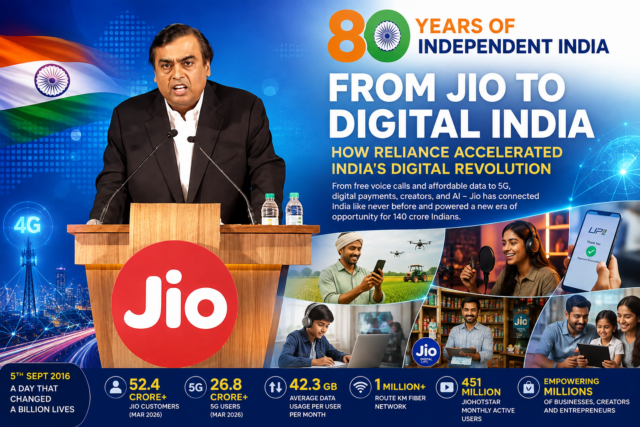
New Delhi, 16 August 2026: On 15 August 1947, India won its political freedom. Eight decades later, India is celebrating another transformation—the freedom to connect, communicate, create, transact, learn and do business digitally. And at the heart of this transformation stands a remarkable corporate story.
Reliance Jio.
When Jio entered the Indian telecom market on 5 September 2016, it did not simply launch another mobile network.
It challenged the fundamental economics of connectivity.
It made voice calling free, dramatically lowered the cost of data and invested at unprecedented scale in a nationwide 4G network.
Reliance’s own 2016-17 annual report described Jio as a catalyst for India’s digital adoption, noting that it crossed 100 million subscribers in just 170 days and that India’s data consumption increased multi-fold after its launch. (Reliance Industries Limited)
That was the moment India’s digital revolution moved from possibility to mass reality.
THE 80-YEAR JOURNEY: FROM A FREE INDIA TO A CONNECTED INDIA
India’s first freedom struggle was about gaining control over its own destiny. The next decades were about building the foundations of a modern nation—roads, power, industries, telecommunications and institutions.
The digital era added another layer:
Connectivity.
And Reliance has repeatedly played a role in making connectivity more affordable.
Dhirubhai Ambani’s vision was to make communication affordable to ordinary Indians. Reliance’s earlier telecom initiatives helped push calling and mobile connectivity towards the mass market.
Mukesh Ambani’s Jio took that philosophy into the Internet age.
First, affordable calling.
Then, affordable data.
And finally, a complete digital ecosystem.
Reliance itself describes this journey as moving from the telecom revolution of the 2000s to catalysing India’s digital adoption through Jio. (Reliance Industries Limited)
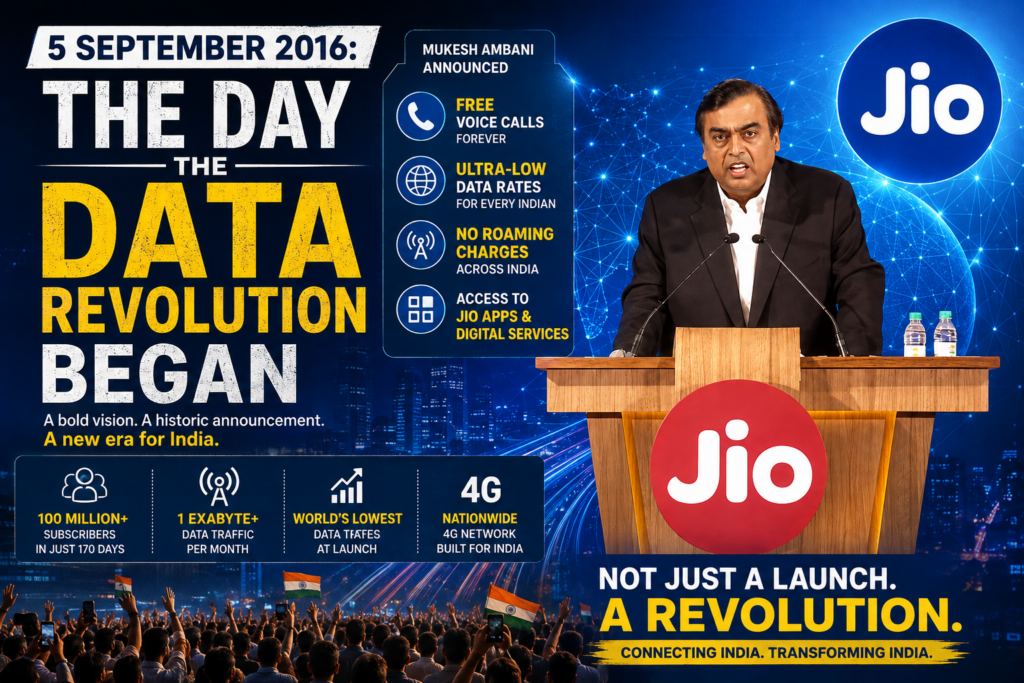
5 SEPTEMBER 2016: THE DAY THE DATA REVOLUTION BEGAN
Before Jio, Indian consumers were familiar with mobile phones, but mobile Internet was still expensive enough to be used cautiously.
Jio changed the equation.
Mukesh Ambani announced that domestic voice calls would be free, national roaming would carry no roaming charges, and data would be offered at dramatically lower rates. Jio’s initial plans ranged from ₹19 per day to monthly plans going up to ₹4,999, with the company describing its data rates as among the world’s lowest. (Reliance Industries Limited)
Then came the announcement that shocked the industry:
Jio’s Welcome Offer made data, voice, video and Jio applications available free until 31 December 2016. (RIL)
It was an audacious strategy. But it worked. Within 170 days, Jio had crossed 100 million subscribers.
THE MOST IMPORTANT NUMBER WAS NOT 100 MILLION
The real significance of Jio’s achievement was not the number of SIM cards sold. It was the behaviour Jio created.
In its first year, Reliance reported that Jio customers were already consuming around 10 GB of data per month on average, while Jio’s monthly data traffic had crossed 1 exabyte. India had rapidly become the world’s largest mobile data-consuming market. (Reliance Industries Limited)
Think about what that meant.
Before Jio:
Data was something to conserve.
After Jio:
Data became something to consume.
And then something to create with.
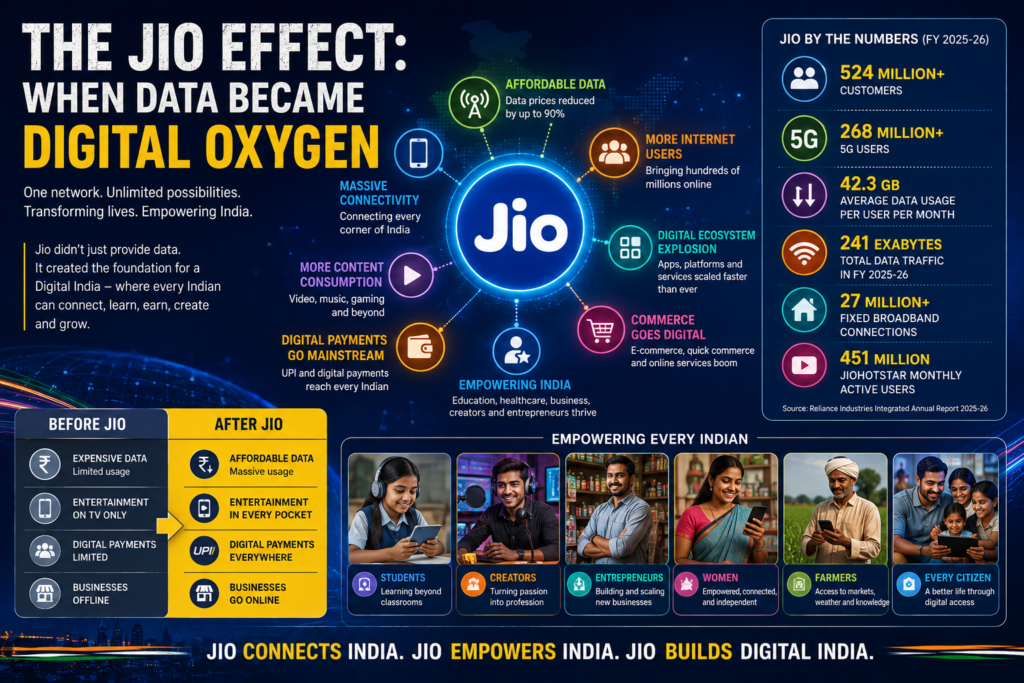
THE JIO EFFECT: WHEN DATA BECAME DIGITAL OXYGEN
Jio’s philosophy was simple:
Data should be affordable and accessible to every Indian.
That philosophy changed the economics of the Internet.
A young person in a village could watch a lecture.
A small trader could use WhatsApp to find customers.
A student could watch tutorials on YouTube.
A homemaker could start an online business.
A young filmmaker could upload a video.
A local shopkeeper could accept a digital payment.
A creator could build an audience without owning a television channel.
Connectivity became opportunity. That is the real story of Jio.
FROM VIEWERS TO CREATORS
Perhaps the most visible transformation came through social media and digital content. India’s smartphone user stopped being merely a consumer.
The smartphone became a:
Camera.
Editing studio.
Broadcasting station.
Advertising platform.
Shopfront.
Payment terminal.
And sometimes—
a full-time workplace.
The creator economy that exists in India today could not have achieved its present scale without the combination of smartphones, affordable data and digital platforms.
According to Boston Consulting Group, India now has more than 2–2.5 million monetised content creators, influencing $350–400 billion in consumer spending. That influence could exceed $1 trillion by 2030. That is a remarkable economic transformation.
THE JIO CONNECTION TO INDIA’S CREATOR ECONOMY
Reliance did not directly employ all these creators—and it would be wrong to claim that But Jio helped create one of the most important foundations on which this economy operates:
Affordable, high-speed connectivity at mass scale.
The chain is simple:
Jio connectivity
↓
Affordable Internet
↓
More smartphones online
↓
More video consumption
↓
More social-media users
↓
Larger audiences
↓
More creators
↓
More advertising
↓
More digital income
A new generation found a new way to earn.
UPI: INDIA’S DIGITAL PAYMENT REVOLUTION
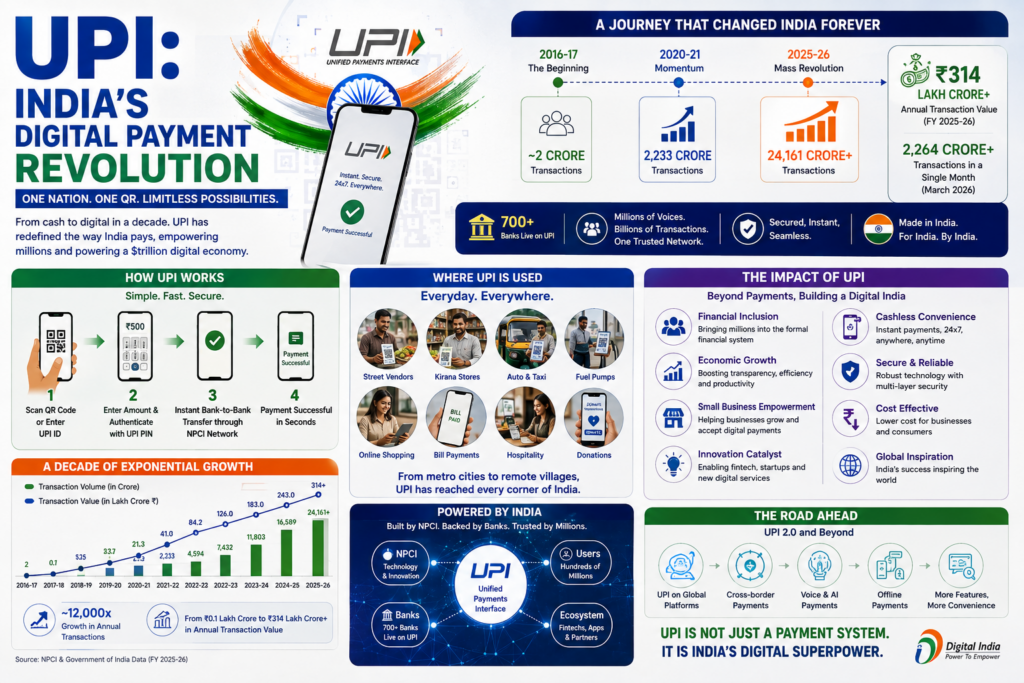
India’s digital story has another extraordinary chapter: UPI.
UPI was developed by NPCI, not Reliance, and therefore its creation should rightly be credited to India’s digital public infrastructure But affordable Internet and smartphones provided the mass connectivity environment in which UPI could explode.
Today, the combination is everywhere:
Smartphone + Internet + UPI = Digital India at the grassroots
A vegetable seller can receive ₹50 digitally.
A student can pay fees online.
A family can transfer money instantly.
A small business can operate without a sophisticated banking infrastructure.
Digital payments turned the smartphone into India’s pocket-sized bank.
And the Jio revolution helped ensure that the Internet required for this digital economy could reach hundreds of millions.
FROM 2 CRORE UPI TRANSACTIONS TO A DIGITAL PAYMENT POWERHOUSE
In FY2016-17, UPI was still in its infancy. Today, India processes tens of billions of UPI transactions every year. This extraordinary expansion represents the coming together of multiple Indian innovations:
UPI + Aadhaar + smartphones + banking + fintech + affordable connectivity.
Jio did not create all of these technologies.
But it helped create the digital highway on which millions of these transactions could travel.
THE GREAT DIGITAL DEMOCRATISATION
The most powerful impact of Jio may be outside India’s biggest cities.
Cheap data brought the Internet closer to:
- Tier-II cities
- Tier-III towns
- Small businesses
- Students
- Rural youth
- Women entrepreneurs
- Local retailers
- First-generation Internet users
The Internet stopped being primarily an urban privilege.
It became a mass Indian utility.
And this is where Jio’s contribution becomes particularly significant.
FROM 10 GB A MONTH TO 42.3 GB
The scale of the transformation is visible in Jio’s own numbers. In its early years, average Jio data consumption was around 10 GB per user per month. By FY2025-26, average per-capita data consumption had reached approximately 42.3 GB per month. That is more than a four-fold increase in usage.
The Indian consumer has moved from:
“How much data can I afford?”
to
“What can I do with unlimited connectivity?”
524 MILLION: THE SCALE OF JIO TODAY
Ten years after its launch, Jio has reached a scale few telecom companies anywhere in the world can match.
As of March 2026:
524 million+ Jio customers
268 million+ 5G users
27 million+ fixed broadband connections
241 exabytes of FY2025-26 data traffic
42.3 GB average monthly data usage per user
These figures come from Reliance’s FY2025-26 disclosures. The numbers tell a remarkable story.
The network launched in 2016 is now carrying the digital lives of more than half a billion people.
THE SECOND REVOLUTION: 5G
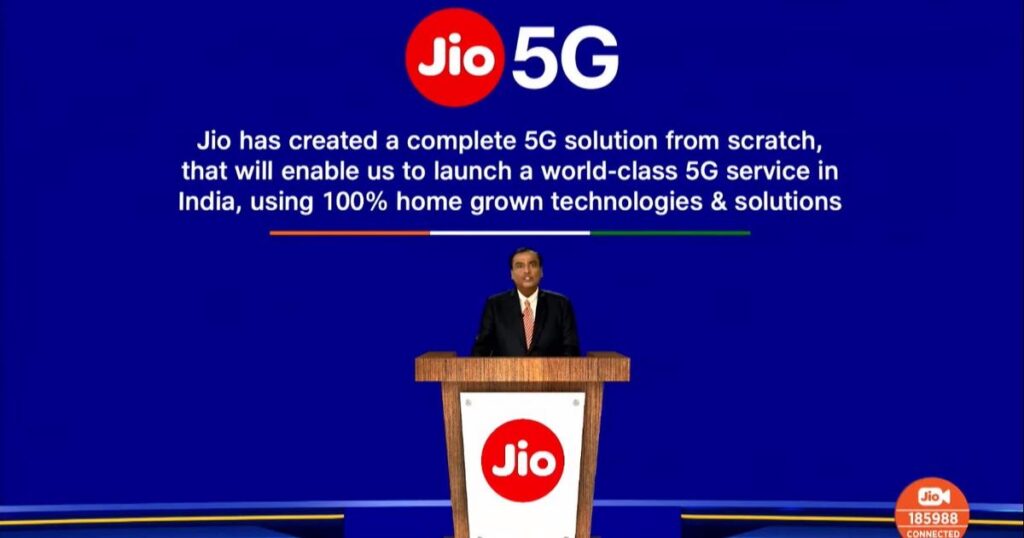
Jio did not stop with 4G. The company has aggressively scaled 5G across India. By March 2026, Jio reported more than 268 million 5G users, with 5G accounting for approximately 55% of its wireless data traffic.
Its fixed broadband business has also crossed 27 million connections.
JioAirFiber alone has reached more than 13 million connected homes.
The mission has moved from connecting smartphones to connecting homes, businesses and entire communities.
JIO IS NO LONGER JUST A TELECOM COMPANY
This is perhaps the biggest change of all. Jio has evolved into a broad digital ecosystem encompassing:
Mobile Connectivity
5G
Home Broadband
Entertainment
Digital Applications
Cloud
Enterprise Services
Gaming
Digital Commerce
AI
The scale is reflected in its financial performance. In FY2025-26, Reliance’s Digital Services business reported:
₹1,49,965 crore revenue from operations
₹76,560 crore EBITDA
with revenue growing 14.2% year-on-year. This is no longer a telecom story.
It is an Indian digital infrastructure story.
THE ENTERTAINMENT REVOLUTION
Once Indians came online, entertainment followed. Video consumption exploded. Streaming became mainstream. Cricket moved to smartphones. Movies moved to smartphones. News moved to smartphones. Creators moved to smartphones.
Reliance’s digital ecosystem has expanded into entertainment through its media and digital businesses. The result is a powerful combination:
Connectivity + Content + Commerce
This is one of the defining characteristics of Reliance’s digital strategy.
FROM CONNECTIVITY TO COMMERCE
The digital consumer does not simply watch content.
The consumer discovers products.
Reviews them.
Compares them.
Pays digitally.
Orders online.
And receives them at home.
This is where Jio and Reliance Retail complement each other.
Reliance Retail had a registered customer base of approximately 387 million as of Q4 FY2026, according to Reliance. (Reliance Industries Limited)
The telecom network connects the consumer.
The digital ecosystem engages the consumer.
The retail network serves the consumer.
That creates a powerful integrated model.
THE NEXT CHAPTER: AI FOR EVERY INDIAN
And now Reliance is preparing for what could be the next great technological transformation:
Artificial Intelligence.
Reliance has announced plans to invest ₹10 lakh crore in multi-gigawatt AI-ready data centres, with the stated objective of building large-scale AI infrastructure in India and reducing the cost of AI access.
The ambition is striking.
The company wants AI to reach:
Farmers.
Students.
Small businesses.
Entrepreneurs.
Large enterprises.
From data for every Indian to AI for every Indian.
THE RELIANCE FORMULA
Across decades, one philosophy appears repeatedly:
Build at scale. Reduce the cost. Expand access. Create the ecosystem.
It happened with:
Telecom
↓
Jio 4G
↓
5G
↓
Retail
↓
Entertainment
↓
Digital Services
↓
AI
The ambition is not simply to participate in India’s growth.
It is to build the infrastructure through which that growth happens.
THE JIO LEGACY

The most important legacy of Jio may not be the number of subscribers it has today. It may be the ecosystem that grew because hundreds of millions of Indians came online. A generation of creators emerged.
Small businesses went digital.
Digital payments became routine.
Video became mobile.
Entertainment became personalised.
Commerce became omnichannel.
Education became accessible from anywhere.
And the smartphone became an economic tool.
Jio did not create every part of this transformation.
But it helped accelerate the transformation by making the most fundamental resource—connectivity—available at unprecedented scale and affordability.
FROM POLITICAL FREEDOM TO DIGITAL FREEDOM
India’s first freedom gave Indians the right to determine their own destiny.
The digital revolution is giving millions new tools to pursue that destiny.
A creator can reach an audience.
A small entrepreneur can find customers.
A student can access knowledge.
A village business can find a market.
A consumer can access services.
A young Indian can compete with the world from a smartphone.
That is another form of freedom.
And on India’s 80th Independence Day, the story of Jio represents something larger than the success of one company.
It represents the power of Indian scale, Indian ambition and Indian entrepreneurship.
THE FINAL WORD
In 2016, Reliance made a bold proposition: Data should be affordable for every Indian. Ten years later, the result is visible everywhere.
In every smartphone.
Every Reel.
Every YouTube channel.
Every QR code.
Every online business.
Every digital transaction.
Every streaming screen.
Every virtual classroom.
Every creator building an audience.
Every small entrepreneur reaching a customer online.
And now, in the next phase, in every AI application that can reach an Indian user.
Jio did not merely change India’s telecom market.
It helped change what Indians could do with technology.
From calls to data.
From data to content.
From content to commerce.
From consumers to creators.
From smartphones to digital businesses.
And from 4G to 5G and AI.
On the 80th Independence Day of India, the Jio story can therefore be seen as part of a much larger national transformation:
A Free India Became a Connected India.
A Connected India Became a Digital India.
And a Digital India Is Now Preparing to Become an AI-Powered India.
Reliance Jio has been one of the most powerful engines driving that journey.
Author
About the Author