
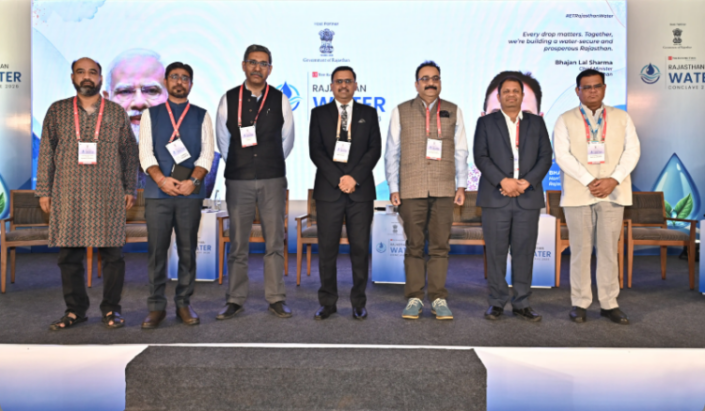
Public-private partnerships (PPP), corporate social responsibility (CSR) initiatives and active community participation will be critical to ensuring Rajasthan’s long-term water security, experts said at the ETGovernment Rajasthan Water Conclave 2026.
The conclave brought together policymakers, industry leaders, development organisations and water experts, who stressed that collaborative action is essential to address water scarcity, strengthen climate resilience and promote sustainable water management across the state.
Collaborative Approach Essential for Water Security
Experts agreed that achieving water security cannot be accomplished by government efforts alone. Instead, they emphasised the need for a coordinated approach where governments provide policy direction, industries contribute investments and innovation, development organisations strengthen implementation, and local communities actively participate in conservation efforts.
The discussion concluded that integrated partnerships will be crucial in building a climate-resilient and water-secure Rajasthan.
Community Participation at the Core
Rishi Arora, Co-Lead at the Piramal School of Leadership, highlighted that community ownership remains the foundation of successful water conservation programmes.
Drawing from the Piramal Foundation’s experience in Rajasthan, he said long-term behavioural change, local participation and strong last-mile engagement are essential for ensuring sustainable outcomes. He added that CSR should act as an implementation partner that empowers communities while promoting responsible water stewardship.
Technology and Innovation Can Accelerate Conservation
Anuj Sharma, CEO of Arghyam, emphasised that technology, digital tools and innovative solutions can significantly improve water conservation efforts.
He noted that private sector participation through CSR complements government initiatives by bringing innovation, execution capabilities and measurable outcomes to water management programmes.
Scientific Planning and Policy Reforms Needed
Dr. Arvind Kumar, President and Founder of the India Water Foundation, stressed the importance of integrated water governance supported by scientific research, policy reforms and community engagement.
He advocated wider adoption of technologies such as:
- Hydrogeological mapping
- Wastewater reuse
- Scientific water resource planning
These measures, he said, would strengthen groundwater management and improve long-term climate resilience.
Grassroots Models Deliver Results
Sharing experiences from field projects, Dr. Subh Karan Singh, President of Arpan Seva Sansthan, said watershed development, scientific planning and community participation have significantly improved groundwater recharge and water availability in several parts of Rajasthan.
He called for successful watershed models to be replicated across the state through stronger partnerships between governments, NGOs, research institutions and corporate organisations.
CSR Investments Driving Sustainable Impact
Industry representatives highlighted the growing role of CSR in supporting long-term water conservation.
Anupam Nidhi, Head CSR at Hindustan Zinc & Vedanta Limited, said CSR investments should prioritise community-led water conservation, improved water infrastructure and innovative solutions that generate lasting environmental and social benefits.
Similarly, Raghavendra Pratap Singh, Director (Operations) at the Aga Khan Foundation, emphasised that successful water conservation requires sustained CSR investments backed by scientific planning and continuous community engagement.
Prabhakant Jain, CSR Head at Dharampal Satyapal Ltd, added that CSR has evolved into a powerful catalyst for sustainable development by bringing together governments, industries and communities to create lasting environmental impact.
The conclave concluded with a consensus that stronger collaboration between the public sector, private companies, civil society organisations and local communities will be essential for ensuring Rajasthan’s long-term water security and climate resilience.
Author

About the Author