
New Delhi, 17 July: While solar panels capture sunlight and wind turbines harness the breeze, another powerful source of renewable energy works silently beneath our feet. It never sleeps, never depends on the weather, and has been heating the Earth for billions of years. This is geothermal energy—one of the world’s oldest and most reliable sources of clean power.
Although geothermal energy contributes only a small share of global electricity today, experts believe it could become a major pillar of the world’s clean energy transition. But what exactly is geothermal energy, where does it come from, and why is it attracting renewed attention? Here’s the complete story.
What is Geothermal Energy?
The word geothermal comes from two Greek words:
- Geo = Earth
- Therme = Heat
Simply put, geothermal energy is the heat stored inside the Earth.
Deep below the Earth’s surface lies an enormous reservoir of heat created by:
- Heat left over from the Earth’s formation about 4.5 billion years ago
- Natural radioactive decay of minerals deep underground
This heat continuously warms underground rocks and water, creating a natural source of energy that can be used for electricity, heating and cooling.
The Story Begins at the Centre of the Earth
The Earth is made up of several layers.
1. Crust
The outer layer where humans live.
2. Mantle
A thick layer of hot molten rock.
3. Outer Core
Made mostly of molten iron and nickel.
4. Inner Core
A solid ball of iron with temperatures reaching nearly 5,500°C, almost as hot as the Sun’s surface.
Heat slowly moves upward from these deep layers through rocks, warming underground reservoirs of water.
How Does Geothermal Energy Reach the Surface?
Rainwater slowly seeps deep into the ground.
As it travels downward:
- It encounters hot rocks.
- The water heats up.
- It becomes extremely hot water or steam.
- Pressure builds naturally underground.
Sometimes this steam escapes naturally through:
- Hot springs
- Geysers
- Steam vents
- Fumaroles
Countries like Iceland, New Zealand and the United States have many such natural geothermal areas.
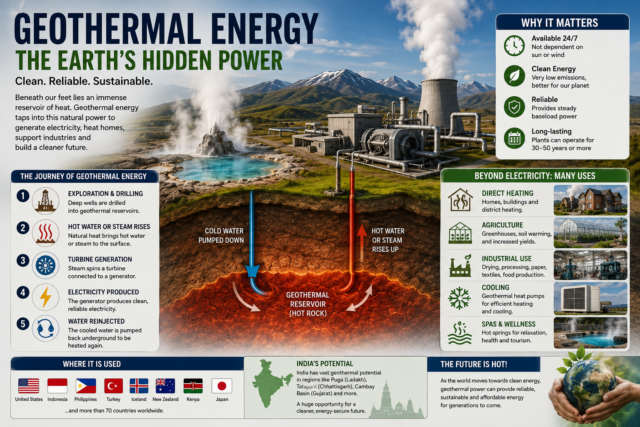
How Do Geothermal Power Plants Work?
The process is surprisingly simple.
Step 1: Drill Wells
Engineers drill deep wells into geothermal reservoirs.
Step 2: Bring Steam to the Surface
Hot water or steam rises naturally due to underground pressure.
Step 3: Spin a Turbine
The steam rotates a turbine connected to a generator.
Step 4: Generate Electricity
The generator converts mechanical energy into electricity.
Step 5: Recycle the Water
After cooling, the water is pumped back underground to be reheated, creating a sustainable closed-loop system.
Three Main Types of Geothermal Power Plants
Dry Steam Plant
Uses steam directly from underground to drive turbines.
Best for: High-temperature geothermal fields.
Flash Steam Plant
High-pressure hot water is brought to the surface.
As pressure drops, part of the water instantly turns into steam (“flashes”), which drives the turbine.
This is the most common geothermal power technology worldwide.
Binary Cycle Plant
Moderately hot water heats a second liquid with a lower boiling point.
The second liquid vaporizes and spins the turbine.
This technology allows electricity generation even from lower-temperature geothermal resources.
Beyond Electricity: Many Uses of Geothermal Energy
Geothermal energy is much more than power generation.
Home Heating
Entire neighbourhoods in countries like Iceland receive heating through geothermal systems.
Cooling Buildings
Geothermal heat pumps provide energy-efficient heating in winter and cooling in summer.
Agriculture
Farmers use geothermal heat to warm greenhouses and extend growing seasons.
Fish Farming
Warm geothermal water helps maintain ideal temperatures in aquaculture.
Industry
Used in food processing, drying crops, paper production and textile manufacturing.
Tourism
Natural hot springs and geothermal spas attract millions of visitors each year.
Where Is Geothermal Energy Used?
More than 70 countries use geothermal energy in some form.
Leading geothermal electricity producers include:
- United States
- Indonesia
- Philippines
- Turkey
- New Zealand
- Iceland
- Kenya
- Mexico
- Italy
- Japan
Iceland is one of the world’s best examples, where geothermal energy supplies a large share of heating and electricity.
India’s Geothermal Potential
India has not yet developed commercial geothermal power plants, but scientists believe the country has significant untapped potential.
Major geothermal regions include:
- Puga Valley (Ladakh)
- Tatapani (Chhattisgarh)
- Cambay Basin (Gujarat)
- Manikaran (Himachal Pradesh)
- Bakreshwar (West Bengal)
- Godavari Basin (Andhra Pradesh)
The Geological Survey of India has identified hundreds of geothermal springs that could support future energy projects.
Why Geothermal Energy Matters
Available 24×7
Unlike solar and wind, geothermal energy is not affected by sunlight, clouds or wind speed.
Very Low Emissions
Geothermal plants emit only a fraction of the greenhouse gases produced by fossil fuel power stations.
Reliable
They provide steady “baseload” electricity around the clock.
Small Land Requirement
A geothermal plant occupies far less land than an equivalent solar or wind project.
Long Operating Life
Many geothermal plants operate efficiently for 30–50 years or more.
Challenges
Despite its advantages, geothermal energy also faces hurdles.
High Initial Cost
Exploration and drilling require significant investment.
Location-Specific
Only areas with suitable underground heat can support geothermal projects.
Geological Risks
Finding productive reservoirs is uncertain and technically challenging.
Skilled Expertise
Specialized engineering and geological knowledge are essential.
The Future of Geothermal Energy
As countries strive to reduce carbon emissions and strengthen energy security, geothermal energy is gaining renewed attention. Advances in deep drilling, enhanced geothermal systems (EGS), and improved exploration technologies are making previously inaccessible heat resources more viable.
Experts believe geothermal energy could complement solar, wind, hydropower, and biomass, providing dependable clean electricity around the clock and helping balance renewable energy grids.
Geothermal Energy at a Glance
| Feature | Details |
|---|---|
| Source | Heat from inside the Earth |
| Renewable | Yes |
| Available | 24×7 |
| Carbon Emissions | Very Low |
| Weather Dependent | No |
| Main Uses | Electricity, heating, cooling, agriculture, industry |
| Major Producers | USA, Indonesia, Philippines, Turkey, Iceland |
| India’s Potential | High, largely untapped |
The Bottom Line
Geothermal energy is one of the most dependable yet underutilized renewable energy sources. Hidden beneath the Earth’s surface is a vast reserve of clean, constant heat capable of powering homes, industries, and communities with minimal environmental impact. While its development depends on geology and requires substantial upfront investment, technological progress is steadily unlocking new possibilities. As the global transition to clean energy accelerates, geothermal power is poised to play an increasingly important role in delivering reliable, low-carbon energy for generations to come.
Author

About the Author