
Editorial
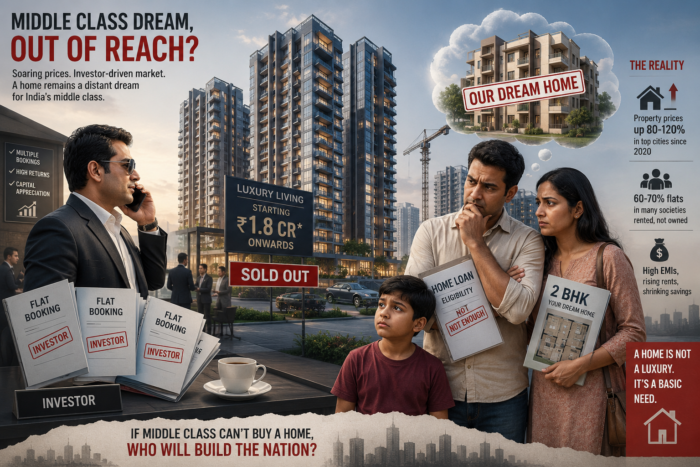
New Delhi, 15 July: For generations, owning a home has been the biggest aspiration of India’s middle class. A stable job, disciplined savings, and a home loan were once enough to buy a modest two-bedroom apartment. Today, however, that dream is fading rapidly. Across India’s major cities, builders are increasingly launching luxury projects while affordable and mid-income housing options continue to shrink. For many middle-class families, purchasing a home has become financially out of reach.
Luxury Housing Dominates New Project Launches
Industry reports from Anarock, Knight Frank India, and PropEquity indicate that luxury housing has become the fastest-growing segment of India’s residential real estate market. Homes priced above ₹1.5 crore have recorded strong growth in both launches and sales since the pandemic. In contrast, the supply of homes priced below ₹1 crore has steadily declined. Developers argue that rising land prices, construction costs, and demand for premium homes have pushed them towards high-end projects that offer better profit margins.
Where Have the Affordable 2-BHK Flats Gone?
Until a few years ago, buyers in cities like Delhi-NCR, Mumbai, Pune, Bengaluru, Hyderabad, and Chennai could find newly launched 2-BHK apartments at relatively affordable prices. Today, many new projects begin at well above ₹1.5 crore, making them inaccessible to average salaried households. The shrinking availability of affordable homes is forcing many middle-class families to postpone homeownership indefinitely.
The Middle Class Pays Taxes but Can’t Buy a Home
India’s middle class forms the backbone of the country’s tax system. Salaried employees contribute significantly through income tax, GST, stamp duty, registration charges, and other indirect taxes. Yet, despite paying substantial taxes throughout their working lives, many families find themselves unable to afford their first home. Rising property prices have far outpaced salary growth, making homeownership increasingly difficult even for dual-income households.
Investors Are Driving the Market
Property experts believe that investors account for a significant share of bookings in many premium residential projects. At the time of launch, flats are often booked by investors with relatively small initial payments, hoping to benefit from future price appreciation before possession. While investment plays a legitimate role in the housing market, industry observers say it can also reduce the availability of homes for genuine end-users, particularly in high-demand urban locations.
A Growing Nation of Tenants
Resident welfare associations in several metropolitan cities report that a large proportion of apartments in many housing societies are occupied by tenants rather than owners. In some premium residential developments, rental occupancy is estimated to exceed 60%, and in certain locations it may even be higher. Although comprehensive national data is limited, the trend suggests that more middle-class families are remaining renters instead of becoming homeowners.
Housing Is Not a Luxury—It Is a Basic Need
Food, clothing and shelter remain the three basic necessities of life. Families may reduce discretionary spending, postpone vacations or delay buying new clothes during inflationary periods. However, they cannot indefinitely postpone the need for a secure roof over their heads. Housing affordability, therefore, is not merely an economic issue but a social one that directly affects financial security and quality of life.
Why the Government Should Be Concerned
A sustained decline in housing affordability could have wider economic and political implications. Homeownership has traditionally been associated with financial stability and wealth creation for the middle class. If an increasing number of working families feel excluded from the property market despite paying taxes and contributing to economic growth, housing affordability could become a significant public policy issue in the years ahead.
Possible Policy Reforms
Experts suggest that policymakers could consider several measures to improve affordability:
- Increase incentives for affordable and mid-income housing projects.
- Review taxation and disclosure norms for multiple residential property ownership, while ensuring fairness and legal compliance.
- Strengthen scrutiny of speculative investments and funding sources where required under existing laws.
- Expand tax benefits or provide additional interest relief on home loans for first-time homebuyers.
- Encourage builders to allocate a larger share of projects to affordable and mid-income housing segments.
- Improve transparency in property transactions to discourage speculative practices.
The Road Ahead
India’s real estate sector remains one of the country’s largest employment generators and economic contributors. However, sustainable growth cannot depend solely on luxury housing. A healthy housing market must also serve teachers, engineers, government employees, healthcare workers, private-sector professionals and millions of middle-class families who aspire to own their first home.
If affordable housing continues to shrink while luxury projects dominate new launches, the dream of owning a home may gradually slip beyond the reach of India’s middle class. Addressing this challenge will require coordinated efforts from governments, developers, financial institutions and regulators to ensure that economic growth translates into housing opportunities for ordinary citizens—not just affluent buyers and investors.
Editorial Note: The policy suggestions discussed above represent possible approaches to improving housing affordability and are presented as issues for public debate rather than established government policy or verified evidence of market misconduct.
Author

About the Author