New Delhi, 10 July:The latest edition of the India-Germany Climate Talks, hosted by the German Embassy in New Delhi, highlighted the pivotal role women play in driving India’s clean energy transition and called for gender inclusion to become a central pillar of climate and energy policymaking.
The dialogue brought together policymakers, climate experts, entrepreneurs and development practitioners to discuss how women can contribute as innovators, entrepreneurs, researchers, community leaders and decision-makers in building a more inclusive and sustainable energy future.
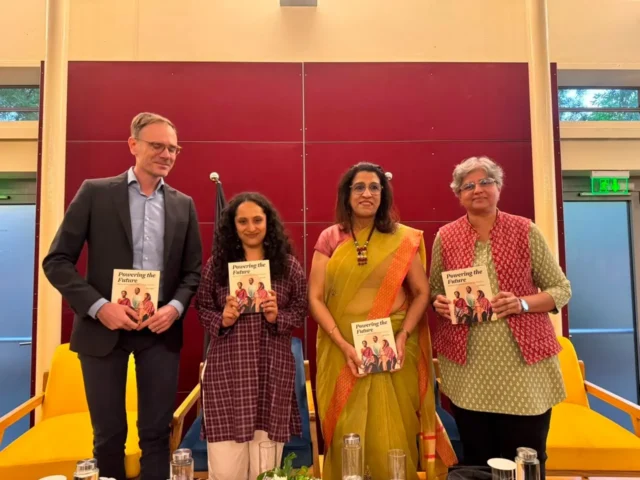
A key highlight of the event was the launch of Powering the Future: Women at the Heart of India’s Energy Transition, authored by Neha Saigal, Co-founder of Intertidal Lab and the Climate & Care Initiative, Bengaluru. Published by Heinrich Böll Stiftung (hbs) New Delhi, the book documents inspiring stories of women leading clean energy initiatives across Odisha, Punjab, Jharkhand, Maharashtra and Tamil Nadu.
The publication showcases women transforming rural livelihoods through solar energy enterprises, promoting clean cooking technologies, advancing electric mobility and helping communities navigate the socio-economic challenges associated with the transition away from coal. It also stresses the importance of embedding gender equity, care and inclusivity into institutions and policy frameworks.
Bridging the Gender Gap in Clean Mobility
The discussions also focused on women’s participation in India’s rapidly growing electric mobility sector. According to the findings presented in the book, women currently account for only 0.03% of India’s transport workforce, while merely 0.01% are licensed mobility service providers with stable earnings and public visibility.
Despite the rapid expansion of the electric vehicle (EV) ecosystem, gender inclusion remains limited in policy design. Of India’s 27 state EV policies, only seven contain specific measures aimed at supporting women, while Delhi and West Bengal are the only states with explicit provisions encouraging women drivers.
One notable example highlighted during the event was Punjab’s Pink E-Auto Scheme in Amritsar. Introduced under the city’s Rejuvenation of Autorickshaws in Amritsar through Holistic Intervention (RAAHI) programme, the initiative integrates gender inclusion into the electric three-wheeler ecosystem by offering women from low-income communities a 90% capital subsidy, structured driver training and institutional support.
The programme was supported by extensive community outreach, engaging nearly 300 women through discussions on licensing, financing, safety and long-term livelihood opportunities before its implementation.
Women Must Shape India’s Energy Future
Speaking at the event, author Neha Saigal said India’s transition to clean energy presents an opportunity to place gender equality at the centre of policymaking rather than treating it as an afterthought.
She noted that women are not only consumers of energy but also caregivers, entrepreneurs and livelihood creators whose lived experiences should influence future energy policies. She further observed that India’s energy transition is not a single uniform process but a series of local transitions shaped by regional realities, requiring policies that ensure equity while moving toward a low-carbon economy.
Inclusive Climate Action a Shared Priority
German Ambassador to India Philipp Ackermann underscored the importance of inclusive climate action, stating that a gender-responsive energy transition is both a social imperative and an economic opportunity.
He said the Indo-German Partnership for Green and Sustainable Development is helping both countries advance clean energy while ensuring that the transition remains people-centric, equitable and inclusive.
The discussion also featured Priyadarshini Karve, who highlighted the role of decentralised renewable energy in expanding access while creating leadership opportunities for women, and Amrita Rana, who spoke about the connections between public health, clean mobility and community-led climate action.
Concluding the session, experts agreed that achieving a just and resilient energy transition will require greater participation of women across the clean energy value chain, stronger gender-responsive policies and sustained investment in local leadership to ensure that no community is left behind.
Author

About the Author