New Delhi, 6 July: Every morning, the Sun rises without sending a bill. Yet, for thousands of years, people used its energy only for light, warmth, and drying crops. Today, the same sunlight is powering homes, factories, schools, airports, and even satellites. Solar energy has become one of the fastest-growing sources of clean energy in the world, helping countries reduce pollution while meeting rising electricity demands.
But have you ever wondered who invented solar energy, how it works, and why it has become so important?
What is Solar Energy?
Solar energy is the energy we receive from the Sun in the form of light and heat. Using modern technology, this sunlight is converted into electricity through solar panels, also known as photovoltaic (PV) panels.
Since sunlight is available every day and naturally replenishes itself, solar energy is called a renewable or clean source of energy.
Who Invented Solar Energy?
No single person invented solar energy because humans have used sunlight for thousands of years. However, the technology that converts sunlight into electricity has an interesting history.
Important Milestones
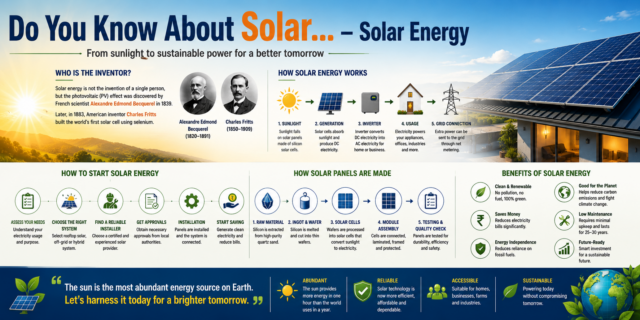
- 1839: French scientist Alexandre Edmond Becquerel discovered the photovoltaic effect, proving that sunlight could produce electricity.
- 1883: American inventor Charles Fritts built the world’s first solar cell using selenium.
- 1954: Scientists at Bell Laboratories (USA) developed the first practical silicon solar cell, considered the beginning of the modern solar industry.
- 1958: Solar panels were first used to power satellites in space.
- 2000 onwards: Solar technology became cheaper, more efficient, and suitable for homes and industries worldwide.
How Does Solar Energy Work?
The process is surprisingly simple.
Step 1: Sunlight Falls on Solar Panels
Solar panels contain hundreds of small solar cells made from silicon.
Step 2: Solar Cells Generate Electricity
When sunlight strikes these cells, electrons begin moving, producing Direct Current (DC) electricity.
Step 3: Inverter Converts Power
Since homes use Alternating Current (AC) electricity, an inverter converts DC into AC.
Step 4: Electricity is Used
The electricity powers lights, fans, air conditioners, appliances, factories, and can even charge electric vehicles.
Step 5: Extra Power Goes to the Grid
If more electricity is generated than needed, it can be supplied to the electricity grid through net metering, reducing electricity bills.
How Are Solar Panels Made?
Solar panel manufacturing involves several advanced steps:
- Silicon is extracted from sand.
- The silicon is purified and formed into wafers.
- Solar cells are manufactured from these wafers.
- Multiple cells are connected together.
- They are sealed between protective glass and weather-resistant materials.
- Frames, wiring, and junction boxes are added.
- The finished panel undergoes quality testing before installation.
Modern solar panels generally last 25 to 30 years.
Why is Solar Energy Important?
Solar energy offers multiple benefits:
- Produces electricity without air pollution.
- Reduces dependence on coal and fossil fuels.
- Helps fight climate change.
- Lowers electricity bills.
- Requires minimal maintenance.
- Creates employment in manufacturing, installation, and maintenance.
- Supports energy security by reducing fuel imports.
Types of Solar Energy
1. Rooftop Solar
Installed on homes, offices, schools, hospitals, and factories.
2. Utility-Scale Solar Parks
Large solar farms that generate electricity for thousands of consumers.
3. Floating Solar
Panels installed on lakes, reservoirs, and dams, saving land while reducing water evaporation.
4. Solar Water Pumps
Used widely in agriculture for irrigation.
5. Solar Water Heaters
Use sunlight directly to heat water instead of generating electricity.
India’s Solar Journey
India has emerged as one of the world’s fastest-growing solar markets.
Major initiatives include:
- National Solar Mission (2010)
- Rooftop Solar Programme
- PM Surya Ghar Muft Bijli Yojana
- Development of ultra-mega solar parks
- Domestic manufacturing under the Make in India initiative
States such as Rajasthan, Gujarat, Karnataka, and Tamil Nadu have become major solar power hubs.
Challenges
Despite rapid growth, solar energy still faces certain challenges:
- Electricity generation depends on sunlight.
- Initial installation costs can be high.
- Large solar parks require significant land.
- Battery storage remains relatively expensive.
- Recycling old solar panels is an emerging issue.
However, continuous technological improvements are making solar systems more affordable and efficient every year.
What Does the Future Look Like?
Experts believe solar energy will become one of the world’s largest electricity sources over the coming decades. Researchers are working on:
- Higher-efficiency solar panels
- Flexible and lightweight solar cells
- Transparent solar windows
- Better battery storage systems
- Solar-powered transportation
- Building-integrated solar technologies
With falling costs and supportive government policies, solar power is expected to play a central role in achieving global clean energy and climate goals.
Did You Know?
- The Sun provides enough energy to Earth in one hour to meet the world’s electricity needs for an entire year.
- Solar panels generate electricity even on cloudy days, although at reduced efficiency.
- Most solar panels continue producing electricity for 25–30 years.
- India is among the world’s leading countries in solar capacity expansion.
Conclusion
Solar energy is more than just an alternative source of electricity—it is a cornerstone of a cleaner, more sustainable future. From a scientific discovery in the 19th century to powering homes, industries, and satellites today, solar technology has transformed the way the world thinks about energy. As costs continue to decline and innovation accelerates, harnessing the power of the Sun will remain one of humanity’s most effective solutions for meeting future energy needs while protecting the planet.
Author

About the Author