New Delhi, 6 July: India’s clean energy story is not merely about generating electricity from the sun or wind. It is a remarkable journey of technological innovation, policy reforms, environmental responsibility, and the nation’s aspiration to become energy secure while combating climate change. Today, India ranks among the world’s fastest-growing renewable energy markets, but this transformation has taken decades of planning and perseverance.
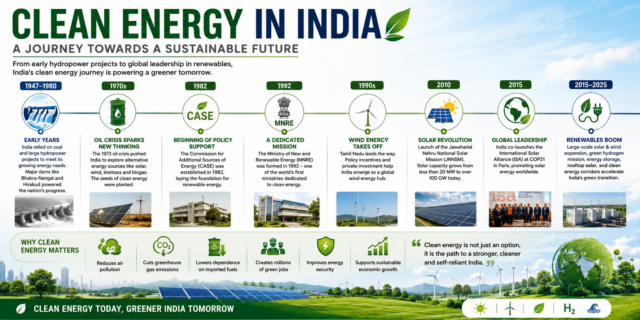
The Early Years: Dependence on Coal and Hydropower (1947–1980)
After Independence, India’s electricity sector relied almost entirely on coal-fired thermal power plants and large hydroelectric dams. The government’s focus was to provide electricity for industries, agriculture, and urban development.
Major hydroelectric projects like:
- Bhakra-Nangal Dam
- Hirakud Dam
- Damodar Valley Corporation
became symbols of modern India. However, renewable energy beyond hydropower had not yet entered mainstream planning.
The Oil Crisis Sparks a New Thinking (1970s)
The global oil crisis of 1973 exposed India’s dependence on imported fossil fuels. Rising fuel prices forced policymakers to search for alternative energy sources.
This period marked the beginning of research into:
- Solar Energy
- Wind Energy
- Biomass
- Biogas
Though still at an experimental stage, these efforts laid the foundation for India’s clean energy revolution.
Birth of Renewable Energy Policy (1980s)
India became one of the first developing countries to establish a dedicated institution for renewable energy.
In 1982, the Government created the Commission for Additional Sources of Energy (CASE) under the Department of Science and Technology.
This eventually evolved into the Ministry of New and Renewable Energy (MNRE) in 1992—one of the first ministries in the world exclusively dedicated to renewable energy.
Wind Energy Takes Off (1990s)
Tamil Nadu became India’s wind energy pioneer.
Private companies started investing in wind farms with government incentives such as:
- Accelerated depreciation
- Tax benefits
- Feed-in tariffs
Companies like Suzlon helped establish India as a major wind power producer.
The Solar Revolution (2010)
A major turning point came with the launch of the Jawaharlal Nehru National Solar Mission (JNNSM) in 2010.
The mission aimed to:
- Reduce dependence on fossil fuels
- Promote domestic solar manufacturing
- Make solar electricity affordable
- Encourage rooftop solar installations
At the time, India had less than 20 MW of installed solar capacity.
Today, solar capacity has grown to well over 100 GW, making India one of the world’s largest solar power producers.
International Leadership: International Solar Alliance (2015)
In 2015, India, together with France, launched the International Solar Alliance (ISA) during the COP21 Climate Conference in Paris.
The alliance promotes solar energy adoption among sunshine-rich countries and has strengthened India’s global leadership in renewable energy.
India’s Renewable Energy Boom (2015–2025)
Over the last decade, renewable energy has become a national priority.
Major initiatives include:
- Solar Parks
- Rooftop Solar Programme
- PM-KUSUM Scheme for farmers
- Green Energy Corridors
- National Green Hydrogen Mission
- Offshore Wind Policy
- Battery Energy Storage Systems (BESS)
India has also emerged as one of the world’s largest markets for renewable energy investment.
Clean Energy Today
India now generates clean electricity from multiple sources:
| Energy Source | Main Use |
|---|---|
| ☀️ Solar Energy | Homes, industries, agriculture |
| 🌬 Wind Energy | Utility-scale electricity generation |
| 💧 Hydropower | Grid stability and power generation |
| 🌱 Biomass | Rural energy and waste management |
| 🌋 Geothermal | Emerging technology |
| 🌊 Ocean Energy | Research stage |
| 🟢 Green Hydrogen | Future industrial fuel and transport |
Why Clean Energy Matters
Clean energy offers several benefits:
- Reduces air pollution
- Cuts greenhouse gas emissions
- Lowers dependence on imported fuels
- Creates millions of green jobs
- Improves energy security
- Supports sustainable economic growth
The Road Ahead
India has set ambitious clean energy goals, including achieving 500 GW of non-fossil fuel electricity capacity and progressing toward net-zero emissions by 2070. Meeting these targets will require continued investment in renewable energy, battery storage, smart grids, electric mobility, and green hydrogen, alongside supportive policies and innovation.
The country’s journey from coal-dominated electricity generation to becoming a global renewable energy leader demonstrates that economic growth and environmental responsibility can advance together. As technology becomes more affordable and accessible, clean energy is expected to power not only India’s homes and industries but also its long-term vision of sustainable development.
Author
About the Author