
Bundelkhand, 16 June: In the villages of Bundelkhand and beyond, we have learned a hard truth: the freedoms promised by Indian law and policy often dissolve the moment they touch the ground. On paper, bonded labour has been abolished, labour protections strengthened, and welfare nets widened. Yet in the fields and mud houses where people actually live, freedom is rarely absolute. It is conditional, negotiated daily, and frequently surrendered in silence. Development, if it is to mean anything, must be judged not by statutes or schemes alone, but by whether it expands what Amartya Sen called “real freedoms”—the substantive capabilities that allow individuals to lead lives they have reason to value. Without this expansion of agency—the power to choose, to refuse, to shape one’s future—policy remains a hollow declaration.
Early in our field experience, we searched for the obvious markers of exploitation: meagre wages, brutal conditions, overt coercion. Over time, we came to see that the most stubborn unfreedoms are quieter and more insidious. They reside in relationships, in the absence of alternatives, and in the quiet calculus of survival. A landless labourer who had worked for the same farmer for years put it plainly when we asked why he never sought other work: “ऑप्शन तब होता है जब पीछे कुछ हो.” An option exists only when you have something to fall back on. That single sentence captures a structural reality Sen understood well: freedom without capabilities is an illusion. Without a fallback—savings, skills, social security—choice is not liberty; it is a luxury the vulnerable cannot afford.
Nowhere is this clearer than in the cycles of debt that quietly bind labour. A loan for a medical emergency, a daughter’s wedding, or a lean season rarely ends as a simple financial transaction. It morphs into a long-term relationship in which repayment is extracted through labour. There is no written contract, no formal bondage—yet mobility evaporates. As one woman in a self-help group told , “कर्ज सिर्फ नहीं होता, रिश्ता बन जाता हैं.” Debt is not just money; it becomes a relationship. These arrangements are socially accepted precisely because they are framed as mutual support. The employer is not merely an exploiter but a provider in times of distress. This duality sustains dependence: the very system that offers a safety net also tightens the noose.
Caste deepens the bind. Economic vulnerability and social hierarchy reinforce each other in ways that polite village meetings rarely reveal. I have sat through discussions on wage rates where surface consensus masked deeper resignation. Later, in quieter conversations, the same workers would admit their dissatisfaction yet accept the inevitability. One man summed it up with weary clarity: “हाथ जोड़के रहना पड़ता है, वरना काम ही बंद हो जाएगा.” You have to remain submissive, otherwise the work will stop. Here, unfreedom is reproduced not through overt force but through the everyday logic of limited choice. Sen’s framework reminds us that such deprivations of agency are not peripheral to development; they are its central failure.
Yet change is possible, and we have witnessed it—slow, uneven, but unmistakable. The Mahatma Gandhi National Rural Employment Guarantee Act (MGNREGA), despite its flaws, has altered the bargaining landscape in many villages. By providing even a minimal fallback, it has nudged local wages upward and given workers a sliver of negotiating power. Similarly, women’s self-help groups have become crucibles of transformation. Women who once possessed neither independent income nor voice now manage small enterprises, access credit, and sit in panchayat meetings. One group leader captured the shift during a training session: “पहले हम काम करते थे, अब फैसला भी करते हैं.” Earlier we only worked; now we also make decisions. That movement from passive labour to active agency is the very essence of Sen’s vision of development as freedom. Still, it would be dishonest to romanticise these gains. Public works remain irregular, payments delayed, and non-farm opportunities scarce. Seasonal distress continues to drive families back into migration or dependent labour. Freedom in these contexts is not a fixed state; it expands and contracts with circumstance. The deeper lesson from the field is that today’s unfreedom is rarely enforced by law; it is reproduced by systems that shrink the space for genuine choice. When survival hinges on preserving certain relationships, the right to say “no,” to negotiate, or to exit becomes theoretical at best.
As development practitioners, we too often celebrate outputs—jobs created, loans disbursed, assets built. These matters, but they do not answer the decisive question Sen posed: has the real space for choice and agency expanded? True development is not merely the absence of bondage; it is the presence of dignity, mobility, and voice. It is a worker who can refuse without fear, negotiate without hesitation, and imagine a future unbound by inherited constraints.
After years in these villages, one conviction has hardened: development that does not shift power may improve incomes, but it rarely transforms lives. India’s rural story cannot end with roads, schemes, or infrastructure alone. It must confront the invisible architectures—debt, caste, dependency—that continue to limit human agency. Only by expanding the capabilities that give people control over their own destinies can we bridge the chasm between the freedom written in law and the freedom lived in daily life. That is the measure that matters.
About the Writer

Sanjay Kumar
https://www.facebook.com/share/1DZ1984Tbf/?mibextid=wwXIfr
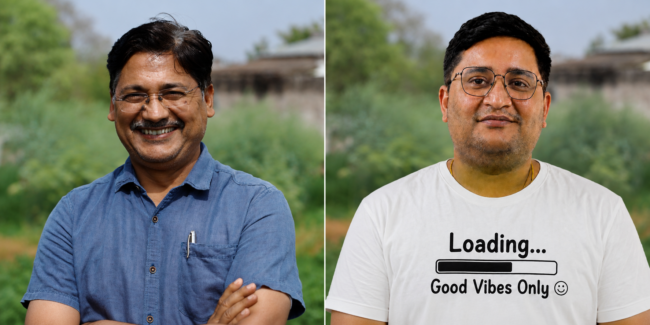
Sanjay Kumar is the Founder & Executive Director of Manjari Foundation, with two decades of experience in rural development, women empowerment, and policy advocacy.

Anmol Goswami
https://www.facebook.com/share/14hP1GfYewE/?mibextid=wwXIfr
Anmol Goswami is a Team Leader at Manjari Foundation, specializing in rural development and strengthening community institutions in Bundelkhand & Haryana.
Author

About the Author