
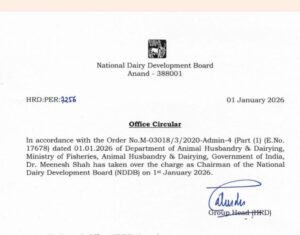
New Delhi, 03 January 2026: Serious questions have surfaced over the appointment and claimed tenure of the Chairman of the National Dairy Development Board (NDDB), following an internal HR Office Circular dated 1 January 2026.
The circular issued by NDDB’s HR department states that Dr Meenesh Shah has taken charge as Chairman of NDDB with effect from 1 January 2026, in compliance with an order of the Department of Animal Husbandry & Dairying, Government of India. However, the circular does not mention any tenure period, nor does it refer to an extension of three-and-a-half years.
Claim of 3.5-Year Tenure Not Backed by Public Notification
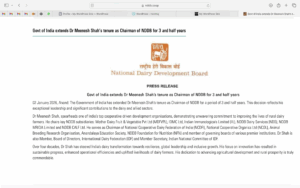
Contrary to the HR circular, a subsequent press communication claims that the Government of India has extended Dr Shah’s tenure as Chairman of NDDB for three and a half years.
So far, no publicly available government notification or appointment order explicitly confirming such a tenure has been placed in the public domain.
This discrepancy has raised questions about how and on what basis the tenure period has been announced.
Focus on NFS: ‘None Found Suitable!
More significantly, scrutiny is now intensifying around the selection process itself for the post of NDDB Chairman.
According to reliable sources familiar with the recruitment process, the selection was processed under the NFS category — ‘None Found Suitable’, a term used when no applicant is found eligible or suitable under the prescribed norms and criteria laid down in the advertisement.
In administrative practice, an NFS outcome clearly indicates that the entire pool of applicants has been rejected, and that no candidate from the same selection process qualifies for appointment, unless the process is formally cancelled and re-initiated.
This has triggered a fundamental question among experts and stakeholders in the cooperative sector:
If all applicants were declared ‘None Found Suitable’, how was one of the applicants subsequently appointed as Chairman?
Key Question: How Was an ‘Unsuitable’ Applicant Appointed?
Records accessed by sources indicate that Dr Meenesh Shah had also applied for the post during the same selection process. If the selection committee concluded the process with an NFS decision, experts argue that no applicant from that pool — including Dr Shah — could be appointed, unless specific procedural steps were taken.
These would ordinarily include:
-
Formal withdrawal or nullification of the NFS decision
-
Initiation of a fresh selection process, or
-
Revision of eligibility criteria with a new advertisement
However, no public record or official communication has so far clarified whether any of these steps were undertaken.
Unanswered Questions Remain
As of now, there is no clarity on:
-
Whether the NFS decision was officially withdrawn
-
Whether a fresh selection process was conducted
-
Whether eligibility norms were amended after the advertisement
Experts stress that in institutions like NDDB — a premier national body central to India’s dairy economy and rural livelihoods — any deviation from established recruitment norms without formal disclosure raises serious transparency concerns.
Until an official clarification is issued, the contradiction between an NFS outcome and a subsequent appointment from the same applicant pool continues to remain unexplained.
Transparency Concerns in a Premier National Institution
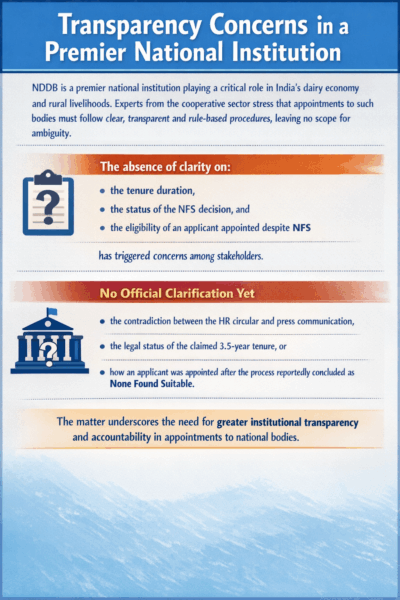
NDDB is a premier national institution playing a critical role in India’s dairy economy and rural livelihoods. Experts from the cooperative sector stress that appointments to such bodies must follow clear, transparent and rule-based procedures, leaving no scope for ambiguity.
The absence of clarity on:
- the tenure duration,
- the status of the NFS decision, and
- the eligibility of an applicant appointed despite NFS
has triggered concerns among stakeholders.
No Official Clarification Yet
As of now, no official clarification has been issued by NDDB or the concerned ministry addressing:
- the contradiction between the HR circular and press communication,
- the legal status of the claimed 3.5-year tenure, or
- how an applicant was appointed after the process reportedly concluded as None Found Suitable.
The matter underscores the need for greater institutional transparency and accountability in appointments to national bodies.
Author

About the Author